Showing posts with label American politics. Show all posts

Sunday, May 24, 2020

James Monroe: A Life


James Monroe: A Life- Tim McGrath
Dutton/Penguin Group
Release Date: May 5, 2020

Rating: ðŸ“šðŸ“šðŸ“šðŸ“š


Synopsis: Monroe lived a life defined by revolutions. From the battlefields of the War for Independence, to his ambassadorship in Paris in the days of the guillotine, to his own role in the creation of Congress's partisan divide, he was a man who embodied the restless spirit of the age. He was never one to back down from a fight, whether it be with Alexander Hamilton, with whom he nearly engaged in a duel (prevented, ironically, by Aaron Burr), or George Washington, his hero turned political opponent. 
 
This magnificent new biography vividly recreates the epic sweep of Monroe’s life: his near-death wounding at Trenton and a brutal winter at Valley Forge; his pivotal negotiations with France over the Louisiana Purchase; his deep, complex friendships with Thomas Jefferson and James Madison; his valiant leadership when the British ransacked the nation’s capital and burned down the Executive Mansion; and Monroe’s lifelong struggle to reckon with his own complicity in slavery. Elected the fifth president of the United States in 1816, this fiercest of partisans sought to bridge divisions and sow unity, calming turbulent political seas and inheriting Washington's mantle of placing country above party. Over his two terms, Monroe transformed the nation, strengthening American power both at home and abroad. 

Critically-acclaimed author Tim McGrath has consulted an extensive array of primary sources, many rarely seen since Monroe's own time, to conjure up this fascinating portrait of an essential American statesman and president.
________________________________________________________________________


James Monroe is one of those presidents you can usually name, but otherwise probably don't know too much about.  That was the case for me at least.  Tim McGrath's new biography on Monroe is a brilliant introduction to the man, the politician, and the world he lived and worked in.  Monroe's early life is covered without getting into the minutiae that some biographers enjoy- McGrath knows that in Monroe's case at least, the man Monroe would become formed not in his childhood, but as a young lawyer studying under Thomas Jefferson and as a soldier crossing the Delaware with General Washington.

Monroe is pictured from the beginning as a man who believes in doing his duty by his country, despite what that may cost him personally and financially.  The intricacies of politics might not have come as naturally as the job of soldiering, but Monroe learns as he goes, not only from friends like Jefferson and Madison but from opponents, even enemies, and never forgets the lessons that he learned.

McGrath does a brilliant job showing Monroe's development as a politician- from highly partisan to trying to follow in Washington's steps and erase the two-party system. He brings to life the partisan and highly personal fights in Congress as Monroe's enemies work to prevent Monroe and his Cabinet from accomplishing anything, and brings the reader behind the scenes into Cabinet meetings where Monroe takes the slightly unusual approach of listening to all of his Cabinet members and letting free speech and debate fly across the table before asking questions, and allowing himself to have his mind and policies changed if he truly hears convincing arguments.

James Monroe was not a perfect man, and McGrath doesn't try to convince us that he was.  Apologies are not made, although by understanding the world and time he lived in, maybe some of what today we would call his mistakes are more understandable.   Modern readers will cringe at Monroe's thoughts on slavery and Native American policy- but McGrath reminds us that for his time Monroe was considered progressive, especially compared with someone like the up and coming Andrew Jackson.

This is a well-written, well-researched, and thorough biography of a little known president.  Despite the seemingly daunting length of the book (750 pages) the pace flows well and doesn't get bogged down with extraneous details and lectures.  Although McGrath does fall into the trap of foreshadowing-especially at the end of chapters- his "of only Monroe knew then" approach doesn't happen often enough to get truly aggravating.

A definite win for history lovers seeking to learn more about the founding of America and James Monroe, one of the often overlooked founding fathers.

I received an ARC of this book from NetGalley in exchange for an honest review

Monday, December 10, 2018

Bringing Down the Colonel


Bringing Down the Colonel: A Sex Scandal of the Gilded Age, and the "Powerless" Woman Who Took On Washington by [Miller, Patricia]


Bringing Down the Colonel: A Sex Scandal of the Gilded Age & the "Powerless" Woman Who Took on Washington- Patricia Miller
Sarah Crichton Books/Farrar, Strauss and Giroux
Release Date: November 13, 2018

Rating:
📚📚📚📚📚

Synopsis: In Bringing Down the Colonel, the journalist Patricia Miller tells the story of Madeline Pollard, an unlikely nineteenth-century women’s rights crusader. After an affair with a prominent politician left her “ruined,” Pollard brought the man—and the hypocrisy of America’s control of women’s sexuality—to trial. And, surprisingly, she won.


Pollard and the married Colonel Breckinridge began their decade-long affair when she was just a teenager. After the death of his wife, Breckinridge asked for Pollard’s hand—and then broke off the engagement to marry another woman. But Pollard struck back, suing Breckinridge for breach of promise in a shockingly public trial. With premarital sex considered irredeemably ruinous for a woman, Pollard was asserting the unthinkable: that the sexual morality of men and women should be judged equally.
Nearly 125 years after the Breckinridge-Pollard scandal, America is still obsessed with women’s sexual morality. And in the age of Donald Trump and Harvey Weinstein, we’ve witnessed fraught public reckonings with a type of sexual exploitation unnervingly similar to that experienced by Pollard. Using newspaper articles, personal journals, previously unpublished autobiographies, and letters, Bringing Down the Colonel tells the story of one of the earliest women to publicly fight back.
__________________________________________________________________


In the era of the Me Too movement, women are looking towards history and politics and wondering: are we the first to stand up?  We know women fought for the right to work, the right to vote, and we earnestly want to know not only what those women went through, but why.  Why did society and politics need the push they needed, and why did it succeed sometimes but not others?  What were all the unwritten currents for and against these pioneers?

Patricia Miller does an excellent job answering these questions in Bringing Down the Colonel: A Sex Scandal of the Gilded Age, and the "Powerless" Woman who Took on Washington.  Here she tells the story of Madeline Pollard and Colonel Breckinridge, and the unlikely lawsuit that helped turn of the century America question their double standard of men, women, and sexual morality.  Pollard was in a relationship with Breckinridge for at least ten years while he was married to another woman- and always claiming that were it possible, he would marry her.  But when his wife died, Breckinridge married another woman instead.  Madeline Pollard did what few women of the time were brave enough to do: she publicly admitted the relationship and her "ruin" and sued Breckinridge for breach of promise.  The resulting scandal not only forced society to ask questions it had never asked before, but brought down an elected official and brought thousands of Southern women into the political fray.

As fascinating as the story is by itself, Miller fills modern readers in on the backstory- the social norms of the time and those that were changing- to flesh out a complete world for her readers to understand.  Women were beginning to enter the workforce in increasingly large numbers.  Fathers and brothers were beginning to have to face the idea that a woman unchaperoned in public wasn't announcing her sexual availability, because their own wives, sisters, and daughters were now in those public spheres.  It was not 'just' the radical women who were asking for work equality and the right to vote, or to stand up to abuses happening around them. Miller explores the economic and educational environments that had begun to change, and does a solid job of helping the reader to understand why the mid-1890s was a time ripe for the changes Pollard and others pushed for. 

 Madeline Pollard forced the conversation of sex into public, into politics, and into the home.  She forced society to look at foundling orphanages, homes for fallen women, and the manipulations and social conventions that powerful men used to keep an entire class of women vulnerable to them.  She inspired the first movement of women who (though they couldn't vote) used their opinions and influence to ensure that a sexual predator was not reelected to a government position.  Pollard and the women who financed her battle took on Washington and inspired a generation of women to demand conversations and change in society and politics, morality and ethics.  The Pollard trial certainly didn't end the sexual double standard, but it did begin the conversation we still carry on today.

Although occasionally dry and repetitive, Bringing Down the Colonel is an inspiring, well-researched book, and gives readers an excellent understanding of how women have fought the 'battle of the sexes' - and gives an excellent historical reminder of how far we have come, and how equality is always relative. A must read!

Tuesday, November 13, 2018

Heirs of the Founders


Heirs of the Founders: The Epic Rivalry of Henry Clay, John Calhoun and Daniel Webster, the Second Generation of American Giants by [Brands, H. W.]


Heirs of the Founders: The Epic Rivalry of Henry Clay, John Calhoun, and Daniel Webster, the Second Generation of American Giants- H.M. Brands
Doubleday/Random House
Release Date: November 13, 2018

Rating:
📚📚📚

Synopsis: In the early 1800s, three young men strode onto the national stage, elected to Congress at a moment when the Founding Fathers were beginning to retire to their farms. Daniel Webster of Massachusetts, a champion orator known for his eloquence, spoke for the North and its business class. Henry Clay of Kentucky, as dashing as he was ambitious, embodied the hopes of the rising West. South Carolina's John Calhoun, with piercing eyes and an even more piercing intellect, defended the South and slavery.
     Together these heirs of Washington, Jefferson and Adams took the country to war, battled one another for the presidency and set themselves the task of finishing the work the Founders had left undone. Their rise was marked by dramatic duels, fierce debates, scandal and political betrayal. Yet each in his own way sought to remedy the two glaring flaws in the Constitution: its refusal to specify where authority ultimately rested, with the states or the nation, and its unwillingness to address the essential incompatibility of republicanism and slavery.
      They wrestled with these issues for four decades, arguing bitterly and hammering out political compromises that held the Union together, but only just. Then, in 1850, when California moved to join the Union as a free state, "the immortal trio" had one last chance to save the country from the real risk of civil war. But, by that point, they had never been further apart.
_____________________________________________________________


The debate over what  certain aspects of the Constitution: who has what authority, and how amendments should be interpreted, are not new debates.  The "second generation" of American politicians, including Daniel Webster, John Calhoun, and Henry Clay, were fiercely arguing over how aspects of the Constitution should be applied before the War of 1812.  What rights did the Constitution grant states versus the federal government? How were new states to be brought into the Union?  Tariffs, taxes, and infrastructure were debated in Congress then as they are now.  Through the early 1800s Congress struggled with the idea of states rights, and what was due to individual states and different geographic sections of the country were often even more bitterly divisive than political parties are today.  Clay, Calhoun, and Webster spent forty years fighting to iron out what they saw as flaws or glaring omissions in the Constitution.  Each had personal ambitions that included the White House, each wanted to make lasting impressions on history, and each wanted to ensure the best for their region.  

A well-researched book, Heirs of the Founders works to help readers understand the battles the so-called "second generation" of American politicians fought in an effort to define the new United States of America.  Brands does a good job of leading readers through the different sides and their thinking, as well as emphasizing that then, as now, there were moderates who were willing to compromise to get things done and the more hard line groups who refused any hint of compromise.  The difference being that men like Clay often succeeded in bringing both sides to accept compromises that today rarely happen.  Brands quotes extensively from speeches each of these well-known orators gave but helps us dig deeper behind the scenes to understand what was going on.  I thought he did a particularly excellent job in exploring the complicated, nuanced, and sensitive aspects of national and individual opinions on the issue of slavery.  

Like Joanne Freeman's The Field of Blood, readers know where the country is headed.  Many contemporary Americans were surprised less by the fact that the Civil War happened and more by the fact that it didn't occur at least a decade earlier.  In Heirs we see the men who fought to hold off the break of the Union, but we also see, as they saw, that the extreme regional sectionalism of the first half of the 19th century made it inevitable.

I received an ARC of this book from NetGalley in exchange for an honest review

Tuesday, September 4, 2018

Field of Blood


The Field of Blood: Violence in Congress and the Road to Civil War by [Freeman, Joanne B.]


The Field of Blood: Violence in Congress and the Road to Civil War- Joanne B. Freeman
Farrar, Straus, & Giroux
Release Date: September 11, 2018

Rating:
📚📚📚📚📚

Synopsis: In The Field of Blood, Joanne B. Freeman recovers the long-lost story of physical violence on the floor of the U.S. Congress. Drawing on an extraordinary range of sources, she shows that the Capitol was rife with conflict in the decades before the Civil War. Legislative sessions were often punctuated by mortal threats, canings, flipped desks, and all-out slugfests. When debate broke down, congressmen drew pistols and waved Bowie knives. One representative even killed another in a duel. Many were beaten and bullied in an attempt to intimidate them into compliance, particularly on the issue of slavery.

These fights didn’t happen in a vacuum. Freeman’s dramatic accounts of brawls and thrashings tell a larger story of how fisticuffs and journalism, and the powerful emotions they elicited, raised tensions between North and South and led toward war. In the process, she brings the antebellum Congress to life, revealing its rough realities—the feel, sense, and sound of it—as well as its nation-shaping import. Funny, tragic, and rivetingly told, The Field of Blood offers a front-row view of congressional mayhem and sheds new light on the careers of John Quincy Adams, Henry Clay, and other luminaries, as well as introducing a host of lesser-known but no less fascinating men. The result is a fresh understanding of the workings of American democracy and the bonds of Union on the eve of their greatest peril.
_________________________________________________________ 

Joanne B. Freeman's The Field of Blood: Violence in Congress and the Road to Civil War is an entertaining, well researched, and well-written examination of physical violence in U.S. Congress in the decades leading to the Civil War.  Most of it stems from diarist B.B. French, who managed to be on hand or on the fringes for every major political and historical event of his lifetime.  A New Hampshire native, French was highly active in D.C. politics, knew politicians and presidents, and often had a ring-side seat to the debates and violence on the floors of Congress. 

Not merely a cataloging of duels, brawls, canings, and insults, Field of Blood examines the reasons behind the violence- both personal and cultural.  Violence and duels were seen as honorable, manly codes of conduct in the South and barbaric and uncivilized in the North.  Southern politicians would often use bullying and threats of violence to hold power in Congress.  Politicians were seen as closely representing the constituents, their state, and their region and "fighting for the people's rights" was often taken very literally.  Insult an individual and you insulted the region.  Insult the region and you insulted the individual.  Honor was often called into question and (usually) representatives settled things outside the halls of Congress.  It was an interesting dynamic that the patriotic French watched: people believed Congress to be solemn, serious, full of great men giving great speeches- if they saw what French saw, the general public might think very differently.  

Freeman presents readers with a little looked at slice of American history leading up to the Civil War, bringing 19th century political figures to life with a humorous and down-to-earth style of writing that keeps the reader engaged from beginning to end.  Americans who believe today's political standoffs and partisanship are unprecedented may appreciate reading the literal stand-offs of the past, when people sent guns to their Congressmen so they could fight for their constituents' rights and pistols, rifles, and bowie knives were regularly carried by politicians "just in case." 

 For anyone who imagines 19th century Congressmen as staid and boring old men, Freedman will introduce you to a whole new side of American politics. A great read!


I received an ARC of this book from NetGalley in exchange for an honest review

Tuesday, June 5, 2018

Price of Greatness


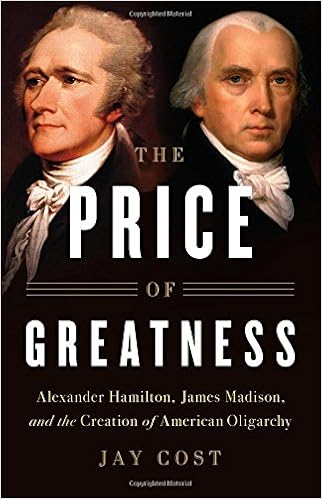
The Price of Greatness: Alexander Hamilton, James Madison, and the Creation of American Oligarchy- Jay Cost
Basic Books
Release Date: June 5, 2018

Rating:
📚📚

Synopsis: In the history of American politics there are few stories as enigmatic as that of Alexander Hamilton and James Madison's bitterly personal falling out. Together they helped bring the Constitution into being, yet soon after the new republic was born they broke over the meaning of its founding document. Hamilton emphasized economic growth, Madison the importance of republican principles.

Jay Cost is the first to argue that both men were right--and that their quarrel reveals a fundamental paradox at the heart of the American experiment. He shows that each man in his own way came to accept corruption as a necessary cost of growth. The Price of Greatness reveals the trade-off that made the United States the richest nation in human history, and that continues to fracture our politics to this day.

_____________________________________________________________


The Price of Greatness explores the origins of much of the American political and economic engines that we still see today, from the starting point of Alexander Hamilton and James Madison.  These two Founding Fathers quickly became divided over America's identity and path, and Jay Cost argues that both men were, in ways, right- and wrong.

I always like learning about original context in history- political, social, economic, etc. and The Price of Greatness does explain some of America's early economic ideas. Unfortunately, the book was a little too dry and rambling (and repetitive) for me to manage more than about a chapter at a time, which means I probably didn't retain or understand as much information as I would have liked.  Particularly by the end, Cost seems to stray from the original point of the book- which I took to be the creation of early American political and economic systems- to wander down a recital of various historical ways the government has not acted 'for the people, by the people'.  He begins to talk about corruption- as we understand the term today and as Madison and Hamilton would have used the term- and tries to show the reader how to return to America's founding greatness.  But all he really succeeds in showing us, in my opinion, is that human nature and greed will naturally take advantage of any system, and that there will always be conflict.  

Ultimately, The Price of Greatness does only a mediocre job in explaining "the Creation of American Oligarchy", but if you can get through the dry and repetitive writing, there are some interesting historical nuggets hidden within the text.  I'm not entirely sure, however, I found it worth the effort of working through reading the book.


I received an ARC of this book from NetGalley in exchange for an honest review