Showing posts with label Pride and Prejudice. Show all posts

Thursday, June 6, 2019

Ayesha At Last


Ayesha At Last by [Jalaluddin, Uzma]


Ayesha At Last- Uzma Jalaluddin
Berkley/Penguin Random House
Release Date: June 4, 2019

Rating:
📚📚📚📚

Warning: Potential Spoilers Ahead! 

Synopsis: Ayesha Shamsi has a lot going on. Her dreams of being a poet have been set aside for a teaching job so she can pay off her debts to her wealthy uncle. She lives with her boisterous Muslim family and is always being reminded that her flighty younger cousin, Hafsa, is close to rejecting her one hundredth marriage proposal. Though Ayesha is lonely, she doesn't want an arranged marriage. Then she meets Khalid, who is just as smart and handsome as he is conservative and judgmental. She is irritatingly attracted to someone who looks down on her choices and who dresses like he belongs in the seventh century.

When a surprise engagement is announced between Khalid and Hafsa, Ayesha is torn between how she feels about the straightforward Khalid and the unsettling new gossip she hears about his family. Looking into the rumors, she finds she has to deal with not only what she discovers about Khalid, but also the truth she realizes about herself.
_______________________________________________________________

In this latest retelling of Jane Austen's classic Pride & Prejudice, Ayesha is trying to get her life on track  and balance a modern Muslim life with her extended family's pressure to marry traditionally.  Khalid is trying to balance his conservative beliefs and his overbearing mother's need to run everything with pressure from workplace friends and enemies to change who and what he is.  When they meet, Ayesha and Khalid are attracted, but also dislike each other.  Assumptions are made, identities are mistaken, and Ayesha and Khalid both have to face some uncomfortable truths before they can choose their paths forward.

 Ayesha is easily relatable and lovable. She is a woman who sees herself balancing between two worlds and cultures, modern and traditional, Eastern and Western.  She has dreams of traveling and writing poetry but is practical enough to get a job she doesn't like as a substitute teacher for the sake of her family.  Always compared to her spoiled and flighty younger cousin Hafsa, Ayesha is expected to do the right thing, be sensible, and no one in the family seems to wonder if she is ever lonely or regrets giving up her dreams.  Khalid is harder to get to know- both for us as the reader and for other characters.  He is quiet, lacks all social skills, and when he does speak he inevitable puts his foot in his mouth.  Instead of being the proud Darcy who knows himself and rules his world, Khalid has been shaped by his conservative, overbearing mother and his only act of rebellion seems to have been to stay in touch with his older sister after she is banished by their mother.  When he stops thinking and just acts he can be sweet and charming, and that is the man Ayesha slowly begins to fall for.  I really liked watching both characters slowly grow and try to find themselves, and there are some great moments of realization that happiness comes from figuring out who you are, and can't rely on anyone else.

Ayesha At Last introduces the reader to the colorful (and often chaotic) world of large Indian Muslim families. Nonstop descriptions of food, clothes, music and more engage all the senses and immerse the reader into this delightful book by debut author Uzma Jalaluddin.  It is full of humor, wit, and fun as well as facing serious issues of prejudice, family expectations, and balancing different cultures and traditions. Jalaluddin is a natural storyteller, and Ayesha rarely reads like a debut novel.  Surprisingly, the times it becomes most forced or clunky tend to be in scenes most reminiscent of Pride & Prejudice. Quotes (or near quotes) from Austen are stilted and tended to take me out of the rhythm of the book.  Sometimes it felt like Ayesha was trying to force too many things into it. But as a whole, Ayesha At Last is a wonderful story of self discovery, a sweet romance, and an emotional triumph.  Fans of Sonali Dev's Austen retelling Pride, Prejudice and Other Flavors, the crazy meddling families in Kevin Kwan's Crazy Rich Asians and Nalini Singh's Rebel Hard and charming romances in general will rejoice in Uzma Jalaluddin's Ayesha At Last.  


I received an ARC of this book from NetGalley in exchange for an honest review

Monday, July 23, 2018

Mary B


Mary B: A Novel: An Untold Story of Pride and Prejudice by [Chen, Katherine J.]


Mary B- Katherine J. Chen
Random House
Release Date: July 24, 2018

Rating:

Synopsis: What is to be done with Mary Bennet? She possesses neither the beauty of her eldest sister, Jane, nor the high-spirited charm of second-born Lizzy. Even compared to her frivolous younger siblings, Kitty and Lydia, Mary knows she is lacking in the ways that matter for single, not-so-well-to-do women in nineteenth-century England who must secure their futures through the finding of a husband. As her sisters wed, one by one, Mary pictures herself growing old, a spinster with no estate to run or children to mind, dependent on the charity of others. At least she has the silent rebellion and secret pleasures of reading and writing to keep her company.

But even her fictional creations are no match for the scandal, tragedy, and romance that eventually visit Mary’s own life. In Mary B, readers are transported beyond the center of the ballroom to discover that wallflowers are sometimes the most intriguing guests at the party. Beneath Mary’s plain appearance and bookish demeanor simmers an inner life brimming with passion, humor, and imagination—and a voice that demands to be heard.

_____________________________________________________________


Retellings or 'untold stories' of classic and beloved books are always risky.  They can go into avenues that the original author could not follow, they can be spicy or modern.  They can explore from the point of view of servants or secondary characters.  They can allow readers to revisit and enjoy the same world they loved in the original.  Or they can fall completely flat.  Sadly, this was the case for me with Katherine J. Chen's Mary B.  The story of the Bennets from the point of view of Mary, the middle daughter, could have been a wonderful exploration of the world of Longbourne from the point of view of a plain and generally overlooked, quiet, middle daughter.  It could have been a story of how a woman in Regency England chooses an independent life as a scholar or writer over marriage and fortune.  Or it could have followed the idea that Jane Austen herself described in a letter, where Mary marries quietly and enjoys a life of respectable society.

Instead, Chen seems determined to depress the reader and destroy everything they loved about the characters in Austen's Pride and Prejudice.  Chen doesn't retell the entire Austen original from Mary's point of view (which is probably a good thing) but glosses over that to focus on what happens in her mind after P&P ends.  Mary discovers her imagination can take her to new and improbable worlds through writing, and if this had been Chen's focus- maybe Mary becomes the next Mrs. Radcliffe- the book could have been enjoyable.  But the focus seems to be on making everyone miserable.  No characters are given the happiness we hoped for, including Mary.  Characters become their complete opposites.  Mary's life seems focused on misery and poor choices.  When Mary falls in love with first one and then another man unlikely or unable to marry her, it seems to be based mostly on being grateful for a modicum of attention (not always positive attention) than genuine depth of emotion.  Chen's writing alternates between mimicking or copying Austen's and then having her characters say things in completely modern language. Her characters are mostly shallow and completely unlikeable. 

As a book clearly intended to appeal to people who loved the original Pride and Prejudice, Chen's Mary B. has little to no chance of charming that audience.  For readers who have not read Austen's novel, Mary B.'depressing mood has little likelihood of endearing it to a new audience.  I was frequently tempted to put the book down, but kept at it on the hope that things would turn around, characters would become likable, if not become more like their original inspiration, and readers would get the happy ending they wanted.  None of that happens and a novel that could have become a triumphant exploration of female independence remained one that I wouldn't recommend to anyone, and wish I could unread.  The first book in a long time I've read and had no choice but to give a "0" books ("so bad I can't even") rating, with no redeeming features whatsoever. This is one "untold story" that, in my opinion, should have remained untold.

I received an ARC of this book from NetGalley in exchange for an honest review

Tuesday, April 19, 2016

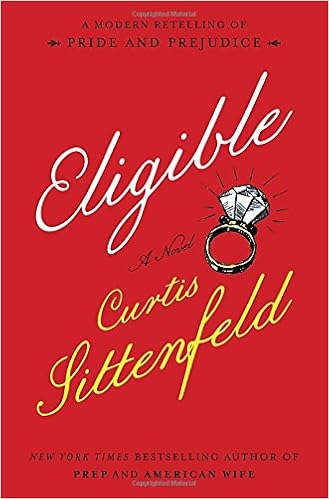
Eligible- Curtis Sittenfeld


Eligible: A modern retelling of Pride and Prejudice- Curtis Sittenfeld
Random House
Release Date: April 19, 2016

Synopsis: This version of the Bennet family—and Mr. Darcy—is one that you have and haven’t met before: Liz is a magazine writer in her late thirties who, like her yoga instructor older sister, Jane, lives in New York City. When their father has a health scare, they return to their childhood home in Cincinnati to help—and discover that the sprawling Tudor they grew up in is crumbling and the family is in disarray.
Youngest sisters Kitty and Lydia are too busy with their CrossFit workouts and Paleo diets to get jobs. Mary, the middle sister, is earning her third online master’s degree and barely leaves her room, except for those mysterious Tuesday-night outings she won’t discuss. And Mrs. Bennet has one thing on her mind: how to marry off her daughters, especially as Jane’s fortieth birthday fast approaches.
Enter Chip Bingley, a handsome new-in-town doctor who recently appeared on the juggernaut reality TV dating show Eligible. At a Fourth of July barbecue, Chip takes an immediate interest in Jane, but Chip’s friend neurosurgeon Fitzwilliam Darcy reveals himself to Liz to be much less charming. . . . 


As a devotee of the original Pride & Prejudice, and a confirmed Janeite, I wasn't sure about the idea of "modern retellings" of Austen's books. Certainly they've been the inspiration for countless movies and books, and the originals are still incredibly popular. So much of the tension and urgency in a book like Pride & Prejudice comes from the time period and social setting.  Austen's dry wit and irony perfectly critique 19th century society, social structures, class and gender limitations, etc. How can that be translated into a modern setting convincingly?

In many ways, Eligible answers that question with: it can't.  I enjoyed the book: it was a fast and funny read, and I was always eager to see how the next scene or problem in P&P would be retold. But when I closed the book, I would start thinking of all the things that didn't work, or disappointed.  The Bennet family as a whole isn't especially likable and the foundation of family love that is present in the original is thin at best, and I often thought it was non-existent. Even the relationship between Liz and her father isn't shown as being especially close or supportive.  Most of the problems that you sympathize with in P&P were entirely self inflicted in Eligible.  Mr. Bennet inherited money from his family and seems to have spent his entire working career doing nothing.  Mrs. Bennet is a shopaholic with what seems to be beginning hoarder tendencies. Neither parent seem to care about reality, and are in fact completely unconcerned that their house is falling to pieces, their finances are going down the drain, and their three younger daughters are complete wastes of space.  Mary is a professional student with no apparent purpose in life and a much more purposely unlikeable personality than her socially awkward P&P counterpart. Lydia and Kitty remain clueless and act like teens even though they are both in their 20s and have yet to even try to see the point of getting a job.  Lydia in particular seems determined to get by in life on her looks and what she seems to think is a charming personality.  Even Liz, the main character, is often not especially likable.  Much more judgmental than her counterpart, she tries to "fix" the family while visiting after her father's heart attack by railroading them into accepting major life changes.  As much as you agree that the changes are needed (like selling the house they can no longer afford, and attempting to convince the younger girls to actually get jobs and earn their way), Liz doesn't do anything with much tact or thought to anyone's feelings, just harsh necessity.

It doesn't come as a big surprise that Darcy is also not especially likable, is far ruder than the original, and his original declaration of love makes you want to punch him.  What is disappointing is that by the end of the book I was never actually convinced why Liz and Darcy ended up together- there weren't great changes in either of them, no real excuse for Darcy's behavior, and no convincing chemistry or love between them. The only likable main characters in the book were Jane, a yoga instructor who remains sweet and forgiving of Bingley even after he proves to have no spine, no great character, and not much to recommend him other than money and (eventually) loving Jane; and Kathy de Bourgh, Liz's feminist idol whose walk on role is more an acknowledgement that any version of P&P requires a de Bourgh at least in passing than anything else.  Charlotte Lucas and Mr Collins ("Cousin Willie") likewise seem to have been written in more because of formula than that they had a useful role to play.  Lydia's great indiscretion, a major turning point in the original and a genuine catastrophe for the whole family, is really only a problem to her conservative parents. Darcy doesn't get to save the day, the family, or sacrifice his own comfort and feelings as a way to show his changed heart and love. Wickham remains a complete and unlikeable jerk, but not the horrible deceiver and seducer of P&P.  

The subtle social criticisms and humor of P&P are in no way subtle in Eligible.  Every possible stereotype is invoked, sometimes for laughs, sometimes you're not sure why. Eligible's humor is more crass than subtle, and social and gender issues hit you like a hammer.  Most of the characters are one-sided and Darcy, one of literature's greatest romantic heroes, just falls flat, as does the development of Darcy and Liz's romance. Liz, whose P&P counterpart is (in an approximation of the word's of Meg Ryan in You've Got Mail) "one of literature's most complex heroines"     is anything but that in Eligible.

What is surprising is that I enjoyed Eligible while I was reading it. It was after I'd finished that the book fell apart for me.  Maybe it's unfair to compare it so heavily with Pride & Prejudice- it's a different author and a different time/social frame.  Maybe the book would stand better as its own story.  But it also seems impossible not to make the comparisons, especially for someone who loves the original book- which is presumably the audience expected to read Eligible.

   
I received an ARC of this book from NetGalley for an honest review.