Showing posts with label World War I History. Show all posts

Monday, March 11, 2019

Escape Artists


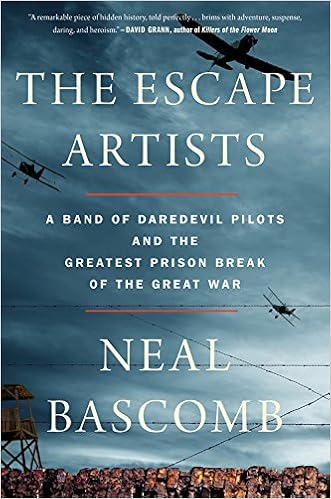
The Escape Artists: A Band of Daredevil Pilots and the Greatest Prison Break of the Great War- Neal Bascomb
Houghton Mifflin Harcourt
Release Date: September 18, 2018

Rating:
📚📚📚📚📚

Synopsis: In the winter trenches and flak-filled skies of World War I, soldiers and pilots alike might avoid death, only to find themselves imprisoned in Germany’s archipelago of POW camps, often in abominable conditions. The most infamous was Holzminden, a land-locked Alcatraz of sorts that housed the most troublesome, escape-prone prisoners. Its commandant was a boorish, hate-filled tyrant named Karl Niemeyer who swore that none should ever leave.

Desperate to break out of “Hellminden” and return to the fight, a group of Allied prisoners led by ace pilot (and former Army sapper) David Gray hatch an elaborate escape plan. Their plot demands a risky feat of engineering as well as a bevy of disguises, forged documents, fake walls, and steely resolve. Once beyond the watch towers and round-the-clock patrols, Gray and almost a dozen of his half-starved fellow prisoners must then make a heroic 150 mile dash through enemy-occupied territory towards free Holland.

Drawing on never-before-seen memoirs and letters, Neal Bascomb brings this narrative to cinematic life, amid the twilight of the British Empire and the darkest, most savage hours of the fight against Germany. At turns tragic, funny, inspirational, and nail-biting suspenseful, this is the little-known story of the biggest POW breakout of the Great War.  
_____________________________________________________________________

The Escape Artists tells the true story of a number of prisoners of war during World War I (mostly British pilots) and their attempts to escape German POW camps and into the safety of neutral Holland.  The book is well-written, well-researched, and thrilling from start to finish.  While most people have at least vaguely heard of the Great Escape of World War II (or at least know it was a movie), how many of us know about the POW camps of the first World War?  Did you know that many of the WW II pilots were taught by their first war counterparts?  Pilots who made it back to England helped prepare young men going into the second war by sharing their experiences in the camps and sharing the methods they used- or knew others used- to break out.

Bascomb's descriptions of the early fighter planes are terrifying- the fragility of these early planes meant it was a brave person willing to go up in them.  The POW camps sound like they would drive even the strongest to insanity.  I was surprised to learn how much of the treatment of POWs in the first war was still being negotiated between countries as the war progressed.  The various escape plans designed by the prisoners were often something you would expect out of a movie- from disguises as German officers or women to chutes out of windows to tunnels under the camps, complete with carefully forged papers.  For every failed escape attempt there was a lesson learned, leading to the final success of the POWs who escaped from Holzminden- considered a land-locked Alcatraz where Germans sent the most escape prone prisoners in the belief that it was escape proof.  

The Escape Artists is by turns humorous and tragic, inspirational and full of edge-of-your-seat suspense.  A wonderful and much needed look into this lesser known aspect of World War I.  A riveting, well-written, carefully researched, must read for history buffs!   

Wednesday, June 14, 2017

Dead Wake


Dead Wake: The Last Crossing of the Lusitania by [Larson, Erik]


Dead Wake: The Last Crossing of the Lusitania- Erik Larson
Broadway Books, Random House
Release Date: March 10, 2015

Rating (out of 5):
📚📚📚📚📚

Synopsis: On May 1, 1915, with World War I entering its tenth month, a luxury ocean liner as richly appointed as an English country house sailed out of New York, bound for Liverpool, carrying a record number of children and infants.  For months, German U-boats had brought terror to the North Atlantic.  But the Lusitania was one of the era's great transatlantic "greyhounds"- the fastest liner then in service- and her captain, William Thomas Turner, placed tremendous faith in the gentlemanly strictures of warfare that for a century had kept civilian ships safe from attack.

Germany, however, was determined to change the rules of the game.  As the Lusitania made her way toward Liverpool, an array of forces both grand and achingly small- hubris, a chance fog, a closely guarded secret, and more- all converged to produce one of the great disasters of history.  Gripping and important, Dead Wake captures the sheer drama and emotional power of a disaster whose intimate details and true meaning have long been obscured by history.


_________________________________

Dead Wake is, from the very beginning, a gripping story surrounding the final crossing of the Lusitania.  The narrative shifts between following the ocean liner and her passengers; the German captain Schwieger and his submarine 'U20' who will sink Lusitania; President Woodrow Wilson as he tries to balance a rocky and emotional personal life with an increasingly challenging American neutrality in the war; and the English code breakers of 'Room 40' who intercepted German U-boat transmissions.   The end result is a well researched, brilliantly woven narrative providing depth, human interest, and historic and social context to a story most people know only vaguely: the sinking of the Lusitania.

One of the greatest transatlantic ocean liners of its era, the Lusitania was fast, richly appointed, and each trip guaranteed to carry some of the most rich and famous people of both America and England, as well as 'regular' people sailing for work or to reunite with families.  With the memory of the Titanic disaster still fresh in people's minds new regulations insisted that life jackets be provided in each cabin and enough life boats were aboard for all passengers and crew.  The crew even regularly practiced handling the life boats.  Despite the ongoing war and a specific message from Germany naming Lusitania as a target, most people put their faith in the ship's speed to outrun a submarine, and their belief that the British navy would escort the ship once they were in the war zone.  The danger seemed more a possible adventure than a real threat.  With the help of diaries and letters Larson brings to life what travel on the Lusitania was like, and follows the trip through several specific individuals in first, second, and third class.   

Equally vividly are the descriptions of the German submarine 'U20' and its captain.  Schwieger is not painted as a one dimensional evil figure, but as a human who liked dogs, treated his crew well, and excelled at commanding a relatively new kind of vessel in a new kind of naval warfare.  Larson's descriptions of life aboard German submarines are so real you can smell it.

Beside the vivid details of daily ship life are the equally fascinating, and sometimes appalling, stories of the politics behind British military decisions which could arguably have contributed greatly to the sinking of the Lusitania.  Thanks to code breakers, transmissions from German U-boats were all read by the British intelligence (who were so obsessed with secrecy that few transmissions were ever acted upon) and boats like 'U20' were tracked closely.  While other merchant or civilian ships had been escorted by warships through the contested zones- and the owner of the Lusitania's line specifically asked for escort- the ship was neither escorted, nor provided the specific details that might have helped her captain avoid submarines on his own, nor was he told about a new and safer passage just opened up to civilian ships.  Due to a disaster early on in the war, military rules forbade any military vessels from coming to the aid of a ship struck by U-boat torpedo.  Thanks to this, the fastest ship nearest Lusitania was forbidden from going to its rescue, an action which would undoubtably have saved numerous lives.  

Larson describes the sinking of Lusitania and the ordeal of the passengers and crew in the water waiting for rescue without dramatics while still being deeply aware of the sensitivity of the human tragedy he is telling.  Whenever possible he uses the words of survivors to describe their ordeal.  It is impossible to read the last part of Dead Wake without being deeply moved by the tragedies and reunions in the final, emotional dramas of the passengers and crew of the Lusitania. Larson is able to describe not only the human impact of this tragedy, but also the cultural one- describing several irreplaceable first edition novels and great paintings by masters being transported by passengers now lost to us forever.  While it is probably humanly impossible to tell the tale of such a tragedy without foreshadowing and seeing 'omens', these are kept to a minimum, allowing the narrative to tell itself without too much of the 'what ifs' and 'if only' that often crop up in books like this.

Dead Wake brings the story of the Lusitania's last voyage to life through a compelling and dramatic narrative.  Emotionally gripping, detailed, and fascinating,  Dead Wake is an instant classic and a must read for both historians and laypeople alike.