Showing posts with label author interview. Show all posts

Monday, September 1, 2025

Author Interview: Judy Mohr & Dancing In The Purple Rain


Kiwi Judy L Mohr is a writer, developmental editor, writing coach, amateur photographer, and a science nerd with a keen interest in internet technologies and social media security. Her knowledge ranges from highly efficient ways to hide the bodies through to how to improve your SEO rankings for your websites. When she isn't writing, editing, or doing something withing the local writing community, she can often be found with a camera in her hand enjoying the world around her- no doubt scouting for locations to hide the bodies. (Shh... Don't tell anyone.) Follow her crazy adventures on her blog or on Instagram.

Q: You write both fiction and nonfiction. Do you find it difficult to switch between the two? How different is your writing process for fiction and nonfiction?

A: The biggest difference between writing fiction and nonfiction for me is the voice. Within my fiction, I'm heavily focused on trying to tell the story of the characters, so I'm in their heads, talking like they do. However, for my nonfiction, it's my own head and my own voice, talking like I do in real life... for the most part.

That different voice means that writing fiction is slower for me. I have to put more thought into it, constantly asking myself if the character would really say or think that.

This is not to say that I don't think when writing nonfiction, because I do. If anything, I overthink. Would my readers really be interested in this bit of information, or have I dived into the weeds a bit to far? It's a balance that has taken me over a decade to find. 

The other major difference between fiction and nonfiction is how the "book" starts its life. Fiction starts as random thoughts and ideas (random scenes that don't have a home yet), but they are secret and never shared until there is a home found for the ideas. Whereas my nonfiction often starts its life as a series of blog posts. When enough blog posts are written on a certain topic, that's when I look at turning those blog posts into a book.

Q: Do you carefully plot out every scene or see where the characters take you? What's your writing process?

A: I'm a plantser, with pantser tendencies. This means that I'll start with a vague idea, but I write whatever comes to mind. This allows me to explore random ideas, things that I never would have considered otherwise. However, eventually, enough of the material is present where I need to start "shaping" it into something that makes sense. 

For my fiction, this process normally results in what I call a "barf" draft, where all ideas found the page in one big jumbled mess. I often need to spend a significant amount of time teasing out the plot, deliberately taking the time to write that full plot synopsis. That's when the real work begins, writing the full scenes and putting flesh on the bones. 

For my nonfiction... Well, I've already mentioned that my nonfiction often starts as a blog series. Turning those blogs into a book requires that I work out a full outline, identifying what questions each chapter needs to answer. Then it's populate the manuscript with the blogs already written and fill in the gaps. This process makes for fast writing of nonfiction.

Q: What particular challenges do you face in your writing? What is difficult for you? Do you have any tips for other writers who face similar challenges?

A: The biggest challenge during writing is constantly reminding myself that writing is HARD.

We humans want things to be easy, because... well... Let's face reality, most of us are lazy, and I'm no exception there. So, I will often default to writing the easy stuff first... then freak out with the mountain that I have yet to climb. But when I force myself to face the difficult writing... It is so satisfying at the top... Then I realize that the mountain I just climbed was only the little one.

Gah! Writing is HARD!

Q: You're a developmental editor. Did you use other editors or do everything yourself?

A: Yes and no. I will always use a copyeditor (though the budgets are incredibly tight on that front), but I won't always use a developmental editor. That's not to say that I haven't used a developmental editor in the past, but sometimes a manuscript doesn't need one. 

That said, I will ALWAYS use beta readers. Even if I hired a developmental editor, beta readers are part of my process. 

Sometimes, what I thought was on the page wasn't actually on the page, and we won't know that until someone else reads our manuscripts.

For my fiction, beta reader comments have led to total rewrites of certain scenes to add clarity. For the nonfiction, whole sections have been added. However, sometimes, a sentence was added to clarify the audience for a section, saying something like, "If you didn't understand anything that I just said, then this idea is definitely not for you." But without those beta reader comments, I don't know what a manuscript really needs from a reader's perspective.

Q: Can you talk a little about your editing experience for new writers?

A: I'm blessed to have worked as a professional developmental editor since 2015. This has given me the tools I need to tear apart my own writing and make it bleed. But my editorial skills are part instinct and part learned skills... and they're skills anyone can learn if they are willing to put in the time and energy needed to learn them.

For a new writer, learning those editorial skills starts with the fearful step of sharing your writing with others. And you can't take to heart anything that anyone says. Learning how to step back and see the comments and feedback for what they really are is a skill that ALL writers seeking publication need to learn.

Then it becomes a matter of finding the right set of eyes to read your work to provide you with the feedback you need. And once you have the feedback, it's up to the writer to decide what to do with it. Sometimes, the decision is to "ignore".

Because I have the years of experience as a professional developmental editor, I'm able to treat myself as though I was my own client. Though I don't write myself an editorial report. But I still have the manuscripts that come back with "This didn't make sense?" or "Would the character really say that?" or "You don't need to show AND tell." And I laugh my head off whenever I see the flaws that I've just pointed out in a client manuscript in my own manuscript- because it does happen. He-said-she-said fest galore. Oopsie.

But this is all part of the process.

Q: Are you a self/hybrid or traditional published author? Why did you decide this was the path for you?

A: I'm technically a hybrid author, with some works traditionally published and others self-published. However, I've elected to be primarily indie-published these days, using my own publishing imprint. 

It wasn't an easy decision, and one that took me years to decide upon, but the publishing landscape has changed so much in just the last five years alone.

I don't think anyone would disagree with me when I say that Covid changed so many things. But the publishing industry was flipped upside down because of the pandemic. 

Acquisition trends changed overnight. Bookstores changed how they were purchasing books (assuming they survived the pandemic). And digital format significantly increased in popularity (particularly audiobooks).

Add the mess that came in because of the introduction of AI-generative technologies, and the publishing landscape today no longer resembles what it was in 2019.

Meanwhile, authors are now required to do the heavy lifting when it comes to marketing, particularly in the online world.

But to be honest, the nail in the coffin for the traditional path for me was to see the clauses that are being added to the contracts of some of my writing buddies. It's in their contracts that the publisher reserves the right to use AI to produce translations and audiobooks. Granted, their books would never have been in audio or in other languages otherwise, but I can't trust AI to get English right. How can I trust it to get another language right when I don't speak that language to check on the mess? It was at that point that I just gave up on the traditional path.

I only have so much energy to go around. And I have a certain standard that I hold myself accountable to. I can't be wasting my energy trying to fix other people's messy adventures with AI. I have enough on my plate fixing human-generated messes (including the messes I generate for myself- and I've made quite a few over the past few years).

Q: Can you describe your publishing experience for writers who hope to publish one day?

A: Everyone's publishing experience is going to be different, because everyone will be bringing to the table a different set of skills that can be leveraged as part of the process. And that's the biggest lesson that I've learned through this journey.

I have strengths and weaknesses, and I need to be prepared to hire someone to help fill in the gaps of my weaknesses. 

Notice above I used the term indie-publishing, because that is the better way to think of self-publishing. Like independent films, you're not doing this alone. You have a team of people working together, each person leaning into their strengths.

For those writers who elect to head down this path themselves, think of yourself as either an authorpreneur or the executive producer of the project known as "Your Book". You're bank-rolling the venture, but you're not necessarily doing all the work yourself. And that idea makes a huge difference.

BUT all of this takes time.

I refuse to rush any stage of the process, just to get a book out there. If something isn't ready to go when I said it would go, I'll move the publication date. I would rather run the risk of losing those "release day" sales and put a quality product out there than to rush to market and have something tank in the reviews. The former is a position that one can easily recover from.

"One step at a time." I say that to myself at least once a day.

Dancing In The Purple Rain

In a poisoned world, Michaella, a genetically engineered telepath, uncovers a web of lies and implanted memories when her closest friend is killed. Michaella must now rely only on her personal AI and a 200-year-old playing card as she attempts to maintain her grip on reality to save herself and future generations from becoming emotionless automations. 

Dancing in the Purple Rain is available from a variety of retailers. For a full list, visit: https://judylmohr.com/books/dancing-in-the-purple-rain/


Tuesday, August 12, 2025

Author Interview: Lancy McCall & Code Block


 Author Interview: Lancy McCall & Code Block

Lancy McCall is a self-published author whose first book, Left Turn, came out in 2022. I've had the pleasure of being Lancy's writing coach for some time now and am thrilled that Lancy will be releasing Code Block August 15, 2025. She was kind enough to take a break from her day job and marketing prep for her new book do to this interview with me. 


Q: Do you carefully plot out every scene in your books or see where the characters take you? What’s your writing process?

A: I fall somewhere between a plotter and a discovery writer. I like to say I’m a “GPS-er,” meaning I know my final destination, but I might take a few detours along the way and then recalculate my route to get back on track toward that predetermined ending. My writing process always starts with my characters. Who are they? Where are they at the beginning, and where do they need to be by the end? What internal and external challenges are driving them throughout the story? Once I have a strong sense of my characters, I turn to the plot. I use the 7-point plot exercise described by Dan Wells, where you figure out the key scenes for each plotline, then map them out on a timeline. (This article spellsout my process well: https://lancymccall.com/lm20210531). While I don’t outline every scene in advance, I do need a clear sense of the order of events. If I don’t know when something happens, I have trouble moving forward.

Q: What particular challenges do you face in your writing? What is difficult for you? Do you have any tips for other writers who face similar challenges?

A: Dialogue and action come pretty easily for me, but I struggle with description and narrative. I’m a bit of a bullet-point, bottom-line kind of person in real life, so it makes sense that my writing reflects that. Each revision pass almost always adds thousands of words to the manuscript. I’m still learning how to “show” rather than “tell”—how to write a scene that reveals a character’s traits or emotions through their actions rather than just stating them outright. I also tend to lean too technical in my first drafts. Sometimes I include too much jargon or get overly detailed about the business functions being discussed. During revisions, I rework those sections to make sure they support the story without overwhelming the reader—or tempting them to roll their eyes or skip ahead.

Q: Did publishing your first book, Left Turn, change your writing process?

A: I didn’t really have a writing process before Left Turn. A lot of authors you meet have been writing since they were kids, but that wasn’t me. Before Left Turn, all my writing was technical—part of my day job as a project manager. That first book helped me find my writing process. That said, Left Turn had lived in my head for years before I ever wrote anything. So when I finally sat down to write it, the story flowed out of me fully formed. Conversely, I struggled with Code Block. And I think it’s because it hadn’t had the same time to marinate. I had only a vague idea of what the story was and very few imagined scenes in my head when I started. (And I’m still tweaking my writing process to pull the story out without it needing to percolate like that.)

Q: How did you find your editors?

A: For Left Turn, I worked in solitude, figuring things out as I went. I made pass after pass, editing the heck out of that book until I reached the point where I’d done everything I could and it needed someone else’s eyes on it. I used the Reedsy marketplace to find both a developmental editor and a copyeditor. Each gave me helpful feedback, and everything—from payments to communication—was handled within the Reedsy platform. After publishing that first book, I met other authors and heard about their relationships with their editors. It made my experience feel very transactional and not much like a relationship at all. So I decided that for my next book, I wanted to work with someone I could build a deeper connection with. For Code Block, I reached out to other authors and editors I’d met at writing conferences and on social media, asking for recommendations. I compiled a list, checked out their websites, and paid attention to their editing processes. Eventually, I found a couple of editors through word of mouth who felt like the right fit.

Q: Can you talk a little about your editing experience for new writers?

A: When I talk to new writers about editing, my biggest piece of advice is to remember that your goal is to make your book the best version of itself. And you can’t do that alone. You need other eyes on it to catch the things that you’re too close to see. With my first book, I braced myself for brutal feedback. It was my debut, after all. But the comments weren’t harsh; they were constructive. Everything my editor pointed out made sense. It was a lesson in “this is good, but it could be better if…” And honestly, there were so many positive notes that I was a little taken aback—in a good way. I know it’s intimidating to get that first edit back, but every mark or comment is meant to make your book stronger. I love getting feedback that helps me spot things I missed or suggests ways to bring a point forward so readers connect with it more easily. One other thing I want to emphasize: it’s important that you and your editor are aligned on your story. If your editor thinks they’re working on a swoony romance but you’re writing women’s fiction, they might steer the edits in a direction that doesn’t match your vision. In the end, it’s your story. You get to decide which edits to accept. But when you’re both clear up front on the story’s genre and purpose, the process is smoother, more effective, less costly, and—let’s face it—less emotional.

Q: Can you describe your publishing experience with Code Block? Was it similar or different to Left Turn? Why did you decide this was the path for you?

A: Publishing Code Block has been easier because I feel more knowledgeable this time. It’s like returning to a vacation spot and knowing your way around a little better than the first time you visited. With Left Turn, I was learning everything as I went. I did tons of research before making each move. But with Code Block, I already knew the general order of tasks and when things needed to happen. (Thank goodness for my detailed notes!). For example, I knew to line up my editors and cover designer early, which helped compress the timeline. Another big difference was in my approach to the workflow. With Left Turn, I did everything sequentially—each step waited on the one before it, mostly because I was still figuring things out. With Code Block, I knew I could work on the blurb and social media content while the manuscript was with my editor. That made it easier to stay organized and avoid wasting time on things that could wait.  I’m still figuring out the marketing piece. 😉

You can find out more about Lancy on her website.


Thursday, May 9, 2024

Author Interview: Lancy McCall

 I recently got to talk with Lancy McCall, author of Left Turn, about her book and her writing process. Here’s our interview!


Lancy McCall


Left Turn follows Alex Tanner, a corporate rising star who meets and falls for Scottish actor Finley McAlister, a celebrity looking to escape the spotlight. What inspired your story? 

I used to travel to and from England on business. When they adapted the Outlander books for TV, I thought, “What would happen if I got on the plane home from London and Sam Heughan sat next to me? What would he say? What would I say?” From there, it just bloomed into this story of a professional woman bumping into a celebrity who changes her life.


Alex and Fin live in very different worlds but find common ground. What inspired their characters' interactions and backstories?

Alex’s world came easily to me as we share a common background. I worked for years in her industry and experienced the same things she’s been through.

For Finley, I’ve always enjoyed listening to celebrity interviews where they talk about their craft. Their dedication to acting shaped how I thought Fin would view his world. And I’ve always sympathized with those chased by the paparazzi and the disruption to their lives this must cause.


Do you carefully plot out every scene in your books or see where the characters take you? What’s your writing process?

My characters often come to me first. Often, a scene will pop into my head and I wonder about it. What’s going on here? How did they get here? Where did they come from? What’s going to happen next? From there, I flesh out a story about what’s happening to these people and how they will react.


I am an outliner, but it’s a loose outline subject to change. It’s more like a GPS route… I know my destination, and a few stops we’re making along the way, but while I’m driving, I may take an unexpected detour. Then I need to “recalculate the route” and figure out how to get back on track to that final destination.


What kind of research do you do and how long do you spend researching before beginning a book?

As a project manager, I live in this strange world where you must be comfortable moving from the high-level overview down into the details. As a writer, I find it’s the same. You need to keep your eye on the bigger arc and where the story’s going, while also giving enough details to bring that world or those characters to life. When I start a story, there are obvious details I know I’m going to need to research to round out my characters. For example, for Left Turn, I knew ahead of time, I would need to know how movie stars are paid. But once I started writing, I realized I also needed to research how celebrities stay under the radar while traveling. Much of my research occurs while I’m writing, because I want the story to be believable, and if I don’t understand how something happens, how will my readers?


What were some themes that were important for you to explore in this book?

It’s always amazed me how people perceive the world so differently. I think it’s important to understand that each individual defines success as unique to them, and what you see on the outside doesn’t always reflect how people feel on the inside. Along those same lines, how people measure their success changes as their priorities in life change.


Another important concept I wanted to convey is the bias that women encounter in the corporate world. Sometimes it’s in your face and hard to miss, but usually, it’s so subtle, you don’t realize it’s happening until you have distance from it.

And the last theme I wanted to explore was the effect of all the attention we give to celebrities and how destructive it can be. 


Is this the first book in the series? If so, when is the next book coming out and what can your fans expect in the next story?

Left Turn is the first book in the Women of Caprock series. This series features interconnected stand-alone novels, each centering on strong women, their careers, and the relationships in their lives.


The next book in the series, Code Block, features Claire Broussard, an application developer who’s trying to find her place in a new company and finding her progress consistently blocked by the grumpy operations manager, Noah Raines.


Left Turn just became a Literary Titan’s Book Award Winner! Find out more about Lancy McCall and Left Turn at Lancy’s website.

Tuesday, November 6, 2018

Author Interview: Karen Odden

USA Today Bestselling author Karen Odden


 Historical mystery writer Karen Odden's debut novel, A Lady in the Smoke, hit the USA Today bestseller's list and won the New Mexico-Arizona 2017 Book Award for e-Book Fiction.  In her newest release, A Dangerous Duet, Odden returns to Victorian England with Nell Hallam, an ambitious pianist who stumbles across a disturbing mystery while playing piano in a Soho music hall.     Karen took a break from her crazy schedule of writing, book promotions, and family to talk with me about Dangerous Duet, her writing, and more!


Nell Hallam isn't a traditional Victorian young woman.  She doesn't balk at dressing in men's clothing, working in a rough music hall, or facing danger to help friends and family.  What inspired you to create the character of Nell? 

Years ago, when I was doing research for the Introduction that I wrote for Charles Dickens’s Hard Times(for the Barnes & Noble classics series) I came across the story of Fanny Dickens, his older sister, who was a brilliant pianist and attended the Royal Academy of Music in London in the 1820s. Their father was an irresponsible spendthrift, always in debt, which resulted both in Charles working in the infamous bootblack factory, and Fanny having to leave the Academy because she couldn’t afford tuition. Eventually she was allowed to return in exchange for providing lessons to other students. But it got me to thinking—what would happen if she hadn’t been offered that position? There weren’t many professions open to women in the 1870s in England, and most of them weren’t particularly remunerative: seamstress, governess, companion, nurse—and prostitute. Some female performers were paid decently, but that depended upon having a particular skill or what we’d now call “street cred” from graduating from a school like the Academy. So I wondered, could Nell earn the tuition by playing piano? Were there places she might be hired? That brought me to the music halls, of which there were hundreds in London by 1875.

One of the things that I think really sets you apart as an author is your ability to describe London as if it is a living, breathing character.  How do you immerse yourself in the city to describe it in such sensory detail?

Images are a great help. You can go online and find dozens of images for Victorian music halls, the Pantechnicon on fire, the sheet music Nell might have used, costumes, and London itself. I was very lucky this time in that there is still one Victorian music hall standing: Wilton’s, in Graces Alley, Whitechapel (www.wiltons.org.uk). In 2012, when I was researching for this book, I had the chance to tag along with my husband on a business trip, and I went not only to the Royal Academy, where I was lucky enough to find an exhibit on music halls, but also to Wilton’s. I prowled all over the place, including the basement where the plaster was falling off the bricks and the floors were uneven. I stood at the back of the music hall and could envision Nell in the corner at stage right with her piano. From there, it was easy to imagine the Octavian.

Do you carefully plot out every scene in your books or see where the characters take you?

I begin with a premise and a character. After that, it’s an uneven progression among careful plotting, adventurous research, and letting my characters lead. I often write plot points on sticky notes, which I lay out on my floor; then I move them around to find the best order to create tension and build suspense. But let’s say there’s a scene that I know has to happen. For example, in my first book, A Lady in the Smoke, I knew that Elizabeth and Tom Flynn had to meet; I needed a scene in which he gave her a piece of information about her father that she didn’t know, and she convinced him that she was willing to help find the truth. But as I sat at my desk to write that scene, I felt as though both those characters were so clear in my head, I could just push Elizabeth into the room where Tom Flynn has been waiting … and then they did the moving and talking; I just wrote down what happened.

People who have read A Lady in the Smoke will notice the brief cameo in A Dangerous Duet of Mr. Flynn and Jeremy at the Falcon newspaper offices. Was that a coincidence? Do you want each book to stand on its own, or are you trying to build a body of work with connections between each book? Should we expect surprise "guest appearances" by previous characters in future books too?

Yes! I want each book to stand alone, but I love the idea of creating a world in which characters live beyond the pages of a single book. To be honest, I feel wary about writing a series in which the protagonist remains the same. I know many other mystery/suspense writers manage to do it, and do it well—Susan Elia MacNeal, Rhys Bowen, Anne Perry, and G. M. Malliet, to mention a few. But I am afraid it might begin to feel formulaic—and I might get bored! So for now I plan to remain in the world of 1875 London, and while I may revisit characters, I don’t anticipate writing a series of books with the same protagonist every time. However, in my third novel, about a young woman painter at the Slade in London, Mr. Flynn has a cameo—and Inspector Matthew Hallam (Nell’s brother) becomes one of the main characters. 

So much of A Dangerous Duet focuses on the importance of music in Nell's life? Do you play an instrument? What are your favorite kinds of music? Composers?


I played piano (badly and briefly) as a child; but my father was a classically trained pianist and played the organ at churches and gave piano lessons. We had a baby grand in our living room at home, and piano is still my favorite instrument, with the cello a runner-up. Of myself and my three siblings, only my brother Kevin inherited my father’s enormous talent. He can hear a song once and play it by ear on the piano; he played violin when he was young and still plays bass and guitar and keyboards. One of my favorite things about him coming to visit is he’ll play the piano in our den! My son plays piano as well, and one of the pieces he is working on now is the Mozart Sonata in C that is one of Nell’s audition pieces and will be familiar to many of my readers (https://www.youtube.com/watch?v=XXIu0MRuIQU). The second piece of audition music is Chopin’s Scherzo, which I picked on the advice of a professional musician; after I heard it a few times it became one of my favorite pieces of classical music. Here’s a link to a performance: https://www.youtube.com/watch?v=i7o3e8InNig


What kind of research do you do and how long do you spend researching before beginning a book?

I usually begin with a premise and research as I go. For example, when I was researching for A Dangerous Duet, I didn’t originally have an inspector character in mind. But when I realized I wanted one, I found several books and articles about Scotland Yard, the best being Haia Shpayer-Makov’s The Ascent of the Detective. After the first draft was finished, I realized I needed to bring the injured character closer to Nell than a random patient, to make her desire to help more personal; so I invented Nell’s friend Marceline—which meant a whole new round of research into trapeze artists of the era. So I don’t do all my research up front; the story often dictates when I have to take a break and start reading around on a particular topic. But research is a delightful rabbit hole! 

What was the most interesting thing you discovered while doing research for this book?

Music halls were astonishing places. People attended them the way we attend movie theaters today. The variety of acts is astounding—everything from trained animals to trapeze acts to knife-throwers and musicians and songstresses. But they also provided a place for the lower classes to consolidate their class identity—not merely in terms of what they weren’t (middle class, rather serious, aspiring to bettering themselves, pursuing their work ethic)—but what they were: bawdy, robust, gleeful, wry, cynical and practical. In tone, most of the acts were more along the lines of a Saturday Night Live skit than a beautifully produced Broadway show.

Did publishing your first book, A Lady in the Smoke, change your writing process?

Oh, gosh yes—in about a million ways. I made so many mistakes writing that book! But bad mistakes make for efficient learning. For example, when I first wrote Lady, the railway disaster—the inciting incident that kicks off the action—didn’t appear until chapter 8! Now (in its finished version) it appears at the end of chapter 1. Those first seven chapters were important to have in my head; but they didn’t belong in the book. It took me some time to see that the inciting incidents need to happen early. With A Dangerous Duet, it starts a bit slower than Lady—there is no trainwreck right away, so to speak. But Nell finding Marceline half-dead in the alley happens in chapter 1. It just takes a little while to see why that’s important and what it means. Lady also taught me the importance of making sure that the stakes are personal for the protagonist. The question I always ask is: what does she stand to lose if she doesn’t solve the puzzle? It can’t just be for the “greater good” of society. I also learned about the importance of writing backstories, even for the minor characters. I need those in order to feel as though my characters aren’t merely foils or helpers or suitors for the protagonist. They have to live and breathe their own concerns, or they feel hollow, and I get an uneasy feeling in my gut.

What particular challenge do you face in your writing?  What is difficult for you?

Many aspects of writing are challenging—in a good way. But what is most difficult for me is humor. I am the least funny person I know. (Seriously!) That’s not to say I don’t laugh—I do! When I get the New Yorker, I read the cartoons first and chortle over them. I love a funny story; I love funny movies; I even like my son’s terrible puns. But let me explain: a few years ago some friends and I were sitting around drinking wine and playing Cards Against Humanity. It’s sort of like Apples to Apples, except for adults, and it’s pretty profane. The idea is that the dealer lays down a card and then all the other players anonymously put down a card from their hand that makes a “match”; usually the aim is to be clever or funny. The person who makes the best match gets to be dealer for the next hand. Well, we went twenty rounds and I was never the dealer. My friends began to feel sorry for me and let me deal a few times, so I’d have a chance! You wouldn’t think humor is important when writing a mystery, but I think the best mysteries do have some humor—dark, or wry, or sideways. It’s necessary to leaven the tale. 


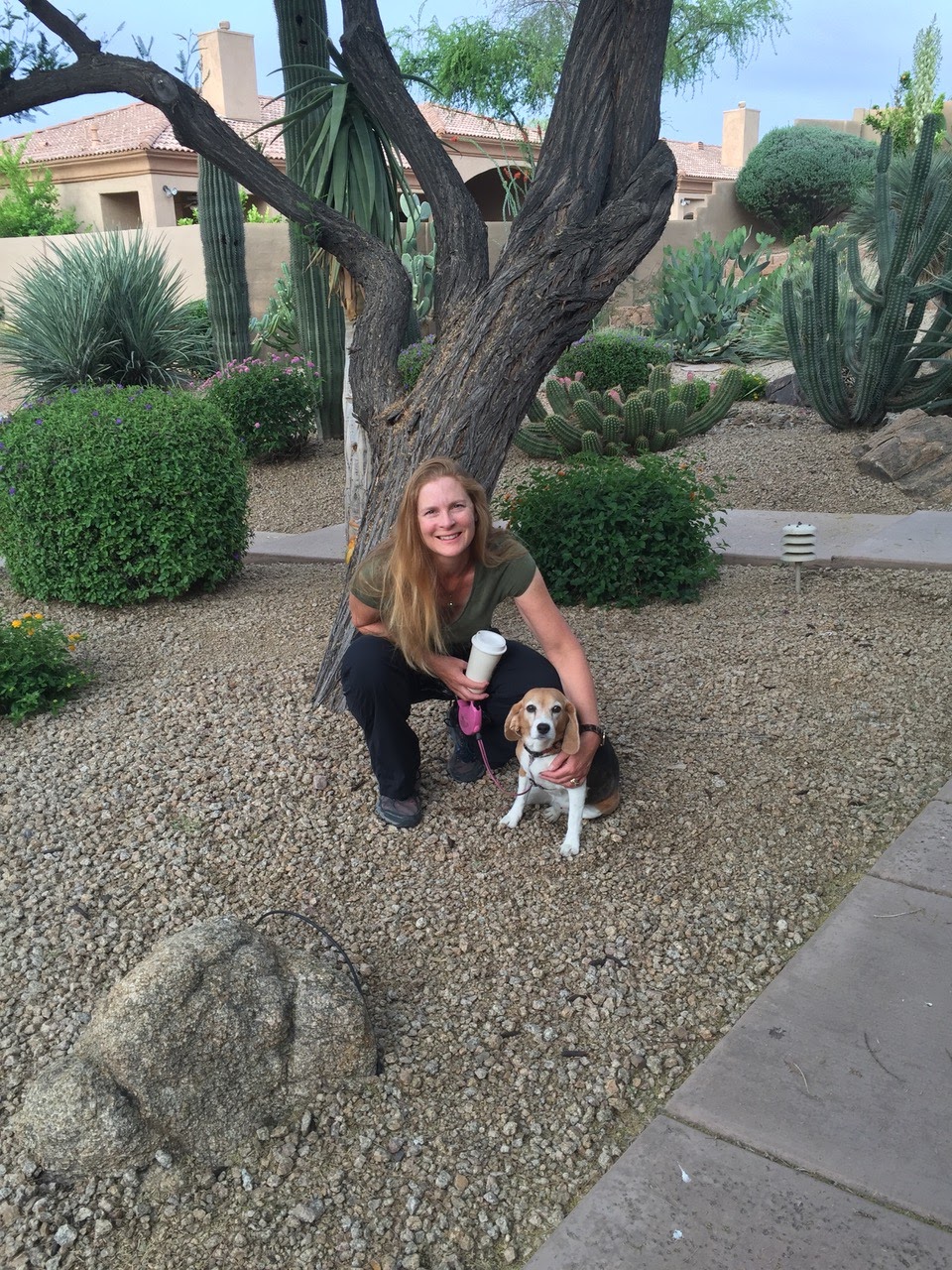
Karen and her hiking partner, Rosy the beagle
When you aren't writing, what else do you enjoy doing?

I have two kids, so a lot of my time the last decade was spent just being a mom. But now that they’re older, they need less of my time, so I take time to hike in the beautiful desert, read (always!) for fun, bake, and binge-watch Netflix! The dark series Ozark, with Laura Linney and Jason Bateman, is my latest catnip.