Monday, June 26, 2017

Profligate Son


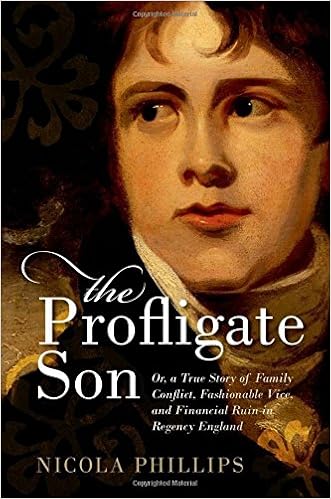
The Profligate Son of, a True Story of Family Conflict, Fashionable Vice, and Financial Ruin in Regency England- Nicola Phillips
Oxford University Press
Release Date: June 26, 2014

Rating (out of 5):
πŸ“šπŸ“šπŸ“šπŸ“š

Synopsis: In Regency England a profligate son was regarded as every parent's worst nightmare: he symbolized the dangerous temptations of a new consumer society and the failure of parents to instil moral, sexual, and financial self-control in their sons. This book tells the dramatic and moving story of one of those 'profligate sons': William Jackson, a charming teenage boy, whose embattled relationship with his father and frustrated attempts to keep up with his wealthy friends, resulted in personal and family tragedy.

________________________________

During the late eighteenth- early nineteenth century English society began to change from what we today call Georgian society to Regency society.  It was a time of change in many ways: economic, social, sexual, and cultural- and this change often came in the form of a cultural gap between parents and children.  Fortunately, many people kept excellent diaries, journals, as well as all their letters, allowing us today to dig into the emotional turmoil these changing times could produce.  The Profligate Son is a perfect example, allowing readers to follow one father and son during this fascinating time period.

William Jackson came of age in the early 1800s.  His father was an East India Company man who returned to England wealthy and determined to start a respectable and respected family and raise his son a 'gentleman'.  However, Mr Jackson's idea of a 'gentleman' and William's were quite different- both products of their time.  Where Mr. Jackson expected his son to be obedient, quiet, intelligent, and help establish the credit of the family name through prudent financial management, William was determined to be everything a young Regency buck could be.  He gambled, drank, visited prostitutes, and bought endless amounts of clothes, horses, and accessories.  William's view of a gentleman was very much the entitled view held by the aristocracy he tried to emulate. He never quite seemed to understand the idea of debt- young aristocrats lived on their expectations and he went through life assuming (despite being told otherwise) his father would pay for everything while he was under age, then conveniently die so William could inherit a fortune and pay all his creditors.

William quickly learned to play the system, using his appearance as a gentleman and his father's name to get what he wanted.  During what author Phillips calls "the first age of mass consumer credit" society and the legal system were still working out the problem of different ideas towards debt and credit.  As tradesmen banged on the door William went from simple debt to forgery in order to try and continue the lifestyle he wanted to maintain.  Horrified by William's attitude and lack of care for the family name, Mr. Jackson did all he could to set his son straight.  This eventually meant letting William have a taste of debtor's prison and standing trial for forgery.  

The Profligate Son is a fascinating book, well researched and well written, using one family's well documented story as a microcosm to explore the nature of social and economic change during the time period.  Phillips does an excellent job of explaining to a modern audience the 1800 British justice system and the rather fuzzy and changeable lines between crimes and classes.  She immerses the reader into a world of riches and vice, debtors prison and prison ships, as well as the criminal justice systems of England and Australia.  While William is a thoroughly unlikeable and unsympathetic young man (even when you don't agree with how Mr. Jackson handles things, you completely sympathize with his problems) I couldn't wait to find out what happened to him next.  

Even though I knew going in what the end would be (the dust jacket tells you right from the start William's Australia bound) the book was as full of surprises and drama as if it was fiction instead of well documented fact.  An excellent book for those interested in learning more about Regency England.

Wednesday, June 21, 2017

Pleasure of Passion

The Pleasures of Passion (The Sinful Suitors Book 4) by [Jeffries, Sabrina]


The Pleasure of Passion (Sinful Suitors #4)- Sabrina Jeffries
Pocket Books, Simon & Schuster
Release Date: June 20, 2017

Rating (out of 5):
πŸ“šπŸ“šπŸ“š

Synopsis: When Niall Lindsey, the Earl of Margrave, is forced to flee after killing a man in a duel, he expects his secret love, Brilliana Trevor, to go with him, or at the very least wait for him. To his shock, she does neither and sends him off with no promise for the future. Seven years and one pardon later, Niall returns to England disillusioned and cynical. And being blackmailed by the government into working with his former love to help catch a counterfeiter connected to her father doesn’t improve his mood any. But as his role as Brilliana’s fake fiancΓ© brings his long-buried feelings to the surface once again, he wonders who is more dangerous—the counterfeiter or the woman rapidly stealing his heart.

Forced to marry another man after Niall was exiled, the now widowed Brilliana wants nothing to do with the reckless rogue who she believes abandoned her to a dreary, loveless life. So having to rely on him to save her father is the last thing she wants, much less trusts him with....But as their scheme strips away the lies and secrets of their shared past, can she let go of the old hurt and put her pride aside? Or will the pleasures of their renewed passion finally enable them both to rediscover love?


___________________________________

Back from years of exile Niall Lindsey, the Earl of Margrave, is still trying to find his footing in England when he is recruited by the government to track down a counterfeiter.  The problem is, the man responsible may be the father of the woman Niall once hoped to marry.  Seven years ago Brilliana couldn't leave her sick mother to run away with Niall and is now a widow who is disillusioned with men and marriage and intends to protect her heart.  Although she hates her father for his gambling, abandoning her and her mother, and then forcing her to marry someone to keep him out of debtor's prison, Bree doesn't want to see her father hanged as a counterfeiter.  She agrees to help Niall get close to her father and discover the truth.  The best way to do that? Pretend they are engaged.  Can they set aside old hurts and pride to discover the counterfeit culprit, and possibly discover love again?

While all the "Sinful Suitors" series can be read as standalone books, having read The Study of Seduction and The Danger of Desire beforehand will help give additional background to The Pleasures of Passion.  Many of the characters are recurring and the story of Niall, Brilliana, the duel that separated them, and Bree's previous marriage get started in these books.  In Pleasure of Passion Niall and Bree quickly end up in an engagement of convenience, although they can't stand each other.  Lies, betrayals, and secrets from seven years ago have colored how they see each other and buried the love they once had.  Being forced to work together means spending time together, and eventually they hash out the misunderstandings of the past, while trying to get to know each other as the people they are now.  Even before really knowing Bree as she is today, Niall decides he wants to marry her, not just pretend an engagement.  But Bree is used to being deceived and abandoned by everyone and is convinced she can't trust, or love, again.  

The mystery of the counterfeiter is more a catalyst for getting Niall and Bree to work together than a major plot point, although it plays a great part at the end of wrapping everything up in a funny yet serious scene that is one of the best in the book.  Bree's Aunt Agatha especially gets to shine and steals the whole scene.

I'm not usually a huge fan of 'second chance' romances and Passion has many of the traits I find frustrating in them:  the two main characters are so sure of their version of events, and so unwilling to talk about things that hurt feelings, misunderstandings and pride get in the way for most of the book.  Both Niall and Bree say some pretty terrible things to each other and I wanted to smack both of them more than once and force them to sit down and talk.  Both (especially Niall in my opinion) forget how young they were the first time around, and make no allowances for youth and inexperience.  Niall quickly decides that even though he could never love her again, he wants to prove there is still passion between them.  I never quite figured out why, except maybe he was trying to prove something to himself.  The sparks between them seem to fluctuate as much as their trust in each other- when they are 'on' they are a great couple, otherwise not so much.  Bree was, for me, the more sympathetic and relatable character- impacted by more bad luck than one person should have to deal with in life and cautious as a result.

The Pleasure of Passion was a bit more uneven than most of Sabrina Jeffries' books.  The main characters didn't consistently grab me as they usually do, always seeming a bit distant and I had a tougher time than usual caring about them.  But it does wrap up nicely the ongoing saga of Niall's duel and all its effects, as well as show us more about Baron Fulkham (who is the next book's hero).  Perhaps not a book to recommend to those new to Jeffries' writing, but a good one for long time series fans to follow.


I received an ARC of this book from NetGalley in exchange for an honest review

Wednesday, June 14, 2017

Dead Wake


Dead Wake: The Last Crossing of the Lusitania by [Larson, Erik]


Dead Wake: The Last Crossing of the Lusitania- Erik Larson
Broadway Books, Random House
Release Date: March 10, 2015

Rating (out of 5):
πŸ“šπŸ“šπŸ“šπŸ“šπŸ“š

Synopsis: On May 1, 1915, with World War I entering its tenth month, a luxury ocean liner as richly appointed as an English country house sailed out of New York, bound for Liverpool, carrying a record number of children and infants.  For months, German U-boats had brought terror to the North Atlantic.  But the Lusitania was one of the era's great transatlantic "greyhounds"- the fastest liner then in service- and her captain, William Thomas Turner, placed tremendous faith in the gentlemanly strictures of warfare that for a century had kept civilian ships safe from attack.

Germany, however, was determined to change the rules of the game.  As the Lusitania made her way toward Liverpool, an array of forces both grand and achingly small- hubris, a chance fog, a closely guarded secret, and more- all converged to produce one of the great disasters of history.  Gripping and important, Dead Wake captures the sheer drama and emotional power of a disaster whose intimate details and true meaning have long been obscured by history.


_________________________________

Dead Wake is, from the very beginning, a gripping story surrounding the final crossing of the Lusitania.  The narrative shifts between following the ocean liner and her passengers; the German captain Schwieger and his submarine 'U20' who will sink Lusitania; President Woodrow Wilson as he tries to balance a rocky and emotional personal life with an increasingly challenging American neutrality in the war; and the English code breakers of 'Room 40' who intercepted German U-boat transmissions.   The end result is a well researched, brilliantly woven narrative providing depth, human interest, and historic and social context to a story most people know only vaguely: the sinking of the Lusitania.

One of the greatest transatlantic ocean liners of its era, the Lusitania was fast, richly appointed, and each trip guaranteed to carry some of the most rich and famous people of both America and England, as well as 'regular' people sailing for work or to reunite with families.  With the memory of the Titanic disaster still fresh in people's minds new regulations insisted that life jackets be provided in each cabin and enough life boats were aboard for all passengers and crew.  The crew even regularly practiced handling the life boats.  Despite the ongoing war and a specific message from Germany naming Lusitania as a target, most people put their faith in the ship's speed to outrun a submarine, and their belief that the British navy would escort the ship once they were in the war zone.  The danger seemed more a possible adventure than a real threat.  With the help of diaries and letters Larson brings to life what travel on the Lusitania was like, and follows the trip through several specific individuals in first, second, and third class.   

Equally vividly are the descriptions of the German submarine 'U20' and its captain.  Schwieger is not painted as a one dimensional evil figure, but as a human who liked dogs, treated his crew well, and excelled at commanding a relatively new kind of vessel in a new kind of naval warfare.  Larson's descriptions of life aboard German submarines are so real you can smell it.

Beside the vivid details of daily ship life are the equally fascinating, and sometimes appalling, stories of the politics behind British military decisions which could arguably have contributed greatly to the sinking of the Lusitania.  Thanks to code breakers, transmissions from German U-boats were all read by the British intelligence (who were so obsessed with secrecy that few transmissions were ever acted upon) and boats like 'U20' were tracked closely.  While other merchant or civilian ships had been escorted by warships through the contested zones- and the owner of the Lusitania's line specifically asked for escort- the ship was neither escorted, nor provided the specific details that might have helped her captain avoid submarines on his own, nor was he told about a new and safer passage just opened up to civilian ships.  Due to a disaster early on in the war, military rules forbade any military vessels from coming to the aid of a ship struck by U-boat torpedo.  Thanks to this, the fastest ship nearest Lusitania was forbidden from going to its rescue, an action which would undoubtably have saved numerous lives.  

Larson describes the sinking of Lusitania and the ordeal of the passengers and crew in the water waiting for rescue without dramatics while still being deeply aware of the sensitivity of the human tragedy he is telling.  Whenever possible he uses the words of survivors to describe their ordeal.  It is impossible to read the last part of Dead Wake without being deeply moved by the tragedies and reunions in the final, emotional dramas of the passengers and crew of the Lusitania. Larson is able to describe not only the human impact of this tragedy, but also the cultural one- describing several irreplaceable first edition novels and great paintings by masters being transported by passengers now lost to us forever.  While it is probably humanly impossible to tell the tale of such a tragedy without foreshadowing and seeing 'omens', these are kept to a minimum, allowing the narrative to tell itself without too much of the 'what ifs' and 'if only' that often crop up in books like this.

Dead Wake brings the story of the Lusitania's last voyage to life through a compelling and dramatic narrative.  Emotionally gripping, detailed, and fascinating,  Dead Wake is an instant classic and a must read for both historians and laypeople alike. 


Thursday, June 8, 2017

Silver Silence

Silver Silence (Psy-Changeling Trinity) by [Singh, Nalini]


Silver Silence (Psy-Changeling Trinity)- Nalini Singh
Berkley 
Release Date: June 13, 2017

Rating (out of 5):
πŸ“šπŸ“šπŸ“šπŸ“šπŸ“š

Warning! Spoilers Ahead!

Synopsis: Control. Precision. Family. These are the principles that drive Silver Mercant. At a time when the fledgling Trinity Accord seeks to unite a divided world, with Silver playing a crucial role as director of a worldwide emergency response network, wildness and chaos are the last things she needs in her life. But that's exactly what Valentin Nikolaev, alpha of the StoneWater bears, brings with him.
 
Valentin has never met a more fascinating woman. Though Silver is ruled by Silence--her mind clear of all emotion--Valentin senses a whisper of fire around her. That's what keeps him climbing apartment buildings to be near her. But when a shadow assassin almost succeeds in poisoning Silver, the stakes become deadly serious...and Silver finds herself in the heart of a powerful bear clan.
 
Her would-be assassin has no idea what their poison has unleashed...

_______________________________

Silver Mercant has gone from being Kaleb Krychek's assistant to the director of EmNet, the new worldwide emergency response network that coordinates human, changeling, and Psy resources when emergencies occur.  With the fall of Silence and the new attempts to unite the three races, Silver is one of the key players in the new Trinity Alliance.  Her new high profile has gained her both enemies and allies- including Valentin Nikolaev, alpha of the StoneWater bear clan.  After saving her life from an attempted poisoning, Valentin is determined to keep Silver close where he can protect her- and maybe convince her to leave Silence behind and learn to play with a certain alpha bear.  But Silver believes she is one of those Psy Silence was originally designed to save.  Can Valentin change her mind before assassins or her own powers kill her?

Silver Silence begins Part 2 of Nalini Singh's Psy-Changeling world, a transition that began in Allegiance of Honor.  Fans will remember Silver as Kaleb Krychek's assistant and I for one was beyond thrilled when I first heard she would be getting her own book.  Her persistent suitor is Valentin Nikolaev- not only a new character but our first introduction to bear changelings. Valentin is everything we expect in a powerful predatory changeling alpha: stubborn, smart, stubborn, sneaky, and stubborn.  He also has a great sense of humor and a seemingly limitless amount of patience and love, even for those who claim to reject him.  We can see early on that Silver isn't as Silent as she thinks she is, and watching her take cautious steps into the world of emotion is a delightful journey.  Being dropped into a clan of bears means some of her relaxation of Silence is almost a self-defense mechanism of its own, and once she starts down that path Valentin is only too happy to keep encouraging her.  Silver's strength comes not (only) from her psychic abilities.  She is an organized, efficient, take-no-attitude woman who uses grey silk suits as armor and can bluff so well you'd never want to play poker against her.  She's learned from Ena that sometimes what people think you can/will do is even more powerful than what you actually can/will do- a lesson she puts to good use as new enemies threaten not only her life, but the delicate trust the Trinity Alliance is forging between the races.  

Valentin may be all bear but he works on being "sneaky like a cat" in order to get Silver.  Family and clan is everything to Valentin, meaning he and Silver already start with some things in common.  Even during the height of Silence the Mercant family was a tightly knit unit.  When Silver is poisoned and the culprit seems to be one of the family both she and her grandmother Ena, the Mercant family 'alpha', are rocked by the idea one of their own could betray them.  Ena is a great, strong, scary woman (possibly even a level above Nikita Duncan) and I enjoyed how she, Valentin, and Kaleb interact with each other.  

While Kaleb and a few other familiar faces cameo here, nearly all the characters in Silver Silence are new.  Secondary characters like Nova, Ena and Arwen enrich the book while giving us no hints about who the next book will focus on (I'd say Arwen, but by the end it's pretty obvious he's hooked on a bear as well).  I'm hoping we get to meet more Mercant family and maybe follow some of them as main characters in the future.  Trouble in Valentin's family and in the StoneWater clan as a whole mean there's plenty going on and the antagonists aren't only against Silver.

While Silver Silence begins to explore the new world of Trinity and how three very different races of people can begin to trust each other again, it is, at heart, a story about family, love, and hope.  Love of and loyalty to family drive virtually every decision by both the Mercants, the StoneWater clan, and many of the enemies they face.  How do Psy learn to reconnect not only with their own emotions, but with others?   When nearly every family of humans or changelings knows at least one person who was harmed by a Psy, how can they begin to trust Psy? How do you begin to see individuals instead of painting an entire race with one brush? Even Silver doesn't realize how connected the three races are until the very end, when with one lovely twist Singh gives us something that should have been so obvious you won't believe you didn't think of it yourself.  

Just when you think Nalini Singh can't possibly top her last book, she goes and writes Silver Silence.   While newcomers could start here and not feel lost, having read at least Allegiance of Honor will make Silver Silence even better.  An awesome beginning to the next chapter in Singh's Psy-Changeling world, Silver Silence is a fast-paced, three-dimensional must read full of passion, mystery, love and, above all: hope. Valentin and Silver's story remind us that no matter what is happening in the world around us, we should never stop believing that love and hope can make a difference.

I received an ARC of this book from NetGalley in exchange for an honest review.

Tuesday, May 30, 2017

Most Dangerous Duke in London

The Most Dangerous Duke in London (Decadent Dukes Society) by [Hunter, Madeline]


The Most Dangerous Duke in London- Madeline Hunter
Penguin RandomHouse/Zebra
Release Date: May 30, 2017

Rating (out of 5):
πŸ“šπŸ“šπŸ“š

Warning: Potential Spoilers!

Synopsis: Clara may be the woman Adam wants, but there’s one problem: she’s far more interested in publishing her women’s journal than getting married—especially to a man said to be dead-set on vengeance. Though, with her nose for a story, Clara wonders if his desire for justice is sincere—along with his incredibly unnerving intention to be her husband. If her weak-kneed response to his kiss is any indication, falling for Adam clearly comes with a cost. But who knew courting danger could be such exhilarating fun?

______________________________

Adam Penrose, the notorious Duke of Stratton, has returned to England after several years in France. Rumor has it he killed several men in duels and was obliged to leave Paris.  Rumor also suggests that his real reason for returning to England is vengeance.  His father killed himself surrounded by whispers of treason, but who started the rumors?  And just what kind of revenge will Stratton take?  Clara Cheswick is happy with her life as it is.  She inherited land and a decent fortune from her father and isn't dependent on her younger brother.  She and her friends are publishing a journal that has started to gain popularity.  She has a purpose in life and is answerable to no man.  Clara never met Adam before he left for France but their families were notoriously at odds, the feud going back so long that no one could remember what it was about.  When Clara's grandmother and brother, Theo, want to marry Clara's younger sister to Stratton to ensure he never challenges Theo to a duel, Clara is both skeptical of their motives and outraged they would offer up Emilia like a sacrificial lamb.  Fortunately for Emilia, Adam is interested only in Clara.  But is he looking for a wife, a mistress, or some kind of revenge against Clara's family?  Can Clara discover the truth behind Adam's motives before losing her heart to the man Society calls "the most dangerous duke in London"?

Book One of Madeline Hunter's new trilogy "The Decadent Dukes" introduces us to the dukes of Stratton, Brentworth, and Langford- a trio who learned in school that the only one who will treat a duke like a normal person is another duke.  While all three enjoy the lives of rich and carefree bachelors, we never really see them treated differently from any other peer.  We do see the power of rumor and the leading figures of the Ton, and this is a shadow that follows Stratton throughout the book.  He makes use of his reputation as a dueler and a dangerous man to try and get what he wants.  The problem is that Stratton very quickly gets torn on what it is he actually wants.  He has no way of truly getting revenge against the man who he thinks wronged his father- the Earl of Marwood (Clara's father) is dead.  The new Earl is too young to have had anything to do with the mysterious rumors and too weak to be keeping them going today.  The Earl's grandmother may be a terrifying old lady who kept Adam's mother on the fringe of Society back in the day, but kept her power plays to the ballroom.  Adam's friends and his mother tell him to leave the past in the past, but he feels a duty to discover the truth.  Only the more he searches, the more conflicted he is on whether he really wants to know the truth.  

While I had a hard time really getting into Adam, Clara was a delightful and strong heroine.  She is confident in herself, her path, and her decisions, even when those decisions don't run exactly with what Society dictates she should want.  Unwilling to be relegated to a lesser role at home and commanded by her grandmother, Clara chooses to set up her own home.  She has a comfortable fortune and no need of a husband.  She rejects Stratton's first idea of marriage because she sees no benefit for her in marrying a duke.  Fortunately, Clara is not a woman so set in her ways that she isn't willing to consider changing her mind when she starts to fall for Stratton.  But she also doesn't allow love to blind her to the fact that Stratton is hiding things from her.  She knows he somehow blames her father for his father's death.  The more she finds out about the whole mess, the less convinced she is that Stratton wants to marry her for reasons other than a twisted sort of revenge.    

Stratton is not Hunter's strongest hero in my opinion.  But I had trouble deciding if it was Stratton, or his quest for the truth and vengeance that was my problem with the often uneven pace to the book.  Sometimes Stratton is a strong, dark, and charismatic man.  Other times he seems almost aimless, torn between the past and the present with no idea how to resolve the two.  Sometimes the mystery around the rumors of his father's possible treason seemed important enough that you wanted to encourage him to keep searching for the truth.  Most of the time it was hard to believe that it mattered.  People younger than Adam's father seemed to have no idea of what rumors might have been spread, but every man was worried Stratton would challenge him to a duel.  Considering the duels in France were supposed to be tied to his family's honor, you would think that men would just not insult a duke- especially for something most of them didn't really know anything about.  Fortunately, Clara helped to carry this story to the end and kept me interested enough to want to see how things would be resolved.  While the mystery and plot were more uneven than a typical Madeline Hunter book, the ending had a wonderful surprise twist.  Presumably we'll see Stratton and Clara drop in on his friends, the other Decadent Dukes, in their forthcoming books.

Not Hunter's best work, I wouldn't recommend a reader new to Madeline Hunter start with The Most Dangerous Duke in London.  As a pretty devoted Hunter fan, I found this a bit of a disappointment, but definitely a good introduction to characters we should expect to see through the series.  Clara is an excellent heroine and her terrifying, domineering grandmother breathes life into every page she's on.

I received an ARC of this book from NetGalley in exchange for an honest review.  

Saturday, May 27, 2017

Merely a Marriage


Merely a Marriage (Berkley Sensation) by [Beverley, Jo]


Merely a Marriage- Jo Beverley
Berkely Publishing
Release Date: May 30, 2017

Rating (out of 5):
πŸ“šπŸ“š

Warning: Potential Spoilers!

Synopsis: As England mourns the death of Princess Charlotte, Lady Ariana Boxstall has another succession in mind. Her brother, Norris, is a strapping young man, but he’s also happily unmarried and childless. Norris agrees to take a wife on one condition: that Ariana take a husband first. Although she realizes she risks a lifetime in a loveless marriage, for the sake of her family, Ariana accepts his challenge. 

When the Earl of Kynaston met Ariana eight years ago, he broke her heart. Since then, his own heart has been broken, and he’s sworn off love...until he sees Ariana all grown-up and his resolve is threatened.  

Could Ariana’s bargain with Norris actually lead her to happiness? With real love on the line, she must win over the one man who refuses to be had

_________________________________

Recognizing that her home and family is in danger of falling to her drunken wastrel of an uncle if her brother doesn't marry and produce an heir, Lady Ariana Boxstall is determined to push Norris to get married.  As a 23 year old, Norris is more interested in horses than marriage so he proposes that Arianna marry first.  If she can marry in the next few weeks, he'll follow suit.  Ariana hates Town but heads there to hunt a husband and accidentally ends up embroiled in scandal with the Earl of Kynaston.  She thinks he's a drunk who's squandered all his money, but when he tries to help end the scandal, she sees a new side to the mysterious earl.

Merely a Marriage was a very up and down book for me.  I enjoyed the fast-paced writing and Ariana's light humor, and was certainly interested enough to read the whole book.  But at the same time the characters were shallow, often annoying, and didn't really seem to grow or develop as the book went on.   The book is set just after the death of Princess Charlotte and Charlotte is a ghost that is meant to effect each of the characters in different ways.  It has Ariana pushing Norris to marry and ensure the security of the family home and his mother and sister.  It haunts Kynaston, reminding him of the death of his wife under similar circumstances and acts to further cement his idea of never marrying again.  You would expect it would have Ariana thinking about the dangers of marriage, but apparently that never crosses her mind- she is surprised when Knyaston brings it up.  

Unlike many historical romances, Ariana also never brings up the argument of how marriage would not limit Norris, but would greatly change her own life.  Beyond living in a new place (which does come up) she would legally be under her husband's rule, her money would be his, and marrying the wrong man would have serious consequences.  She blithely assumes she'll just pick one of her previous suitors, get married, and move on.  The problem is that she's a very tall woman and refuses to marry a man shorter than her.  In her mind, based on a disastrous season when she was 17, she's a freak because of her height. As a debutante she was made fun of, and many times she's still that awkward, unsure girl, while other times she's confident in herself and her intelligence.  Ariana also flips back and forth on Knyaston.  8 years ago she was infatuated with him because of his looks but overheard him with friends joking about many debutants, herself included.  Now she's determined to dislike the man and never works to discover anything of who he's become or what he's been through in the intervening years.  The first time she sees him he's drunk in his aunt's library, and she decides that he's not only a rake but a drunkard who is financially ruined, treats his little sister terribly, and ignores everything outside of the bottle.  The reader can tell she's a bit prejudice but frustratingly only sees him through Ariana's eyes and so only learns things as she does.  I would have preferred the narrative to go back and forth between their points of view, but we rarely see anything from Knyaston's viewpoint.  The few times we do, the scenes are short, simple, and don't help drive the narrative or the characters.  

It's impossible to tell when Ariana falls for Knyaston or if she's always loved him and never admitted it (I think even Ariana couldn't answer that), but it's also hard to see why she loves him.  She seems to decide that she can change the man she thinks he is and save him from himself without bothering to learn anything about him.  There's no chemistry between them, although there are several entertaining scenes as they try and debunk rumors of a scandalous tryst.  The end solution, when everyone who's anyone explores Mr. Peake's antiquities collections, is a novel and enjoyable solution to the tricky problem of Society's fickle opinion.

Overall an enjoyable enough book for a quick read, but don't expect a complex plot or engaging characters out of Merely a Marriage.   

I received an ARC of this book from NetGalley in exchange for an honest review.

Tuesday, May 23, 2017

Age of the Horse

The Age of the Horse: An Equine Journey through Human History by [Forrest, Susanna]


The Age of the Horse: An Equine Journey Through Human History
Atlantic Books
Release Date: October 6, 2016

Rating (out of 5):
πŸ“š

Synopsis:  Man has always been fascinated by Equus caballus, recasting horse power into many forms: a hunk of meat, an industrial and agricultural machine, a luxury good, a cherished dancer, a comrade in arms and a symbol of a mythical past. From the wild tarpans sought by the Nazis to jade-laden treasure steeds in Ancient China, broken-down nags recycled into sausages and furniture stuffing, stallions that face fighting bulls and brewery horses that charmed the founder of the Sikh Empire, The Age of the Horse knits the history of the horse into that of humans, through revolution, war, social change and uneasy peace. It also uncovers new roles for the horse in the twenty-first century as a tool in the fight against climate change and as a therapist for soldiers damaged in unwinnable conflicts. 

In this captivating book, Susanna Forrest takes a journey through time and around the world, from the Mongolian steppes to a mirrored manege at Versailles, an elegant polo club in Beijing and a farm, a fort and an auction house in America, exploring the horse's crucial role and revealing how our culture and economy were generated, nourished and shaped by horse power and its gifts and limits.

_______________________________

The Age of the Horse is not a history of the horse.  It is, according to the introduction "a wander down six . . . ways in which we have used the horse, and the routes that ideas, people and horses took across an ever-changing territory."  The six pathways Susanna Forrest takes us down include "Evolution", "Domestication", "Wildness", "Culture", "Power", "Meat", "Wealth", and "War".  Within these six sections Forrest explore the entire range of equine-human interactions from warhorses to status symbols, cart horses to polo horses, from Mongolia to England, ancient past to present day.  

From the luxury of Versailles and the life of a dancer to the harsh world of bull fighting and meat factories, Forrest doesn't shy away from exploring the negative as well as the positive in our treatment of horses over the centuries.  She does an excellent job of balancing and capturing humankind's love of horses with the often cruel realities of human-horse partnership.  Combined with her thorough research behind her subject, it is possible to learn some interesting facts and view horses and humans through interesting historical lenses.  

My problem, and great disappointment, with The Age of the Horse was Forrest's writing style.  A meandering, almost stream of conscious style, Forrest describes everything in the closest of details and uses so many similes and metaphors in her writing that it is oftentimes unreadable.  I found it frustratingly easy to lose the thread of the narrative, or the point Forrest was trying to explore/make, because of the many tangents or 'paths' we wandered down along the way.  The heavy overuse of similes and metaphors bogged down the narrative.  By the end of the book, while I might have learned a few things along the way, I couldn't tell you what they were.  I was more relieved to be finished with the book than reflecting on the human-horse culture I had hoped to learn about.

An excellent concept, poorly executed, makes The Age of the Horse a book probably only the most dedicated of horse enthusiasts will enjoy plodding through.  For the rest of us, I recommend passing on this title.
   

I received an ARC of this book from NetGalley in exchange for an honest review