Showing posts with label Regency England. Show all posts

Wednesday, August 26, 2020

Mad and Bad


Mad and Bad: Real Heroines of the Regency- Bea Koch
Grand Central Publishing
Release Date: September 1, 2020

Rating:
📚📚📚📚

Synopsis:  Regency England is a world immortalized by Jane Austen and Lord Byron in their beloved novels and poems. The popular image of the Regency continues to be mythologized by the hundreds of romance novels set in the period, which focus almost exclusively on wealthy, white, Christian members of the upper classes.

But there are hundreds of fascinating women who don't fit history books limited perception of what was historically accurate for early 19th century England. Women like Dido Elizabeth Belle, whose mother was a slave but was raised by her white father's family in England, Caroline Herschel, who acted as her brother's assistant as he hunted the heavens for comets, and ended up discovering eight on her own, Anne Lister, who lived on her own terms with her common-law wife at Shibden Hall, and Judith Montefiore, a Jewish woman who wrote the first English language Kosher cookbook.

As one of the owners of the successful romance-only bookstore The Ripped Bodice, Bea Koch has had a front row seat to controversies surrounding what is accepted as "historically accurate" for the wildly popular Regency period. Following in the popular footsteps of books like Ann Shen's Bad Girls Throughout History, Koch takes the Regency, one of the most loved and idealized historical time periods and a huge inspiration for American pop culture, and reveals the independent-minded, standard-breaking real historical women who lived life on their terms. She also examines broader questions of culture in chapters that focus on the LGBTQ and Jewish communities, the lives of women of color in the Regency, and women who broke barriers in fields like astronomy and paleontology. In Mad and Bad, we look beyond popular perception of the Regency into the even more vibrant, diverse, and fascinating historical truth.
______________________________________________________________________

When we think of the phrase "mad, bad, and dangerous to know" we think (of course) of Lord Byron and the men like him: dangerous rakes who could seduce a woman with a glance.  But in Mad and Bad: Real Heroines of the Regency, author Bea Koch turns this idea on its head by examining Regency England through the women who did't meet the stereotype of a demure Regency miss.  Koch refutes critics who bash Regency romances, claiming the historic time period is window dressing for stories with far too 'modern' heroines, by introducing us to real Regency heroines, from Lady Jersey and Caroline Lamb to DIdo Elizabeth Belle and Caroline Herschel.

Among the contradictory aspects of the Regency, sex and decorum are at the top of the list. So it is only natural that Koch starts Mad and Bad with some of the real "bad girls" of the era- women who pushed against Society's rules to be influential mistresses of royalty or highly placed politicians.  Any reader of Regency romance knows Almack's Assemblies and the strict and starchy Patronesses who ruled Polite Society.  But Koch gives us the behind-the-scenes stories of their affairs and intrigues that would shock any debutante.  How many Patronesses slept with the Prince Regent?  Or with each other's husbands? Who really ruled the ambassadorial home (and work) of Count and Princess Lieven?

Once she has hooked you with sex, Koch introduces us to women who might not be shocking by today's standards, but certainly didn't fit the stereotypical Regency mold.  Artists, authors, and actresses the reader may know by name are fleshed out into real people following their muse.  Female scientists, astronomers, and geologists struggle to be recognized in a man's world.  Today we think of movies or books that add LGBTQ and non-white characters as being "politically correct"- Koch introduces us to famous, infamous, and relatively unknown, but true life, LGBTQ and non-white people living in Regency England. Koch looks past the scandalous reputations women like Caroline Lamb have to try and find the real woman behind the myth, to put them in context of the times, and to show us the networks of women (and sometimes men) who supported them.    

The writing style of Mad and Bad is relaxed and informal, the people are introduced in relatively short pieces, as the book itself is not designed to be in-depth biographies.  Instead, it is an introduction to a world many readers might not have known even existed, and an introduction to the people who may become the forefront of history as we ask new questions about the "real" Regency England.  Koch provides the reader with plenty of 'recommended reading' and bibliographies to access more in-depth histories of any of the individuals who particularly grasp your attention, and I know my own "to read" list about doubled because of this!  My only complaint was the tendency towards repetition, a little more editing would have pushed this review from 4 to 5 stars easily.

An excellent introduction to a few of the strong women of Regency England who helped pave the way for women to this day.


I received an ARC of this book from NetGalley in exchange for an honest review

Tuesday, July 16, 2019

Work of Art


The Work of Art: A Regency Romance by [Matthews, Mimi]


The Work of Art- Mimi Matthews
Perfectly Proper Press
Release Date: July 23, 2019

Rating:
📚📚📚📚📚

Synopsis: An Uncommon Beauty…
Hidden away in rural Devonshire, Phyllida Satterthwaite has always been considered more odd than beautiful. But in London, her oddity has made her a sensation. Far worse, it’s caught the eye of the sinister Duke of Moreland—a notorious art collector obsessed with acquiring one-of-a-kind treasures. To escape the duke’s clutches, she’s going to need a little help.
An Unlikely Hero…
Captain Arthur Heywood’s days of heroism are long past. Grievously injured in the Peninsular War, he can no longer walk unaided, let alone shoot a pistol. What use can he possibly be to a damsel in distress? He has nothing left to offer except his good name.
Can a marriage of convenience save Philly from the vengeful duke? Or will life with Arthur put her—and her heart—in more danger than ever?

___________________________________________________________________________________


Phyllida Satterthwaite's uncle has swept her away from rural Devonshire and to London, promising her a season and a chance at an advantageous marriage.  Little does she know, he has already chosen her husband: the rich and sinister Duke of Moreland.  When neither her uncle nor Moreland are willing to take no for an answer, Philly turns to the one friend she has managed to make in London: Captain Arthur Heywood.  But can even a marriage of convenience save her from an unhinged madman?

Like Matthews' earlier Holiday by Gaslight, The Work of Art is a beautifully written and emotionally satisfying story of two people who discover that they are their best selves when together.  Philly is innocent and trusting, yet not in an obnoxious too-stupid-to-live way.  She has a soft spot for injured creatures, whether animals or people, and is willing to look beyond a person's exterior to see the hurt beneath- making her far more understanding of some of the cruelty the London elite can dish out than Captain Heywood is!  She's patient and kind, and turns out to be exactly who Arthur needs to help him become himself again.  Arthur returned from the Peninsular Wars injured both physically and mentally. He retreats into a reclusive life in the country to handle the nightmares that followed him home and can't imagine being good for anything now that he's permanently injured. When he offers to marry Philly to protect her, it's because he can't challenge the other men to duels and kill them. 

 Philly much prefers marrying the man she has already fallen for to a pile of dead bodies, and it is her sweetly understanding manner, and her love,  that slowly begin to heal Arthur.  I loved how she is always willing to talk to Arthur about what bothers her, and that the frequent misunderstandings they have due to inexperience and poor self esteem get solved without allowing them to build up into weeks-long dramas. The emotional bonds between Philly and Arthur are palpable from the first and Matthews did a wonderful job of strengthening them in natural ways.  Matthews also does an excellent job balancing romance and menace with her villains and the danger hanging over Philly's head throughout the book.  The reader gets to enjoy seeing a beautiful romance unfolding while still feeling on the edge of danger the entire time.

A definite must read for romance lovers, and one of the best Mimi Matthews books I've read in ages!        


I received an ARC of this book from NetGalley in exchange for an honest review

Tuesday, April 30, 2019

The Regency Years


The Regency Years: During which Jane Austen Writes, Napoleon Fights, Byron makes love, and Britain Becomes Modern- Robert Morrison
W.W. Norton & Company
Release Date: April 30, 2019

Rating:
📚📚📚📚

Synopsis:The Victorians are often credited with ushering in our current era, yet the seeds of change were planted in the years before. The Regency (1811–1820) began when the profligate Prince of Wales―the future king George IV―replaced his insane father, George III, as Britain’s ruler.


Around the regent surged a society steeped in contrasts: evangelicalism and hedonism, elegance and brutality, exuberance and despair. The arts flourished at this time with a showcase of extraordinary writers and painters such as Jane Austen, Lord Byron, the Shelleys, John Constable, and J. M. W. Turner. Science burgeoned during this decade, too, giving us the steam locomotive and the blueprint for the modern computer.
Yet the dark side of the era was visible in poverty, slavery, pornography, opium, and the gothic imaginings that birthed the novel Frankenstein. With the British military in foreign lands, fighting the Napoleonic Wars in Europe and the War of 1812 in the United States, the desire for empire and an expanding colonial enterprise gained unstoppable momentum. Exploring these crosscurrents, Robert Morrison illuminates the profound ways this period shaped and indelibly marked the modern world.
______________________________________________________________________

Regency England (1811-1820) is one of the time periods most favored for historical fiction and movies.  It is the time of the Duke of Wellington, Napoleon Bonaparte, Byron and Shelley, Austen and Scott.  In The Regency Years, Robert Morrison aims to give the general reader an in-depth look at  this short, but important, time span.  He argues that the Regency period plants the seeds for the modern age we think of being ushered in by the Victorians. 

Morrison does an excellent job of examining both the positive and the negative parts of Regency life. The grandeur and beauty live side by side with the excesses and squalor.  Chapters cover economics, social reforms, political strife, literature, science, colonialism and war, sex and entertainment.  While the majority of The Regency Years does not contain information that is new to Regency history devotees, Morrison presents it in a way that ties together aspects of Regency life in new and interesting ways.  Quotes from letters, diaries, and references to popular literature create a well-rounded and well-researched history.

Fast-paced and written in a lively and engaging style, The Regency Years is an excellent history for readers beginning to study the time period, and a detailed, delightful read for those looking to round out their knowledge of this fascinating time period. 


I received an ARC of this book from NetGalley in exchange for an honest review

Monday, June 26, 2017

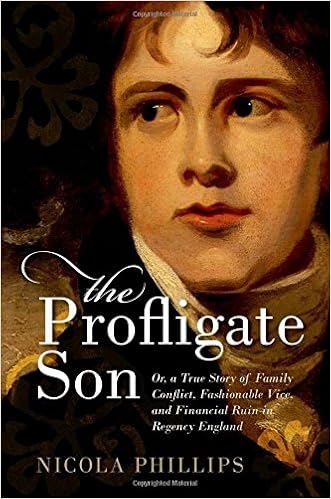
Profligate Son


The Profligate Son of, a True Story of Family Conflict, Fashionable Vice, and Financial Ruin in Regency England- Nicola Phillips
Oxford University Press
Release Date: June 26, 2014

Rating (out of 5):
📚📚📚📚

Synopsis: In Regency England a profligate son was regarded as every parent's worst nightmare: he symbolized the dangerous temptations of a new consumer society and the failure of parents to instil moral, sexual, and financial self-control in their sons. This book tells the dramatic and moving story of one of those 'profligate sons': William Jackson, a charming teenage boy, whose embattled relationship with his father and frustrated attempts to keep up with his wealthy friends, resulted in personal and family tragedy.

________________________________

During the late eighteenth- early nineteenth century English society began to change from what we today call Georgian society to Regency society.  It was a time of change in many ways: economic, social, sexual, and cultural- and this change often came in the form of a cultural gap between parents and children.  Fortunately, many people kept excellent diaries, journals, as well as all their letters, allowing us today to dig into the emotional turmoil these changing times could produce.  The Profligate Son is a perfect example, allowing readers to follow one father and son during this fascinating time period.

William Jackson came of age in the early 1800s.  His father was an East India Company man who returned to England wealthy and determined to start a respectable and respected family and raise his son a 'gentleman'.  However, Mr Jackson's idea of a 'gentleman' and William's were quite different- both products of their time.  Where Mr. Jackson expected his son to be obedient, quiet, intelligent, and help establish the credit of the family name through prudent financial management, William was determined to be everything a young Regency buck could be.  He gambled, drank, visited prostitutes, and bought endless amounts of clothes, horses, and accessories.  William's view of a gentleman was very much the entitled view held by the aristocracy he tried to emulate. He never quite seemed to understand the idea of debt- young aristocrats lived on their expectations and he went through life assuming (despite being told otherwise) his father would pay for everything while he was under age, then conveniently die so William could inherit a fortune and pay all his creditors.

William quickly learned to play the system, using his appearance as a gentleman and his father's name to get what he wanted.  During what author Phillips calls "the first age of mass consumer credit" society and the legal system were still working out the problem of different ideas towards debt and credit.  As tradesmen banged on the door William went from simple debt to forgery in order to try and continue the lifestyle he wanted to maintain.  Horrified by William's attitude and lack of care for the family name, Mr. Jackson did all he could to set his son straight.  This eventually meant letting William have a taste of debtor's prison and standing trial for forgery.  

The Profligate Son is a fascinating book, well researched and well written, using one family's well documented story as a microcosm to explore the nature of social and economic change during the time period.  Phillips does an excellent job of explaining to a modern audience the 1800 British justice system and the rather fuzzy and changeable lines between crimes and classes.  She immerses the reader into a world of riches and vice, debtors prison and prison ships, as well as the criminal justice systems of England and Australia.  While William is a thoroughly unlikeable and unsympathetic young man (even when you don't agree with how Mr. Jackson handles things, you completely sympathize with his problems) I couldn't wait to find out what happened to him next.  

Even though I knew going in what the end would be (the dust jacket tells you right from the start William's Australia bound) the book was as full of surprises and drama as if it was fiction instead of well documented fact.  An excellent book for those interested in learning more about Regency England.