Showing posts with label Greek mythology. Show all posts

Monday, January 1, 2024

Divine Might


Divine Might: Goddesses in Greek Myth- Natalie Haynes

Harper Collins

Release Date: January 2, 2024

Rating: ðŸ“šðŸ“šðŸ“šðŸ“šðŸ“š

Synopsis: New York Times bestselling author Natalie Haynes returns to the world of ancient Greek myth in this scintillating follow-up to Pandora’s Jar.

Few writers today have reshaped our view of the ancient Greek myths more than revered bestselling author Natalie Haynes. Divine Might is a female-centered look at Olympus and the Furies, focusing on the goddesses whose prowess, passions, jealousies, and desires rival those of their male kin: Athene, who sprang fully formed from her father’s brow (giving Zeus a killer headache in the process), the goddess of war and provider of wise counsel. Aphrodite, born of the foam (and sperm released from a Titan’s castrated testicles), the most beautiful of all the Olympian goddesses, the epitome of love who dispenses desire and inspires longing—yet harbors a fearsome vengeful side, doling out brutal punishments to those who displease her. Hera, Zeus’s long-suffering wife, whose jealousy born of his repeated dalliances with mortals, nymphs, and other goddesses, leads her to wreak elaborate and often painful revenge on those she believes have wronged her. (Well, wouldn’t you?) Demeter, goddess of the harvest and mother of Persephone; Artemis, the hunter and goddess of wild spaces; the Muses, the nine daughters of Zeus and Mnemosyne, the goddess of memory; and Hestia, goddess of domesticity and sacrificial fire. Infused with Haynes’s engaging charm and irrepressible wit, Divine Might is a refreshing take on the legends and stories we thought we knew.
___________________________________________________

If you've read Natalie Haynes' Pandora's Jar (and you really should!), you have an idea of how Divine Might is set up: Haynes looks at the myths of several Greek goddesses and analyzes them both through the lens of ancient Greece (what were the men really saying in the story versus what we think of today as the story) and then putting a more female-centered view on things. After all, Greece back in the day was a man's world. So how did a goddess use her power and how did women celebrate this?

Haynes applies her impressive knowledge of ancient history and ancient Greek along with her delightful (modern) sense of humor to answer these questions and bring the goddesses into a frame we can understand and be inspired by. From the Homeric Hymns to the Iliad and Odyssey to the poems and plays we know and those we only have fragments of, Haynes does an amazing job of finding the goddesses who aren't always obviously celebrated alongside those who are.  The Furies and the Muses get equal time with Athene and Aphrodite, and Haynes' look at Hera was definitely thought-provoking and changed how I looked at many of her aspects.

 I think two of my favorite chapters (if I had to choose, because they were all great!) were the ones on Demeter and Hestia. Haynes really goes deep into Demeter and her different aspects and does a great job reminding us how, for all we normally think of her as a kindly, mothering figure, she has her power and rage just like the other goddesses. It isn't good to underestimate Demeter, or any woman/mother! Hestia's chapter may be my favorite of all though. Partly because, as Haynes admits up front, there isn't much in the archaeology for Hestia- no grand temples like for Athene- and no long poems like for Demeter. For Hestia, it is in some of the small details we discover her, as well as in the laws Rome developed for Hestia's Roman version, Vesta, and her sacred priestesses the Vestal Virgins. She became one of the most fascinating goddesses to me through Haynes' searching and discoveries. 

Divine Might is a book for anyone interested in Greek mythology and ancient Greek history, anyone who is enjoying the recent retellings of myths and wants to look into some of the goddesses as women would see them, and anyone who enjoyed Pandora's Jar.  I know I'll be rereading both books plenty of times for their thought-provoking conversation and for their humor. Something for everyone!

I received an ARC of this book from NetGalley in exchange for an honest review


Tuesday, August 8, 2023

Medusa's Sisters

Medusa's Sisters- Lauren J.A. Bear

PenguinRandomHouse/Ace

Release Date: August 8, 2023

Rating: ðŸ“šðŸ“šðŸ“šðŸ“š

Synopsis: Even before they were transformed into Gorgons, Medusa and her sisters, Stheno and Euryale, were unique among immortals. Curious about mortals and their lives, Medusa and her sisters entered the human world in search of a place to belong, yet quickly found themselves at the perilous center of a dangerous Olympian rivalry and learned—too late—that a god's love is a violent one.

Forgotten by history and diminished by poets, the other two Gorgons have never been more than horrifying hags, damned and doomed. But they were sisters first, and their journey from sea-born origins to the outskirts of the Parthenon is a journey that rests, hidden, underneath their scales.

Monsters, but not monstrous, Stheno and Euryale will step into the light for the first time to tell the story of how all three sisters lived and were changed by each other, as they struggle against the inherent conflict between sisterhood and individuality, myth and truth, vengeance and peace.
_______________________________________________________________

This was a powerful retelling of the story of Medusa and her sisters, and is kind of what I'd looked for in Natalie Haynes' Stone Blind but didn't get. The story alternates between Stheno's first-person narrative and a limited third-person narrative for Euryale, which took some getting used to. At first I found it jarring, but I got used to it the longer I read. As I didn't really like Euryale, I was happy not to be in her head for her chapters.

The first third of the book or so was a little slow for me. They are born and growing up and not much is happening except to show us immortality, the relationship between the sisters, their mother, and a few of their other relations. As the sisters (who can pass as human at this stage) decide to travel and learn about humans things pick up. Other stories are woven in and we learn the sisters' personalities as they learn about humans. Stheno is the protector, Euryale the self-absorbed flirt, Medusa the ever-curious and innocent. 

This story probably has the best reason (if you can call it that) for why Athena cursed the sisters after Poisidon raped Medusa of any version I've read. Certainly the most personal, selfish, and heartbreakingly awful one. The author doesn't shy away from reminding us that Greek culture, like the myths, didn't place much importance on women and rape was a regular thing that men were not usually held accountable for. Or that women were generally blamed for. There is certainly victim blaming for Medusa. So consider most of the book a trigger warning, if you hadn't already assumed that by the idea that this was about Medusa and her sisters. The author doesn't gloss over much.

Without giving away spoilers, I can't get too specific on much. I was surprised to learn this was a debut novel- the writing was mostly better than I expect from debut novelists (although there was a lot more "if I had but known" writing than I needed). At the same time, I'm not sure the author had quite figured out how to end the book and it seemed to get a little awkward again towards the end.

The women take their stories back here in ways you expect and also in stories and ways you don't expect. Medusa's death and what comes after are powerfully and emotionally written and actually brought me to tears in a few places. This is definitely one of the most powerful retellings I've read.

I received an ARC of this book from NetGalley in exchange for an honest review


Friday, April 28, 2023

Clytemnestra

 Clytemnestra- Constanza Casati

Sourcebooks Landmark

Release Date: May 2, 2023

Rating: ðŸ“šðŸ“šðŸ“šðŸ“š

Synopsis: As for queens, they are either hated or forgotten. She already knows which option suits her best…

You were born to a king, but you marry a tyrant. You stand by helplessly as he sacrifices your child to placate the gods. You watch him wage war on a foreign shore, and you comfort yourself with violent thoughts of your own. Because this was not the first offence against you. This was not the life you ever deserved. And this will not be your undoing. Slowly, you plot.

But when your husband returns in triumph, you become a woman with a choice.

Acceptance or vengeance, infamy follows both. So, you bide your time and force the gods' hands in the game of retribution. For you understood something long ago that the others never did.

If power isn't given to you, you have to take it for yourself.

_______________________________________________________________________

In a world where women are considered more property than people, when the myths we know are never about women (and if they are, they aren't good stories), ancient Greece in no place to be a strong and independent woman. Current retellings of ancient myths are giving us new voices for women who have lived too long in the shadows, either voiceless or villains, and Clytemnestra is certainly one of them. Constanza Casati's debut novel wipes away any other attempt to tell Clytemnestra's story and should, in my opinion, become THE go-to retelling of the Queen of Mycenae's story.

A princess of Sparta, Clytemnestra grew up strong, learning to fight, hunt, and wrestle just like all the other children. The only rule? Don't get caught. She protects her younger sisters, physically and emotionally, but is always closest to Helen. Her husband Tantalus is a king, and unlike the men she knows-he listens to her, respects her strength, and doesn't try to overshadow her. But when Agamemnon and Menelaus come to Sparta, things change and Clytemnestra's world changes too. Seeing a strong woman as a challenge, Agamemnon decides to have her for himself and kills Tantalus and their baby, forcing her to marry him. As queen of Mycenae, wife of a man she hates, and mother to his children, she tries to live a new life- but when Helen runs away to Troy and gives Agamemnon the excuse he wants to start a war with Troy, disaster strikes again. 

If you know any of the stories of Clytemnestra, or the Trojan War, you won't be surprised by the basic plot. What I found wonderful was how well the author drew the reader into Clytemnestra's emotional life, easily making you feel her rage, pain, and grief and how it shaped her over her life. It balanced with her warrior nature and aggravation with the Greeks who felt they were better than her just because she was a woman. Over and over she has to prove herself, and does, and reminds them that her actions are the same as a man's- and a king's- so should be treated as such. 

There is a short, sweet, set of letters between the siblings late in the book where they are trying to console Clytemnestra and you really get each sibling's thoughts and feelings (as opposed to Clytemnestra's) for the first time. This might be my favorite part of the book. It is completely different from the rest of the book, and feels a bit like we're looking behind the scenes at something personal and private that Clytemnestra would keep to herself. It is also a nice reminder that not all men in this world are horrible, since one of the letters is from her brother Polydeuces.

Clytemnestra is an absolute must read for anyone who enjoys retellings or even just stories about strong women. This is a book that doesn't read as if it was a debut novel- the writing is more confident and polished than you often read in a first book. I would love to see Casati write her next book for Medea, since we might be able to trust her to tell Medea's story with the same emotional honesty she showed Clytemnestra. Here's hoping!


I received an ARC of this book from NetGalley in exchange for an honest review 

Saturday, January 7, 2023

Phaedra


Phaedra-Laura Shepperson

Alcove Press/Penguin Random House

Release Date: January 10, 2023

Rating: ðŸ“šðŸ“šðŸ“š

Trigger Warning: Rape, violence, suicide

Synopsis: Phaedra has been cast to the side all her life: daughter of an adulteress, sister of a monster, and now unwilling bride to the much-older, power-hungry Theseus. Young, naïve, and idealistic, she has accepted her lot in life, resigned to existing under the sinister weight of Theseus’s control and the constant watchful eye of her handsome stepson Hippolytus. 

When supposedly pious Hippolytus assaults her, Phaedra’s world is darkened in the face of untouchable, prideful power. In the face of injustice, Phaedra refuses to remain quiet any longer: such an awful truth demands to be brought to light. When Phaedra publicly accuses Hippolytus of rape, she sparks an overdue reckoning.
 
The men of Athens gather to determine the truth. Meanwhile, the women of the city, who have no vote, are gathering in the shadows. The women know truth is a slippery thing in the hands of men. There are two sides to every story, and theirs has gone unheard. Until now.
_____________________________________________________________

As a fan of Natalie Haynes, I enjoy giving mythological retellings a chance- seeing Greek, Norse, etc. stories from more feminist perspectives and bringing to life the women who were left in the silent shadows of the original stories has lots of potential. Phaedra is a story that had lots of potential, but never quite lived up to it for me. A lot of it was the writing style. Despite having multiple POVs- many, many characters tell this story- all of them sound exactly the same. There is virtually no way of differentiating any of the voices if you just closed your eyes and opened to a page. There is almost no character development among the characters, including the main women, Phaedra and Medea, although I had high hopes for Medea and personally thought some of her scenes were among the best in the book. Phaedra starts out as a young and naive princess who ends up married to Theseus and is in Athens really as a hostage instead of a wife. She is sure she is supposed to witness the gods' justice against the terrible wrongs Theseus has done on Crete. There is hatred in her early on, but that gets banked and we don't get to see it again until pretty much the end. The rest of the time she's . . . not much. You'd think she couldn't be as naive as she acts sometimes, that she'd figure out her status doesn't save her from the terrible things that happen in the Athenian palace. But she never seems to change, or to grow up from the girl we first meet.

When she accuses Hippolytus of rape and the statesman Trypho convinces her to bring it to trial, the modern reader sees plenty of the MeToo movement trying to rise up in ancient Athens. The problem being, of course, women have no voice in ancient Athens and the men who will do the voting are the men who are behaving just the same to the servants in the palace. Maybe Phaedra's status will mean something to them, maybe not. One of the most realistic and heartbreaking scenes in the book is between Phaedra and Theseus when he comes to ask her to stop the trial before his son can be judged. After all, why should his life be ruined because she suffered for a few minutes? It made me want to cry and be sick at the same time, because you know this was genuinely how this man understood the situation, and how generations since have and still do think.

By the end of the book we see the limited choices women in this world have: the vast majority, the 'night chorus', choose to silently accept the violence done to them and find small ways of avoiding the worst of it-working in pairs, putting sleeping draughts in men's wine, moving in shadows to avoid being seen. Medea has made choices others condemn her for, but she believes were right. What will Phaedra choose?


I received an ARC of this book from NetGalley in exchange for an honest review


Saturday, August 13, 2022

Ithaca


Ithaca- Claire North

Redhook/Hachette

Release Date: September 6, 2022

Rating: ðŸ“šðŸ“šðŸ“šðŸ“šðŸ“š

Synopsis: Seventeen years ago, King Odysseus sailed to war with Troy, taking with him every man of fighting age from the island of Ithaca. None of them has returned, and the women of Ithaca have been left behind to run the kingdom.

Penelope was barely into womanhood when she wed Odysseus. While he lived, her position was secure. But now, years on, speculation is mounting that her husband is dead, and suitors are beginning to knock at her door. 
 
No one man is strong enough to claim Odysseus' empty throne—not yet. But everyone waits for the balance of power to tip, and Penelope knows that any choice she makes could plunge Ithaca into bloody civil war. Only through cunning, wit, and her trusted circle of maids, can she maintain the tenuous peace needed for the kingdom to survive. 
_________________________________________________________________

Seventeen years ago, King Odysseus sailed off to war with Troy, as did every man of fighting age on Ithaca. Over the ten years that war raged on the plains of Troy, Ithaca sent money and men who reached fighting age off to Troy, and received songs from the poets about their brave fighters in return. The old men who were left nodded and told the boys who remained that this was what being a man was all about. Seven years have passed since the war ended and none of Ithaca's men have returned- including their king. Outsiders and Ithaca's youth alike are starting to circle, trying to decide how to take the throne from a man who must be dead, but hasn't quite been declared dead- especially by his loyal wife and queen, Penelope.

For seventeen years Ithaca has managed to survive: food has made it to tables, trade has continued in the harbors, farms have continued to produce crops. Suitors are fed and the balancing act of hospitality and greed is kept in check. None of the old men question how this is done- until pirates come to Ithaca. Suddenly they have to do something, and they discover while they think they have been running things, they really have no idea what to do.

Ithaca is the book the Greek poets (and plenty of more modern fiction writers) wouldn't think to ask: what happens when the men leave home to go off fighting? The answer is obvious: the women run everything. But in Greece they are hampered by the cultural problem that they cannot be seen to run anything. In ancient Greece women have a strict place and that is behind the scenes, in the women's quarters, in the women's world. How to handle this catch-22 situation? Ithaca is narrated by Hera, the goddess of wives and marriage, a goddess who knows a few things about toxic masculinity and double standards. She doesn't pull any punches in her assessments of the characters she introduces us to and is willing to call a twerp a twerp if that's what she thinks he is- poetic hero or no. Hera doesn't have much use for heroes or poets. But women and queens, those are different matters. In daylight where Penelope plays the perfect Greek wife mourning her husband, in night's shadows where Penelope hunts for clues about the identity of the pirates and builds an army of women to defend Ithaca, Hera shows us all of Ithaca's secrets. 

In case we, as more modern readers, don't understand the situation Penelope would be in if she just stood up and told the men "You lot are idiots, I'm in charge now", there is a secondary story to bring the message home to us. Penelope's cousin Clytemnestra has been ruling Mycenae openly in her husband's absence. Now Agamemnon is back and while there were a few domestic squabbles about lovers on the side, Hera makes sure we understand that really, it was Clytemnestra's decision to rule openly that has led to her downfall. (And a bit of murder.) By the time Penelope's deception with her weaving is discovered we aren't surprised by the violence that nearly comes from it because we understand now- it isn't necessarily about the act itself but about the woman trying to take some control over her own life (or being perceived to take an active role in the lives of men) that is the real problem, and brings about death. Men must always be in control of the narrative. It is why women, even goddesses, must work in shadow and avoid being seen.  But they get the job done.

If you think that Hera is an odd choice of a narrator in the beginning, it won't take long for you to understand that she is the perfect choice to tell this story of women who are ignored or forgotten, belittled, by the men who rule. Remember, none of the stories you think you know about Hera have been told by women either.

An excellent addition to the popular mythology-alternate genre, fans of Madeline Miller, Jennifer Saint, and Natalie Haynes will definitely enjoy this new take on Penelope's story.  


received an ARC from NetGalley in exchange for an honest review


Friday, April 15, 2022

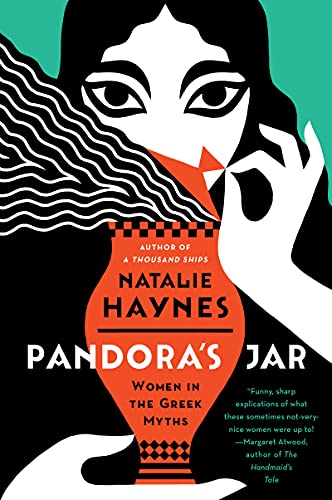
Pandora's Jar


Pandora's Jar: Women in the Greek Myths- Natalie Haynes

Harper Collins

Release Date: March 29, 2022

Rating: ðŸ“šðŸ“šðŸ“šðŸ“š

Synopsis: The tellers of Greek myths—historically men—have routinely sidelined the female characters. When they do take a larger role, women are often portrayed as monstrous, vengeful or just plain evil—like Pandora, the woman of eternal scorn and damnation whose curiosity is tasked with causing all the world’s suffering and wickedness when she opened that forbidden box. But, as Natalie Haynes reveals, in ancient Greek myths there was no box. It was a jar . . . which is far more likely to tip over. 

In Pandora’s Jar, the broadcaster, writer, stand-up comedian, and passionate classicist turns the tables, putting the women of the Greek myths on an equal footing with the men. With wit, humor, and savvy, Haynes revolutionizes our understanding of epic poems, stories, and plays, resurrecting them from a woman’s perspective and tracing the origins of their mythic female characters. She looks at women such as Jocasta, Oedipus’ mother-turned-lover-and-wife (turned Freudian sticking point), at once the cleverest person in the story and yet often unnoticed. She considers Helen of Troy, whose marriage to Paris “caused” the Trojan war—a somewhat uneven response to her decision to leave her husband for another man. She demonstrates how the vilified Medea was like an ancient Beyonce—getting her revenge on the man who hurt and betrayed her, if by extreme measures. And she turns her eye to Medusa, the original monstered woman, whose stare turned men to stone, but who wasn’t always a monster, and had her hair turned to snakes as punishment for being raped.

Pandora’s Jar brings nuance and care to the millennia-old myths and legends and asks the question: Why are we so quick to villainize these women in the first place—and so eager to accept the stories we’ve been told?

_______________________________________________________________


In Pandora's Jar, author Natalie Haynes (A Thousand Ships) explores the different versions of some of the most well known of Greek women in mythology, and how those women have been changed throughout the generations, rarely for the better. Going back to the original Greek, to Homer, Ovid, and scaps of stories before them, Haynes looks at Medusa, Pandora, Helen, Jocasta, Penelope, Clytemnestra, Eurydice, Phaedra, Medea, and the Amazons. Who are these women, both in relation to their original stories, the stories we know best, plays or more modern movies, or perhaps even modern reincarnations or retellings? 


Some of my favorite chapters had to be the ones focused on Medusa, Medea, and the Amazons, although Penelope and Clytemnestra came close behind. With a sharp wit and occasional sarcasm to help keep her reader engaged, Haynes shreds whatever claims to the title hero men like Jason and Theseus have (and you really have to agree with her, especially about Theseus) to bring the story back around to the women. Medusa was hanging out in a cave not bothering anyone, having already suffered being sexually assaulted by Posiedon and cursed by Athene, she's sleeping and along comes this jerk with no personal grudge against her to chops off her head and weaponizes it. Every visual interpretation of this Haynes can find tends to make this moment both violent and sexual. What's that about, really?


Clytemnestra and Medea win Greece's awards for "worst wife" and "worst mother" because, Haynes points out, Greek men were terrified of powerful women. It kind of makes you want to travel back to when the plays were first performed and watch the male audience shake in their sandals- especially over Euripides' Medea. Or would they have been more afraid of Clytemnestra?  A woman with no magical power, no assistance from the gods, just ten years of rage over her husband sacrificing their daughter so he could go off to war and no one saying anything against it. He kills the kid, spends ten years at war making a name for himself and enjoying raping other women, then comes home (with his war "bride" in tow) and expects his wife to be happy about it? I'd have voted justifiable homicide if I was on that jury. 


There's something for everyone in these chapters- from original interpretations of Greek and how they can change meanings that stick with us down through the ages to the dangers of "sanitizing" myths to tell them to children. From descriptions of visual representations of myths in ancient pottery to what Medea's dragon chariot at the end of her play actually meant to the Greeks (which I thought was pretty great even if the male audience might not have); and modern operas of the story of Orpheus and Eurydice to modern Amazons together-we-are-powerful symbolism in Buffy the Vampire Slayer, the exploration into some of Greek mythology's well known (and a few lesser known) women should resonate with women across all levels. 


As Natalie Haynes says, we keep retelling these stories because we find new questions they raise and new voices wanting to be heard, and each generation will undoubtedly continue to do so. But discovering some of the origins makes those stories even more interesting to me.


Monday, January 24, 2022

A Thousand Ships


A Thousand Ships- Natalie Haynes

HarperCollins

Release Date: January 26, 2021

Rating: ðŸ“šðŸ“šðŸ“šðŸ“šðŸ“š

Synopsis: This is the women’s war, just as much as it is the men’s. They have waited long enough for their turn . . .

This was never the story of one woman, or two. It was the story of them all . . .

In the middle of the night, a woman wakes to find her beloved city engulfed in flames. Ten seemingly endless years of conflict between the Greeks and the Trojans are over. Troy has fallen.

From the Trojan women whose fates now lie in the hands of the Greeks, to the Amazon princess who fought Achilles on their behalf, to Penelope awaiting the return of Odysseus, to the three goddesses whose feud started it all, these are the stories of the women whose lives, loves, and rivalries were forever altered by this long and tragic war. 

A woman’s epic, powerfully imbued with new life, A Thousand Ships puts the women, girls and goddesses at the center of the Western world’s great tale ever told.

_____________________________________________________________________________


For those who have been enjoying the resurgence of retold classics and myths from the women's point of view (The Witch's Heart) especially Madeline Miller's Circe, Natalie Haynes' A Thousand Ships should be an absolute must read. Here is a retelling of the end of the Trojan War where the goddess of epic poetry Calliope has decided she is tired of the bards always telling and retelling the bravery of men.  After all, this war affected women as much as men. 


 And so A Thousand Ships is the story of the women: the ones waiting at home for their men to return, the ones waiting on the beaches of Troy to see whose slaves they will be, as well as flickering back in time to hear the stories of women like Briseis- whose removal from Achilles' tent to Agammemnon's caused Achilles to refuse to fight for most of Homer's Iliad. Penelope's story is told as letters to her husband Odysseus throughout the book and we get her absolutely brilliant personality and wit in her thoughts of the bard's tales of Odysseus' adventures. She is by far my favorite person in the entire book.


I loved how Calliope forces her (unnamed) blind bard to see the tragedy of the war instead of the epic manly greatness he thought he wanted to write about. Calliope points out that the casualties of war don't end on the battlefield and that the deaths or tragedies of the women might hurt more exactly because they rarely get to fight back. Her argument that the women are people and should be memorialized just as much as the men is enhanced by including stories of little known women. Creusa, wife of Aeneas and Laodamia, devoted wife of Greek king Protesilaus have their stories told just the same as the Amazon Penthesilea or Hector's wife Andromache. It's an interesting debate that I think would be divided by gender lines (although maybe here I'm being unfair?): are women who don't literally fight in a war heroes as well? Few of the men we meet in this book are honorable, decent or what I would consider 'heroic' while the women suffer by tending the injured, dealing with famine and plague, fear and captivity, etc. Even Odysseus, who I generally consider the most decent among the Greeks, comes in for his share of questioning by Penelope here.


There is one last question that Haynes asks that has never been asked before (as far as I know): where did the golden apple that started all of this come from? Until I read A Thousand Ships it wasn't a question I had asked, but here a larger and wider story unfolds behind the beauty contest and Paris' judgement that might change the way you look at the entire war and make it truly epic in an entirely different way. 


No owls were harmed (or traded) in the course of this book