Showing posts with label Queen Victoria. Show all posts

Monday, November 28, 2016

Victoria


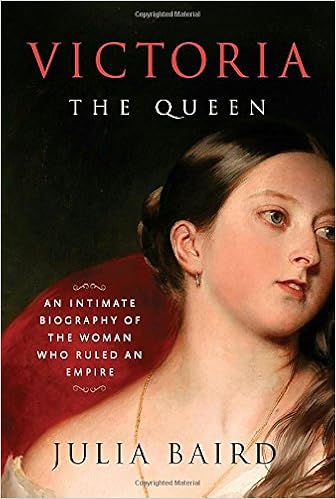
Victoria The Queen: An Intimate Biography of the Woman who Ruled an Empire- Julia Baird
Random House
Release Date: November 22, 2016

Rating (out of 5):
📚📚📚📚

Synopsis: When Victoria was born, in 1819, the world was a very different place. Revolution would threaten many of Europe’s monarchies in the coming decades. In Britain, a generation of royals had indulged their whims at the public’s expense, and republican sentiment was growing. The Industrial Revolution was transforming the landscape, and the British Empire was commanding ever larger tracts of the globe. In a world where women were often powerless, during a century roiling with change, Victoria went on to rule the most powerful country on earth with a decisive hand.
 
Fifth in line to the throne at the time of her birth, Victoria was an ordinary woman thrust into an extraordinary role. As a girl, she defied her mother’s meddling and an adviser’s bullying, forging an iron will of her own. As a teenage queen, she eagerly grasped the crown and relished the freedom it brought her. At twenty, she fell passionately in love with Prince Albert of Saxe-Coburg and Gotha, eventually giving birth to nine children. She loved sex and delighted in power. She was outspoken with her ministers, overstepping conventional boundaries and asserting her opinions. After the death of her adored Albert, she began a controversial, intimate relationship with her servant John Brown. She survived eight assassination attempts over the course of her lifetime. And as science, technology, and democracy were dramatically reshaping the world, Victoria was a symbol of steadfastness and security—queen of a quarter of the world’s population at the height of the British Empire’s reach.
 
Drawing on sources that include fresh revelations about Victoria’s relationship with John Brown, Julia Baird brings vividly to life the fascinating story of a woman who struggled with so many of the things we do today: balancing work and family, raising children, navigating marital strife, losing parents, combating anxiety and self-doubt, finding an identity, searching for meaning.

__________________________

The newest biography on Queen Victoria, Julia Baird's Victoria is a well researched and well written exploration of one of the most famous women who has ever lived- and who is probably known more by the mythology surrounding her and her reign than the reality.

Through Baird's research, including newly available papers on John Brown (Victoria's servant and close confidante after Albert's death) and from Dr. Reid (Victoria's physician in her final years), we see Victoria in new ways.  Baird shows us a complicated and complex woman. A woman both incredibly strong and incredibly in need of emotional connections.  A woman who ruled an empire but believed that women could not rule.  Victoria disagreed with the developing women's suffrage movements, but after her death was held up by suffragists as an example of women's strength.

 Perhaps one of the biggest take aways from Victoria is not actually about Victoria but about what we know about history itself.  Throughout Victoria Baird mentions known occasions of editing or destroying information- whether on Victoria, Albert, John Brown, or others- in an attempt to create an image rather than preserve impartial history.  Her daughter Beatrice is known to have not only heavily edited Victoria's personal diaries, but to have burned the originals after doing so in what Baird (rightly, I think) calls "one of the greatest acts of historical censorship of the century".  Beatrice wrote to her great-nephew King George VI saying that letters between her parents were so intimate (apparently relating to personal arguments), and Victoria's ransom jottings about daily life, could have no value "historical or biographical value whatever".  Beatrice focused on protecting her parents' memory as she wanted them to be seen, and was in the unique position of being able to permanently remove much that conflicted with what she wanted that memory to be.  Baird does an excellent job of reminding those who have never really thought about it that the agendas and prejudices of the historian can greatly alter a biography- whether on purpose on not.  Meanwhile, every history lover reading Victoria will mourn for the letters and diaries that we we never read and what light they might have shed on both people and the world at that time in general.  

Readers who felt Victoria had no "modern" appeal or connection will hopefully be surprised to find how relevant Baird has made Victoria through today's eyes.  Although sometimes slightly repetitive and suffering from the problem I have with many biographies of dramatically forecasting the future (ending of chapters with "if only they knew then what was to happen" approach that seems common, but I find very annoying every time), Victoria is a well researched and captivating book that shines new light on one of the longest reigning and influential English monarchs ever.

I received an ARC of this book from NetGalley in exchange for an honest review.   


Monday, November 7, 2016

Victoria


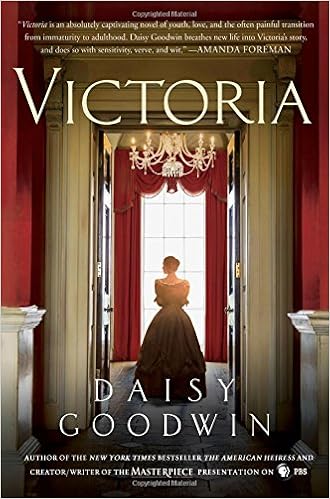
Victoria- Daisy Goodwin
St. Martin's Press
Release Date: November 22, 2016

Rating (out of 5):
📚📚📚📚📚

Synopsis: Drawing on Queen Victoria’s diaries, which she first started reading when she was a student at Cambridge University, Daisy Goodwin―creator and writer of the new PBS/Masterpiece drama Victoria and author of the bestselling novels The American Heiress and The Fortune Hunter―brings the young nineteenth-century monarch, who would go on to reign for 63 years, richly to life in this magnificent novel.

Early one morning, less than a month after her eighteenth birthday, Alexandrina Victoria is roused from bed with the news that her uncle William IV has died and she is now Queen of England. The men who run the country have doubts about whether this sheltered young woman, who stands less than five feet tall, can rule the greatest nation in the world. 
Despite her age, however, the young queen is no puppet. She has very definite ideas about the kind of queen she wants to be, and the first thing is to choose her name.
“I do not like the name Alexandrina,” she proclaims. “From now on I wish to be known only by my second name, Victoria.”
Next, people say she must choose a husband. Everyone keeps telling her she’s destined to marry her first cousin, Prince Albert, but Victoria found him dull and priggish when they met three years ago. She is quite happy being queen with the help of her prime minister, Lord Melbourne, who may be old enough to be her father but is the first person to take her seriously.
_____________________

Victoria is a novel that draws you in from the very beginning and, on reaching the end, leaves you wanting more.  Most of the major characters, especially Victoria and Melbourne, are written as complicated and multi-faceted people, Victoria in particular. She lived all her young life with her smothering mother, the Duchess of Kent, and her mother's controlling "personal secretary" Sir John Conroy.  Kept from interacting with people her own age, and indeed people in general, kept from learning the details of government and protocol that she should have learned in detail, Victoria becomes both an adult and a monarch at the same time.  Probably because of this, she often seems to act out against those trying to guide her as queen, with sometimes very unhappy consequences.  It makes her often seem a spoiled and slightly unlikeable girl, but also highlights her very human struggles.

Challenged at every turn by the men who should be supporting her, she is suspicious of every attempt at guidance except that of Lord Melbourne.  Melbourne, the former husband to the infamous Caro Lamb, seems many similarities between his late wife and his new queen.  How much of Victoria's appeal to Melbourne is him trying to recapture his youth and bright view of the world?  I get the impression that, for this novel at least, even Melbourne didn't quite know the answer.  

The emotional bonds between Victoria and Melbourne show very much a young girl's first infatuation.  But Melbourne is also the only person Victoria believes sees her as an equal and not as a pawn to be controlled.  When Prince Albert comes onto the scene I was disappointed to not be able to see something similar.  Albert seems to disapprove of much of what Victoria enjoys most- from music and dancing to her dog Dash.  They are thrown together with the expectation of marrying by their family, but why does Victoria choose Albert in the end?  There seems to be some chemistry between them, but the respect and friendship she has with Melbourne never appear with Albert.  I don't know how much of this was based on fact and how much was dramatic license.  Did Victoria marry Albert because it was expected, because she couldn't have Melbourne, and grow to love him? Was it Goodwin's choice in order to keep the relationship between Victoria and Melbourne the center of the reader's focus, since it is certainly the center of the book?  I had hoped for a brief Author's note or Historical Note at the end that might have answered this question, or said anything about where Goodwin stayed strictly to the facts vs when she fictionalized aspects, but the advanced copy I read did not have one. I don't know if the final printing will, but if so it would be very interesting.  The book definitely made me want to read more on Victoria and some of the other players in her early reign.

Daisy Goodwin's Victoria is an enthralling, well-researched and well-written novel based on Queen Victoria's own diaries and brings new and dramatic life to a fascinating historical period.  It is a coming of age story as Victoria grows from the sheltered girl of Kensington Palace to Buckingham Palace's Queen of England.  Readers- whether already familiar with Victoria or not- will enjoy this fast-paced look at the life and times of one of the most famous women in history.  

I received an ARC of this book from NetGalley in exchange for an honest review.