Showing posts with label natural science. Show all posts

Tuesday, August 6, 2024

Dinosaurs at the Dinner Party


Dinosaurs at the Dinner Party: How an Eccentric Group of Victorians Discovered Prehistoric Creatures & Accidentally Upended the World- Edward Dolnick

Scribner

Rating: ðŸ“šðŸ“š

Synopsis: In the early 1800s the world was a safe and cozy place. But then a twelve-year-old farm boy in Massachusetts stumbled upon a row of fossilized three-toed footprints the size of dinner plates—the first dinosaur tracks ever found. Soon, in England, Victorians unearthed enormous bones—bones that reached as high as a man’s head. 

Outside of myths and fairy tales, no one had imagined that creatures like three-toed giants once lumbered across the land. And if anyone conjured up such a scene, they would never imagine that all those animals could have vanished hundreds of millions years ago. The thought of sudden, arbitrary disappearance from life was unnerving and forced the Victorians to rethink everything they knew about the world. Celebrated storyteller and historian Edward Dolnick leads readers through a compelling true adventure as the paleontologists of the first half of the 19th century puzzled their way through the fossil record to create the story of dinosaurs we know today.
____________________________________________________________

If you're looking for a carefully explained, well-thoughtout, and logical, chronological explanation of how the Victorians accidentally created paleontology, discovered dinosaurs, and rethought everything they knew about the world- this is not that book.

If you're just interested enough in the idea of discovering dinosaurs where the world had never acknowledged them before, and wondering how Victorian science dealt with that, where any book is a good starter, then Dolnick is probably as good a start as any.

I am by no means an expert on dinosaurs. But I'm a huge reader of everything related to Victorian history and hadn't come across a book devoted to describing the fossil craze of the Victorian period and how it changed the scientific thought process. So the title hooked me. From Mary Anning to William Buckland to Richard Owen, this book introduces you to the English (and one or two French) who thrilled in hunting fossils or those happier in museums trying to understand fossils. It explains the original Victorian view that nature, science, and religion all fit happily together. Fossils and the startling idea of dinosaurs began to erode those views, despite how hard a few clung to them. Before Darwin threw his new explanation of evolution onto the scene, people were already prepared for the change in thinking he was suggesting.

My problem wasn't the more simplistic approach Dolnick took in his explanations or way of writing. Everyone has their own style and the reader can get used to it if the story is good. Or the number of times he would lament about how if only those early scientists had had access to the kinds of equipment etc. that modern scientists have. Which seemed like kind of the point to me. When you're discovering something, you work with what you have. It was the unbelieveable amount of repetition in the book. Read a chapter and then had to take a break for a few days? No problem, you could read the next one and not have missed anything. Different words, saying exactly the same thing. It was like he couldn't figure out what version of a chapter he liked better, so he just left them all in. Occasionally new things would come in, a new person would be introduced, etc. Then they would get the same repeat treatment, hammering away at the reader until I had to skim sections to be able to move forward at all. By the time we got to the famous dinner party in the Crystal Palace dinosaur statues I was pretty numb to all of it.  

Overall, a fantastic idea for a research idea and book, very poorly and repetitiously executed. Definitely made me not want to pick up another book by this author, but did make me interested enough to look through his biblioghraphy to see if anyone had done a better job of writing on the subject.


I received an ARC of this book in exchange for an honest review 

Monday, April 16, 2018

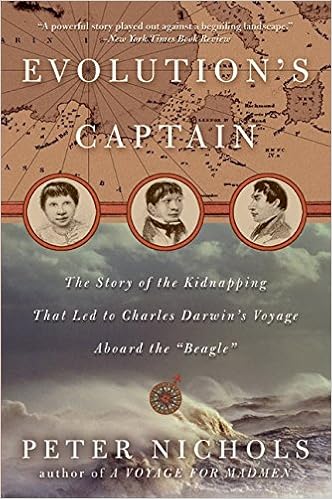
Evolution's Captain


Evolution's Captain: The Story of the Kidnapping That Led to Charles Darwin's Voyage Aboard the Beagle- Peter Nichols
HarperCollins
Release Date: June 29, 2004

Rating:
📚📚📚📚

Synopsis: One of the great ironies of history is that the famous journey—wherein Charles Darwin consolidated the earth-rattling ‘origin of the species’ discoveries—was conceived by another man: Robert FitzRoy. It was FitzRoy who chose Darwin for the journey—not because of Darwin’s scientific expertise, but because he seemed a suitable companion to help FitzRoy fight back the mental illness that had plagued his family for generations. Darwin did not give FitzRoy solace; indeed, the clash between the two men’s opposing views, together with the ramifications of Darwin’s revelations, provided FitzRoy with the final unendurable torment that forced him to end his own life.

________________________________________


Evolution's Captain is a fascinating book following Robert Fitzroy, captain of the HMS Beagle and brilliant surveyor.  The book chronicles Fitzroy's two trips on the Beagle and his adventures surveying South America and Tierra del Fuego for the British admiralty.  Along the way Fitzroy becomes fascinated by the native Fuegians and ends up kidnapping three of them and bringing them back to England. His intention is typical of a man of his time: to educate the Fuegians in British manners, 'civilize' them as proper Englishmen (and one woman), convert them to Christianity and then return them to Tierra del Fuego to spread English Christian Civilization through the islands.  

As much as a modern reader cringes at the concept and thoughts expressed in many of the journals and diaries left by Fitzroy, Darwin, and others of the time period, there is no escaping that for a large part of the 1800s this was how England viewed the world and tried to change it in its image.  The trick for any historian is to try and explain to modern readers the culture of the time period- religious, political, and social- that led to this attitude and life approach.  In this Nichols does an excellent job.  The cultural background he explains makes for fascinating reading and helps us gain something of the perspective that Fitzroy was using during his exploits.  While you don't agree with him, at least you come to understand where he was coming from.  

The great temptation for a book like this would be to have all of the first expedition and Fitzroy's life leading up to Darwin's arrival on the Beagle for the second voyage be merely setting the stage for Darwin and allowing him to take over the rest of the book.  I liked that Nichols resists that temptation and makes Darwin another way for us to follow and understand Fitzroy instead of becoming the centerpiece himself. Darwin is also a symbol (or a symptom) of Fitzroy's thinking later in life.  The Victorian era was one of the greatest and fastest changing eras in terms of social and scientific thought until the creation of the internet.  Babbage's analytic machine, the steam engine, developments in geology and biology brought huge changes with them.  Fitzroy, originally something of an amateur scientist himself, becomes one of the reactionaries who take up the religious mania of the times and attempts to use literal readings of the Bible to argue against growing ideas of evolution and scientific change. The great irony of his life becomes his friendship with Darwin and his decision to bring Darwin on the second expedition as a companion, only to be haunted in later life by Darwin's ideas and the feeling that he was personally to blame for their development.  While Nichols ably proves that this was not the case, it haunted Fitzroy for the rest of his life.

My only complaint is one I often have with histories or biographies- Nichols tends to allow foreshadowing to creep into his writing (especially at the end of chapters). The common "if only they knew", "this would change everything" type of remarks always annoy me, although Nichols does it less than some biographies I've read.

A fascinating book, and a must read for people interested in Victorian England and its cultural/scientific/religious developments , sea exploration and adventure , and South America.

Monday, October 23, 2017

American Wolf

American Wolf: A True Story of Survival and Obsession in the West by [Blakeslee, Nate]


American Wolf: A True Story of Survival and Obsession in the West- Nate Blakeslee
Crown/ Random House
Release Date: October 17, 2017

Rating:
📚📚

Synopsis: Before men ruled the earth, there were wolves. Once abundant in North America, these majestic creatures were hunted to near extinction in the lower 48 states by the 1920s. But in recent decades, conservationists have brought wolves back to the Rockies, igniting a battle over the very soul of the West.

With novelistic detail, Nate Blakeslee tells the gripping story of one of these wolves, O-Six, a charismatic alpha female named for the year of her birth. O-Six is a kind and merciful leader, a fiercely intelligent fighter, and a doting mother. She is beloved by wolf watchers, particularly renowned naturalist Rick McIntyre, and becomes something of a social media star, with followers around the world.

But as she raises her pups and protects her pack, O-Six is challenged on all fronts: by hunters, who compete with wolves for the elk they both prize; by cattle ranchers who are losing livestock and have the ear of politicians; and by other Yellowstone wolves who are vying for control of the park’s stunningly beautiful Lamar Valley.

These forces collide in American Wolf, a riveting multigenerational saga of hardship and triumph that tells a larger story about the ongoing cultural clash in the West—between those fighting for a vanishing way of life and those committed to restoring one of the country’s most iconic landscapes.

__________________________________________ 

In American Wolf author Nate Blakeslee chronicles the return of wolves to Yellowstone National Park, focusing their story in particular through the life and experiences of O-Six.  O-Six grew up to become one of the most famous wolves in Yellowstone: a strong alpha leader, a caring mother, a skilled hunter, an intelligent fighter.  She raised three generations of pups in the Lamar Valley where wolf-watchers could follow the comings and goings of her pack and learn more about wolves than they had ever hoped.  Unfortunately, O-Six and her family have not only natural dangers to face inside the park, but increasingly hunters, ranchers, and politicians outside the park.

Blakeslee's American Wolf is a carefully researched, well-written book that uses notes kept by local wolf-watchers to chronicle a multigenerational account of the return of wolves to Yellowstone, seen particularly through the incredible stories of the Druid Peak Pack and the Lamar Valley Pack. New packs form, yearlings become alphas, pups are born, clashes between rival packs establish new territories, and American Wolf is written in such a way that the reader feels they are experiencing the events along with the wolves. Or at least the wolf-watchers. As with any good documentary, American Wolf doesn't try to gloss over the harsh aspects of life as a wolf in Yellowstone- there are violent fights for prime territory, lean winters, and leadership disputes right along with the cute pups.

For me, the hard part of reading American Wolf was also in the writing.  The style and brilliant narrative that make you experience the wonder of watching wolves with naturalist Rick McIntyre also means that you feel the other side of the culture clash: the hatred of hunters and ranchers in Wyoming, Montana and Idaho.  Blakeslee has carefully researched both the personal and the political saga of wolf reintroduction and brings the reader courtroom drama fit for the movie screen as hunters, Fish and Wildlife, the state and federal government, and environmental groups fight in court.  As a wolf lover, I found these scenes terribly depressing. I will also admit there were a few parts where I cried when wolves I'd been following for chapters until I felt like I knew them met up with hunters.  The frustrating understanding of how environmental science and the beauty of nature are so often casualties to politics makes you feel especially helpless.

American Wolf is a rich environmental drama with a rare ability to balance a story between nature and politics, haunting emotional awe with down-to-earth practicality, love of wolves with a lack of romantic sentimentality.  A difficult, must-read book for anyone interested in environmental conservation and the amazing story of wolves and their return to Yellowstone.


I received an ARC of this book from NetGalley in exchange for an honest review