Showing posts with label American Civil War. Show all posts

Tuesday, April 30, 2024

The Demon of Unrest


The Demon of Unrest: A Saga of Hubris, Heartbreak, and Heroism at the Dawn of the Civil War- Erik Larson

Crown

Release Date: April 30, 2024

Rating: ðŸ“šðŸ“šðŸ“šðŸ“š

Synopsis: On November 6, 1860, Abraham Lincoln became the fluky victor in a tight race for president. The country was bitterly at odds; Southern extremists were moving ever closer to destroying the Union, with one state after another seceding and Lincoln powerless to stop them. Slavery fueled the conflict, but somehow the passions of North and South came to focus on a lonely federal fortress in Charleston: Fort Sumter. 

Master storyteller Erik Larson offers a gripping account of the chaotic months between Lincoln’s election and the Confederacy’s shelling of Sumter—a period marked by tragic errors and miscommunications, enflamed egos and craven ambitions, personal tragedies and betrayals. Lincoln himself wrote that the trials of these five months were “so great that, could I have anticipated them, I would not have believed it possible to survive them.”
 
At the heart of this suspense-filled narrative are Major Robert Anderson, Sumter’s commander and a former slave owner sympathetic to the South but loyal to the Union; Edmund Ruffin, a vain and bloodthirsty radical who stirs secessionist ardor at every opportunity; and Mary Boykin Chesnut, wife of a prominent planter, conflicted over both marriage and slavery and seeing parallels between both. In the middle of it all is the overwhelmed Lincoln, battling with his duplicitous Secretary of State, William Seward, as he tries desperately to avert a war that he fears is inevitable—one that will eventually kill 750,000 Americans.
 
Drawing on diaries, secret communiques, slave ledgers, and plantation records, Larson gives us a political horror story that captures the forces that led America to the brink—a dark reminder that we often don’t see a cataclysm coming until it’s too late.
_______________________________________________________

Erik Larson, known for Devil in the White City and The Splendid and the Vile, among many others, this time takes on Fort Sumter and trying to understand (and explain) the root causes behind the American Civil War.

Americans may think they know the basics: Lincoln got elected, South Carolina seceded, Fort Sumter was fired on, there was a war. But Larson takes us into the deeply human and often tragic months between Lincoln getting elected and the firing on Fort Sumter. Were there moments when things could have been different? When different choices could have caused massively different outcomes?

The surprising truth is that, as Larson shows us, Northerners and Southerners as a whole did not understand each other. And had not for decades-if ever. The Southern aristocrats who made up the politicians most Northerners met with were hot-tempered, extremely proud, and always on alert to having their honor offended at the slightest provocation. And they had largely managed to convince themselves that there was nothing wrong with slavery. So the louder abolitionists in the North became, the more offended the South became. Abolitionists said the institution of slavery was evil, Southerners heard that they themselves were evil.

Add to this hot-heads who had been arguing that Southern states should have separated from the Union for decades, and the situation had been rife for rebellion longer than many were willing to admit. One person who doesn't come out of Demon looking good is outgoing President Buchanan. Buchanan acts oblivious to everything until he can't avoid it any longer (I particularly loved a quote by Georgia representative Toombs who tells Buchanan he's been in the midst of a revolution for over a year, he just hasn't noticed it.). His only goal is to get to Inauguration Day without violence so he can dump the problems on Lincoln and any states that leave happen under Lincoln's watch instead of his. But when South Carolina seceded letters show partying Southerners go to the White House, assuming Buchanan will be happy as well. There's no record of whether Buchanan partied too, but the fact that Southerners in Washington assumed he was on their side did not help issues moving forward. The level that rumors and misunderstandings played in politics of the day was surprising to me.

Reading about the experiences of the people in Fort Sumter itself were some of the most interesting parts for me. Major Anderson, conflicted between his natural feelings for his home in the South and his sworn oath to the US Army (a conflict many military men would have to deal with)- on top of having to make a lot of decisions himself that he shouldn't have had to make, was especially someone I felt for. He knew pretty early on his decisions had the real potential to spark a war if he wasn't careful, and he had almost no feedback from his superiors to help guide him. He was in a no-win situation and I expect plenty of people would have surrended the fort a lot sooner than he did. His sections of the book helped explain a question I never knew I had: what made Fort Sumter so important and such a flash point that we connect it with the start of the war? 

I had a little trouble getting into Demon at first- possibly because when I started it I could only read small sections at a time and I think the beginning of the book would benefit from reading in a large chunk in one sitting to really get into it. There are a lot of people to get to know and some time traveling to get really settled into understanding the 1860 "present" (Larson backs up and gives up some pre-1860 Southern history so we understand where the Southern mindset is and that the idea of seceding isn't something new to them). But once I got settled in the book I really enjoyed it, because there was so much behind-the-scenes history Larson was showing me that I hadn't known about before. As always, Larson uses letters, diaries, and other first-hand accounts to make the events spring to life for the reader- which I love.

While not his best book in my opinion, The Demon of Unrest is an excellent, well-researched book that Larson's fans should enjoy. Full of the drama, pathos, and absolute humanity that draws you into an excellent history book.

I received an ARC of this book from NetGalley in exchange for an honest review


Tuesday, March 26, 2019

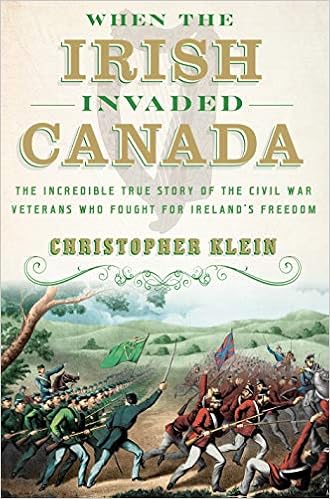
When the Irish Invaded Canada


When the Irish Invaded Canada: The Incredible True Story of the Civil War Veterans Who Fought for Ireland's Freedom- Christopher Klein
Doublday
Release Date: March 12, 2019

Rating:
📚📚📚📚

Synopsis: Just over a year after Robert E. Lee relinquished his sword, a band of Union and Confederate veterans dusted off their guns. But these former foes had no intention of reigniting the Civil War. Instead, they fought side by side to undertake one of the most fantastical missions in military history: to seize the British province of Canada and to hold it hostage until the independence of Ireland was secured.

By the time that these invasions--known collectively as the Fenian raids--began in 1866, Ireland had been Britain's unwilling colony for seven hundred years. Thousands of Civil War veterans who had fled to the United States rather than perish in the wake of the Great Hunger still considered themselves Irishmen first, Americans second. With the tacit support of the U.S. government and inspired by a previous generation of successful American revolutionaries, the group that carried out a series of five attacks on Canada--the Fenian Brotherhood--established a state in exile, planned prison breaks, weathered infighting, stockpiled weapons, and assassinated enemies. Defiantly, this motley group, including a one-armed war hero, an English spy infiltrating rebel forces, and a radical who staged his own funeral, managed to seize a piece of Canada--if only for three days.

When the Irish Invaded Canada is the untold tale of a band of fiercely patriotic Irish Americans and their chapter in Ireland's centuries-long fight for independence. Inspiring, lively, and often undeniably comic, this is a story of fighting for what's right in the face of impossible odds.

__________________________________________________________

An interesting, well-researched book, Klein tells the little known story of Irishmen fighting for Ireland's freedom in America. Plenty of context is provided to understand Irish and English feelings (both politically and personally), culminating in the Great Hunger when millions of Irish died and millions travelled to America to avoid the potato famine. Irishmen fought on both sides of the American Civil War, but many saw this battle as a training ground for a larger, more important, war- the war for Irish freedom from England.

As with any story of a large group of people, political and idealogical differences divided those planning to free Ireland. The focus here, as the title suggests, is the decision by Irish nationalists to hurt England by invading Canada. Three main invasion plans over a few years led to battles, the breaking of neutrality laws, political fighting, and eventually the largest unintended consequence of all: Canada as a separate nation. The political maneuverings were fascinating, with America working secretly (or not) to claim Canada for itself, Irish nationalists trying to hold land hostage to negotiate for Ireland's independence, and individuals searching for glory.

Klein does an excellent job showing the reader how the seemingly ridiculous plan to take Canada by a group of overly optimistic individuals directly influenced the twentieth century Irish rebellions and led to the country we know today. Fascinating and fast-paced, "When the Irish Invaded Canada" is a must read for anyone interested in nineteenth century America and Canada, let alone the evolution of the Irish national movement towards independence.

I received an ARC of this book from NetGalley in exchange for an honest review
Tuesday, September 4, 2018

Field of Blood


The Field of Blood: Violence in Congress and the Road to Civil War by [Freeman, Joanne B.]


The Field of Blood: Violence in Congress and the Road to Civil War- Joanne B. Freeman
Farrar, Straus, & Giroux
Release Date: September 11, 2018

Rating:
📚📚📚📚📚

Synopsis: In The Field of Blood, Joanne B. Freeman recovers the long-lost story of physical violence on the floor of the U.S. Congress. Drawing on an extraordinary range of sources, she shows that the Capitol was rife with conflict in the decades before the Civil War. Legislative sessions were often punctuated by mortal threats, canings, flipped desks, and all-out slugfests. When debate broke down, congressmen drew pistols and waved Bowie knives. One representative even killed another in a duel. Many were beaten and bullied in an attempt to intimidate them into compliance, particularly on the issue of slavery.

These fights didn’t happen in a vacuum. Freeman’s dramatic accounts of brawls and thrashings tell a larger story of how fisticuffs and journalism, and the powerful emotions they elicited, raised tensions between North and South and led toward war. In the process, she brings the antebellum Congress to life, revealing its rough realities—the feel, sense, and sound of it—as well as its nation-shaping import. Funny, tragic, and rivetingly told, The Field of Blood offers a front-row view of congressional mayhem and sheds new light on the careers of John Quincy Adams, Henry Clay, and other luminaries, as well as introducing a host of lesser-known but no less fascinating men. The result is a fresh understanding of the workings of American democracy and the bonds of Union on the eve of their greatest peril.
_________________________________________________________ 

Joanne B. Freeman's The Field of Blood: Violence in Congress and the Road to Civil War is an entertaining, well researched, and well-written examination of physical violence in U.S. Congress in the decades leading to the Civil War.  Most of it stems from diarist B.B. French, who managed to be on hand or on the fringes for every major political and historical event of his lifetime.  A New Hampshire native, French was highly active in D.C. politics, knew politicians and presidents, and often had a ring-side seat to the debates and violence on the floors of Congress. 

Not merely a cataloging of duels, brawls, canings, and insults, Field of Blood examines the reasons behind the violence- both personal and cultural.  Violence and duels were seen as honorable, manly codes of conduct in the South and barbaric and uncivilized in the North.  Southern politicians would often use bullying and threats of violence to hold power in Congress.  Politicians were seen as closely representing the constituents, their state, and their region and "fighting for the people's rights" was often taken very literally.  Insult an individual and you insulted the region.  Insult the region and you insulted the individual.  Honor was often called into question and (usually) representatives settled things outside the halls of Congress.  It was an interesting dynamic that the patriotic French watched: people believed Congress to be solemn, serious, full of great men giving great speeches- if they saw what French saw, the general public might think very differently.  

Freeman presents readers with a little looked at slice of American history leading up to the Civil War, bringing 19th century political figures to life with a humorous and down-to-earth style of writing that keeps the reader engaged from beginning to end.  Americans who believe today's political standoffs and partisanship are unprecedented may appreciate reading the literal stand-offs of the past, when people sent guns to their Congressmen so they could fight for their constituents' rights and pistols, rifles, and bowie knives were regularly carried by politicians "just in case." 

 For anyone who imagines 19th century Congressmen as staid and boring old men, Freedman will introduce you to a whole new side of American politics. A great read!


I received an ARC of this book from NetGalley in exchange for an honest review

Thursday, October 12, 2017

Grant

Grant by [Chernow, Ron]


Grant- Ron Chernow
Penguin Group
Release Date: October 10, 2017

Rating (out of 5):
📚📚📚📚

Synopsis: Ulysses S. Grant's life has typically been misunderstood. All too often he is caricatured as a chronic loser and an inept businessman, or as the triumphant but brutal Union general of the Civil War. But these stereotypes don't come close to capturing him, as Chernow shows in his masterful biography, the first to provide a complete understanding of the general and president whose fortunes rose and fell with dizzying speed and frequency.

With lucidity, breadth, and meticulousness, Chernow finds the threads that bind these disparate stories together, shedding new light on the man whom Walt Whitman described as “nothing heroic... and yet the greatest hero.” Chernow’s probing portrait of Grant's lifelong struggle with alcoholism transforms our understanding of the man at the deepest level. This is America's greatest biographer, bringing movingly to life one of our finest but most underappreciated presidents. The definitive biography, Grant is a grand synthesis of painstaking research and literary brilliance that makes sense of all sides of Grant's life, explaining how this simple Midwesterner could at once be so ordinary and so extraordinary.

_______________________________

As someone who loves history, I have a terrible confession to make: Grant is the first Ron Chernow book I've ever read.  It will certainly not be the last.  Chernow's Grant is meticulously researched, well-written, with an easy style and flow that make a biography feel less like a lecture and more like an intimate conversation.  He provides descriptions and details that bring the time period and the people to vivid life.

Grant was a complex man: both brilliant and naive; overly trusting in civilian life while able to perfectly predict what others would do on the battlefield; a man who claimed to have no great political ambitions yet was a rare (at the time) two term president.  Chernow reminds us of the personal connections of the generals of both the North and South- Grant attended West Point and fought in the Mexican War alongside William T. Sherman, Robert E Lee, and a veritable who's who of later Civil War leaders.  The best man at his wedding was James Longstreet, who would go on to be a great Southern general in the war.  Chernow also brings front and center Grant's hard work for African Americans, supporting the 13th, 14th, and 15th Amendments, with equality and voting rights among his lifelong crusades.  While Lincoln is remembered in American history as the President who ended slavery, readers of Grant will see that President U.S. Grant should be remembered as a tireless proponent of civil rights and militant enemy of the Ku Klux Klan.

Chernow doesn't turn away from Grant's failures in civilian life: his poverty before rejoining the army for the Civil War, his constant struggle with alcoholism, or Grant's repeated mistakes in trusting the wrong people in matters of finance- and occasionally in government.  Grant's personal traits: pride, stubbornness, loyalty among others are shown as what made him the greatest general of his time, but also caused a steep learning curve as President.  

Readers of Stephen W. Sears' Lincoln's Lieutenants will find this a perfect companion to their understanding of the generals of the Civil War, their successes and failures, radically different personalities, and their relationships with Lincoln. It continues to amaze me how individual personalities and personal ambitions shape the course of military history.

Fans of history, biographies, and military history will rejoice in this new biography of General Grant- which will stand unchallenged as his definitive biography for a long time. An easy, flowing narrative, Ron Chernow's Grant will change the average American's view of Grant forever.

I received an ARC of this book from NetGalley in exchange for an honest review

Monday, April 24, 2017

Lincoln's Lieutenants

Lincoln's Lieutenants: The High Command of the Army of the Potomac by [Sears, Stephen W.]


Lincoln's Lieutenants: The High Command of the Army of the Potomac- Stephen W. Sears
Houghton Mifflin Harcourt
Release Date: April 25, 2017

Rating (out of 5)
📚📚📚📚

Synopsis: The high command of the Army of the Potomac was a changeable, often dysfunctional band of brothers, going through the fires of war under seven commanding generals in three years, until Grant came east in 1864. The men in charge all too frequently appeared to be fighting against the administration in Washington instead of for it, increasingly cast as political pawns facing down a vindictive congressional Committee on the Conduct of the War.  President Lincoln oversaw, argued with, and finally tamed his unruly team of generals as the eastern army was stabilized by an unsung supporting cast of corps, division, and brigade generals. 

_____________________________

Lincoln's Lieutenants explores the rocky history of the high command of the Army of the Potomac, from the first shot at Fort Sumter to Lee's surrender at the Appomattox Courthouse.  What starts out as a slightly intimidating, 800 page tome quickly becomes a thrilling read, well-written and researched to provide any history buff a truly fascinating account of the personalities behind the Army of the Potomac.

The Army of the Potomac guarded Washington D.C., fought at the bloody battlefields of Gettysburg, Fredericksburg, Chancellorsville, First and Second Bull Run, and finally, Petersburg.  They faced Confederate General Robert E. Lee almost from first to last and were led by famous generals like McClellan, Burnside, Hooker, Meade, and Grant.  Sears searched archives from Massachusetts to Wisconsin, the National Archives to the Library of Congress and uses first-hand accounts, diaries, and letters to give the reader an in-depth, on-the-scenes view of events and people. Sears does an excellent job of allowing the words of soldiers, generals, and Lincoln to draw readers in, showing the personalities behind the names history still remembers.

I was amazed to learn how much fighting was done among the Cabinet, Senate, and generals. Nearly all the Potomac's generals found themselves at odds with President Lincoln on how their campaigns should be fought. How they managed to fight a war with all of the in-fighting, back-stabbing, favoritism, and egos dominating every decision is still unclear by the end of the book.  Personalities, politics, and patrons played as much (often more) of a role in who led men into battle as experience and ability.  So many of the lower commanding officers had neither experience nor ability in leading men into battle, so many wrong decisions were made or opportunities lost, that it left me wondering how this army ever managed anything.  Grant finally comes east and, for the first time in the war, has each of the Union armies working together (sort of), as well as being the first Potomac general to have a lasting, good working relationship with Lincoln.  I found it helpful that whenever Sears described a battle decision one of the generals made, he would usually add what was happening on the other side and if the decision was actually a good one or not.  For example, every time McClellan claimed the Confederates had 200,000 men against his army, Sears would provide the actual numbers and some explanation for why McClellan thought the way he did.  It was also rather frightening to discover how personal egos and fears often played  such a large role in causing troops to fail being sent to support what could have otherwise been a winning strategy.              

The one complaint I had with this book was Sears' tendency towards repetition.  I appreciated how, after going through the details of a particular campaign, Sears would provide a summary of the events to help the reader get things set in their minds.  However, Sears tended to give multiple summaries of the same event, or repeat more times than necessary who had fallen in each battle and who had taken over their command.  That detracted a bit from the flow and was, for me, annoying,

Overall, Lincoln's Lieutenants was a fascinating book, focusing more on the men in command than just the events they commanded.  History buffs will appreciate the details and the voices of the men allowed to shine through, often providing well timed ironic and humorous moments.  While Lieutenants might be intimidating for those only casually interested in the topic, anyone looking for a well-researched study on the Army of the Potomac will find a treasure in Stephen Sears' newest Lincoln's Lieutenants.

I received an ARC of this book from NetGalley in exchange for an honest review.