Showing posts with label American History. Show all posts

Sunday, October 27, 2024

Mysterious Case of the Victorian Female Detective


The Mysterious Case of the Victorian Female Detective- Sara Lodge

Yale University Press

Release Date: November 5, 2024

Rating: ðŸ“šðŸ“šðŸ“šðŸ“šðŸ“š

Synopsis:  From Wilkie Collins to the adventures of Sherlock Holmes, the traditional image of the Victorian detective is male. Few people realise that women detectives successfully investigated Victorian Britain, working both with the police and for private agencies, which they sometimes managed themselves.

Sara Lodge recovers these forgotten women’s lives. She also reveals the sensational role played by the fantasy female detective in Victorian melodrama and popular fiction, enthralling a public who relished the spectacle of a cross-dressing, fist-swinging heroine who got the better of love rats, burglars, and murderers alike.
 
How did the morally ambiguous work of real women detectives, sometimes paid to betray their fellow women, compare with the exploits of their fictional counterparts, who always save the day? Lodge’s book takes us into the murky underworld of Victorian society on both sides of the Atlantic, revealing the female detective as both an unacknowledged labourer and a feminist icon.
___________________________________________________________

This was a fascinating book exploing the early days of women in the world of detective work- both in fiction and reality. Sara Lodge makes an impressive argument that women were involved in police work long before they 'officially' began being counted as police women, and it was these women who perhaps became the inspiration for the 'female detectives' of the early fictional stories.

Stories of female detectives were being sold by the 1860s, with the detectives donning disguises and blending into the background as servants to gather the proof needed to solve their cases because, the stories argued, it was easier for women to hide in plain sight than men. Often (possibly a case of wish fulfillment?) these fictional detectives were saving women from cruel husbands and bad marriages, accidental bigamy, or other abuses that they didn't see coming, but which the law couldn't protect them from. I loved how Lodge was able to find 19th century plays of female detectives where the women became early action heroes- beating the villanous men and police alike to save the day, with frequent disguises, cross-dressing, guns, and the physical ability to protect both themselves and their clients.

But as much as these heroines of the stage were looked up to, real life detectives occupied a murkier reality. As divorce became more common, many were involved in gathering evidence against spouses - and sometimes creating that evidence.  At a time when public and private spheres was undergoing a shift, the private detective's role itself was being defined, and the women in the profession tended to take the blame if things went wrong. 

Brilliantly researched and well-written, this is a book for any mystery lover to read. If you think the lady detective begins with Agatha Christie, think again!

I received an ARC of this book in exchange for an honest review 


Tuesday, April 30, 2024

The Demon of Unrest


The Demon of Unrest: A Saga of Hubris, Heartbreak, and Heroism at the Dawn of the Civil War- Erik Larson

Crown

Release Date: April 30, 2024

Rating: ðŸ“šðŸ“šðŸ“šðŸ“š

Synopsis: On November 6, 1860, Abraham Lincoln became the fluky victor in a tight race for president. The country was bitterly at odds; Southern extremists were moving ever closer to destroying the Union, with one state after another seceding and Lincoln powerless to stop them. Slavery fueled the conflict, but somehow the passions of North and South came to focus on a lonely federal fortress in Charleston: Fort Sumter. 

Master storyteller Erik Larson offers a gripping account of the chaotic months between Lincoln’s election and the Confederacy’s shelling of Sumter—a period marked by tragic errors and miscommunications, enflamed egos and craven ambitions, personal tragedies and betrayals. Lincoln himself wrote that the trials of these five months were “so great that, could I have anticipated them, I would not have believed it possible to survive them.”
 
At the heart of this suspense-filled narrative are Major Robert Anderson, Sumter’s commander and a former slave owner sympathetic to the South but loyal to the Union; Edmund Ruffin, a vain and bloodthirsty radical who stirs secessionist ardor at every opportunity; and Mary Boykin Chesnut, wife of a prominent planter, conflicted over both marriage and slavery and seeing parallels between both. In the middle of it all is the overwhelmed Lincoln, battling with his duplicitous Secretary of State, William Seward, as he tries desperately to avert a war that he fears is inevitable—one that will eventually kill 750,000 Americans.
 
Drawing on diaries, secret communiques, slave ledgers, and plantation records, Larson gives us a political horror story that captures the forces that led America to the brink—a dark reminder that we often don’t see a cataclysm coming until it’s too late.
_______________________________________________________

Erik Larson, known for Devil in the White City and The Splendid and the Vile, among many others, this time takes on Fort Sumter and trying to understand (and explain) the root causes behind the American Civil War.

Americans may think they know the basics: Lincoln got elected, South Carolina seceded, Fort Sumter was fired on, there was a war. But Larson takes us into the deeply human and often tragic months between Lincoln getting elected and the firing on Fort Sumter. Were there moments when things could have been different? When different choices could have caused massively different outcomes?

The surprising truth is that, as Larson shows us, Northerners and Southerners as a whole did not understand each other. And had not for decades-if ever. The Southern aristocrats who made up the politicians most Northerners met with were hot-tempered, extremely proud, and always on alert to having their honor offended at the slightest provocation. And they had largely managed to convince themselves that there was nothing wrong with slavery. So the louder abolitionists in the North became, the more offended the South became. Abolitionists said the institution of slavery was evil, Southerners heard that they themselves were evil.

Add to this hot-heads who had been arguing that Southern states should have separated from the Union for decades, and the situation had been rife for rebellion longer than many were willing to admit. One person who doesn't come out of Demon looking good is outgoing President Buchanan. Buchanan acts oblivious to everything until he can't avoid it any longer (I particularly loved a quote by Georgia representative Toombs who tells Buchanan he's been in the midst of a revolution for over a year, he just hasn't noticed it.). His only goal is to get to Inauguration Day without violence so he can dump the problems on Lincoln and any states that leave happen under Lincoln's watch instead of his. But when South Carolina seceded letters show partying Southerners go to the White House, assuming Buchanan will be happy as well. There's no record of whether Buchanan partied too, but the fact that Southerners in Washington assumed he was on their side did not help issues moving forward. The level that rumors and misunderstandings played in politics of the day was surprising to me.

Reading about the experiences of the people in Fort Sumter itself were some of the most interesting parts for me. Major Anderson, conflicted between his natural feelings for his home in the South and his sworn oath to the US Army (a conflict many military men would have to deal with)- on top of having to make a lot of decisions himself that he shouldn't have had to make, was especially someone I felt for. He knew pretty early on his decisions had the real potential to spark a war if he wasn't careful, and he had almost no feedback from his superiors to help guide him. He was in a no-win situation and I expect plenty of people would have surrended the fort a lot sooner than he did. His sections of the book helped explain a question I never knew I had: what made Fort Sumter so important and such a flash point that we connect it with the start of the war? 

I had a little trouble getting into Demon at first- possibly because when I started it I could only read small sections at a time and I think the beginning of the book would benefit from reading in a large chunk in one sitting to really get into it. There are a lot of people to get to know and some time traveling to get really settled into understanding the 1860 "present" (Larson backs up and gives up some pre-1860 Southern history so we understand where the Southern mindset is and that the idea of seceding isn't something new to them). But once I got settled in the book I really enjoyed it, because there was so much behind-the-scenes history Larson was showing me that I hadn't known about before. As always, Larson uses letters, diaries, and other first-hand accounts to make the events spring to life for the reader- which I love.

While not his best book in my opinion, The Demon of Unrest is an excellent, well-researched book that Larson's fans should enjoy. Full of the drama, pathos, and absolute humanity that draws you into an excellent history book.

I received an ARC of this book from NetGalley in exchange for an honest review


Sunday, November 20, 2022

Spotlights for November 2022

 Here are a few of the new releases from November of 2022 that I didn't write a blog post on, but a spotlight through Goodreads reviews:


Better Than Fiction- Alexa Martin

Rating: ðŸ“šðŸ“šðŸ“šðŸ“š

Release Date: November 8

Romance-Comedy

An adorable romcom about a bookstore owner who doesn't like to read and a romance author. Opposites attract in the best ways possible as Drew and Jasper explore a surprise relationship, supported by her friends and a book club of meddling readers determined to have a happy ending.


The Pirate's Wife: The Remarkable True Story of Sarah Kidd-Daphne Palmer Geanacopoulos

Rating:📚📚📚

Release Date: November 8

Biography

Discovering the true story of the untold family life behind privateer/pirate Captain Kidd, this is the life of Sarah Kidd. A woman who sailed to New York when it was a new colony of England, married four times for very different reasons over the course of her life, saw the best of times and the worst of times, and was probably the last living person to know the hiding place of Kidd's treasure.


Raven Unveiled- Grace Draven

Rating: ðŸ“šðŸ“šðŸ“š

Release Date: November 8

Fantasy

Book Three in the Fallen Empire fantasy series follows shade speaker Siora and former cat's paw Gharek as they go from enemies to uneasy allies in a quest to save Gharek's daughter and the ghosts Siora sees. Generals are fighting for the newly empty thrown and an evil supernatural entity is stalking the land, eating both the dead and possibly the living- and Siora may be the only one who can save them.


Some Dukes Have All The Luck- Christina Britton

Rating:📚📚📚

Release Date: November 8

Historical Romance

Ash Hawkins, Duke of Buckley, needs a woman interested in a marriage of convenience to take over the raising of his three wards. Bronwyn Pickering needs a husband, preferably titled, to free her from her overbearing and domineering parents. She'll be free to continue her etymological studies on the Isle of Synne and he'll be free to stay in London running his gambling hell. As long as inconvenient emotions don't enter into the equation.


The Queen: Her Life- Andrew Morton

Rating: ðŸ“šðŸ“š

Release Date: November 15

Biography

A new biography on Queen Elizabeth II by Andrew Morton, best know for his biographies of Princess Diana. 


The Final Year of Anne Boleyn- Natalie Gruenineger

Rating:📚📚📚📚📚

Release Date: November 30

Biography

An in-depth look at the final year of Anne Boleyn's life, Natalie Gruenineger explores how relationships between Anne Boleyn and Henry VIII changed as politics, Thomas Cromwell, and Jane Seymour altered the landscape and offers a compelling argument for why she believes Henry VIII knew Anne was innocent of the crimes she was charged with, but had to die anyway.

Saturday, October 29, 2022

Spotlights for October 2022

 October was a busy month for new releases and I didn't write a blog for all the new books I read. But here are some spotlights for a few of the books that released in October 2022 and didn't get the full book blog treatment: 


Station Eternity- Mur Lafferty

Release Date: October 4

Rating: ðŸ“šðŸ“šðŸ“š

A science fiction spoof on the murder mysteries where there's that one person who always happens across dead bodies no matter where they go. Mallory Viridian runs away from the human race to Station Eternity to keep humans safe, only to have humans, murder, and chaos follow her to space.


The Women of Rothschild
- Natalie Livingstone

Release Date: October 24

Rating:📚📚📚📚

A well-written and well-researched book on the English branch of the Rothschild family, following the women of the family (by blood and by marriage) across the 19th and 20th centuries. If you are looking for a book that covers social, political, and religious experiences of a Jewish family in England  over centuries and how change slowly happens, as well as watching how women could wield power in the shadows of a male dominated society, this is definitely a book to check out.


Murder at Balmoral
- Chris McGeorge

Release: October 25

Rating: ðŸ“šðŸ“šðŸ“š

When King Eric of England dies under suspicious circumstances on Christmas, only one of the Royal family could have poisoned him. Friend and Royal Chef Jonathan is tasked with figuring out who did it before the authorities arrive in this closed room mystery whose dark side some may like, others will definitely not, and the timing of which must be under review by the publishers.


Revolutionary Samuel Adams- Stacy Schiff

Release: October 25

Rating:📚📚📚📚

A well written, well researched biography of a little known American Founding Father, Samuel Adams may be hard to pull from the shadows because he left little written work behind, but others certainly left plenty of their opinions written about him! Whether the truth behind what others believed Adams the mastermind of will probably never be fully known, this is certainly a biography every American interested in history should read.   


Brave Hearted-
 Katie Hickman

Release: October 25

Rating:📚📚📚📚📚

Well written and well researched, this new book explores the American West and the women who lived there. It wasn't all cowboys, miners, and outlaws- from early missionaries and pioneers in wagons to women following their mining and military husbands to the first hand accounts of Native American women who saw their lands and cultures taken away from them- this book covers the entire range of women of the early American West. Letters and diaries make it personal and touching while Hickman places people and events in historical and social context.


The Woodville Women-Sarah Hodder

Release: October 30

Rating:📚📚📚

A look at three generations of women during a century of medieval England's turbulent history. Elizabeth Woodville, her daughter Elizabeth of York, and her granddaughter Elizabeth Grey moved among the highest circles in England: queens of England and cousins to kings of England, they balanced the political storm of the Wars of the Roses and Henry VIII's court.


Thursday, August 12, 2021

Imperfect Union


Imperfect Union: How Jessie and John Frémont Mapped the West, Invented Celebrity, and Helped Cause the Civil War- Steve Inskeep

Penguin Group

Release Date: January 14, 2020

Rating: ðŸ“šðŸ“šðŸ“šðŸ“šðŸ“š

Synopsis: John C. Frémont, one of the United States’s leading explorers of the nineteenth century, was relatively unknown in 1842, when he commanded the first of his expeditions to the uncharted West. But in only a few years, he was one of the most acclaimed people of the age – known as a wilderness explorer, bestselling writer, gallant army officer, and latter-day conquistador, who in 1846 began the United States’s takeover of California from Mexico. He was not even 40 years old when Americans began naming mountains and towns after him. He had perfect timing, exploring the West just as it captured the nation’s attention. But the most important factor in his fame may have been the person who made it all possible: his wife, Jessie Benton Frémont. 

Jessie, the daughter of a United States senator who was deeply involved in the West, provided her husband with entrée to the highest levels of government and media, and his career reached new heights only a few months after their elopement. During a time when women were allowed to make few choices for themselves, Jessie – who herself aspired to roles in exploration and politics – threw her skill and passion into promoting her husband. She worked to carefully edit and publicize his accounts of his travels, attracted talented young men to his circle, and lashed out at his enemies. She became her husband’s political adviser, as well as a power player in her own right. In 1856, the famous couple strategized as John became the first-ever presidential nominee of the newly established Republican Party. 

With rare detail and in consummate style, Steve Inskeep tells the story of a couple whose joint ambitions and talents intertwined with those of the nascent United States itself. Taking advantage of expanding news media, aided by an increasingly literate public, the two linked their names to the three great national movements of the time—westward settlement, women’s rights, and opposition to slavery. Together, John and Jessie Frémont took parts in events that defined the country and gave rise to a new, more global America. Theirs is a surprisingly modern tale of ambition and fame; they lived in a time of social and technological disruption and divisive politics that foreshadowed our own. In Imperfect Union, as Inskeep navigates these deeply transformative years through Jessie and John’s own union, he reveals how the Frémonts’ adventures amount to nothing less than a tour of the early American soul.
____________________________________________________________________

Imperfect Union: How Jessie and John Frémont Mapped the West, Invented Celebrity, and Helped Cause the Civil War is a fascinating, well-researched, and brilliantly written exploration of mid-nineteenth century America: its triumphs and failings, challenges and inventions, through the lens of John C. Frémont and his wife Jessie Benton Frémont. They lived during a time of great change and innovation and Jessie was quick to capitalize on all of it to, quite arguably, invent celebrity and public relations in ways that we would all recognize today.

By marrying Jessie, a powerful senator's daughter, John went from being a new and inexperienced Army officer to part of a powerful family with visions of manifest destiny and American Empire. Jessie's connections landed John the role of leader of an exploration party into the West. Her genius spun that exploration into John's becoming a national hero and celebrity; a bestselling author whose travel accounts often almost resembled reality; and the go-to explorer for several other westward mapmaking expeditions. Author Steve Inskeep unwinds Jessie's spin and uses the journals and letters of other members of Frémont's teams to get closer to the truth: that John was often inept, entirely self-focused, and frequently took unnecessary, potentially fatal, risks seemingly for the sake of it.  He seems to have considered orders from commanding officers to be mere suggestions, and the amount of time dumb luck seems to have saved his life (and his team) is mind-boggling. 

Through John's explorations, his forays into politics, his court martial for refusing to follow orders, and more, it was Jessie who stood between John and the world. Jessie who rallied support and gave advise, Jessie who deflected criticism and attacked critics. She was more than the power behind the throne: she was the brains behind the throne. She became as recognizable a celebrity as her husband at a time when women were starting movements towards fighting for the right to vote and have a voice in politics. 

Inskeep explores the changing politics and mindset of the time, the political and moral dilemmas America was facing regarding slavery and the "Indian question", arguments against immigrants and Catholics, with sharp clarity. He doesn't shy away from acknowledging when people like John were willing to compromise where today we would condemn; or where John was willing to perform or accept actions we would today find unacceptable.  Inskeep fully shows the negative to Frémont as well as the progressive.  But Imperfect Union is more than a biography of John and Jessie: it is an exploration of how America and American lives were changing. Through railroads and telegraphs people were being brought closer together, stories and ideas were traveling faster. This is the story of the politics of slavery in the North and the South decades before the first shot was fired to begin the Civil War.  Thanks to Jessie's political connections and John's celebrity status the two knew an incredible number of people who would become key players during the Civil War. 

For history lovers looking for a well-researched, well-written, highly accessible, and completely absorbing account of behind the scenes movements that would shape America and the American people to this very day, look no further than Imperfect Union.

I received an ARC of this book from NetGalley in exchange for an honest review

Wednesday, July 29, 2020

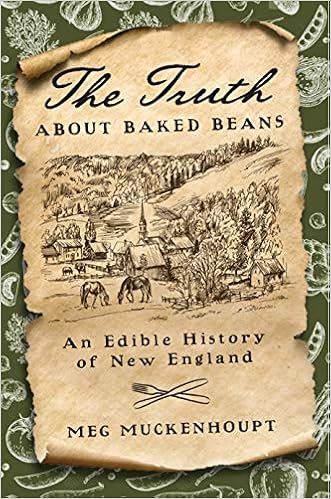
The Truth About Baked Beans


The Truth About Baked Beans: An Edible History of New England- Meg Muckenhoupt
Washington Mews Books
Release Date: August 25, 2020

Rating:
📚📚📚

Synopsis:  Meg Muckenhoupt begins with a simple question: When did Bostonians start making Boston Baked Beans? Storekeepers in Faneuil Hall and Duck Tour guides may tell you that the Pilgrims learned a recipe for beans with maple syrup and bear fat from Native Americans, but in fact, the recipe for Boston Baked Beans is the result of a conscious effort in the late nineteenth century to create New England foods. New England foods were selected and resourcefully reinvented from fanciful stories about what English colonists cooked prior to the American revolution―while pointedly ignoring the foods cooked by contemporary New Englanders, especially the large immigrant populations who were powering industry and taking over farms around the region. 

The Truth about Baked Beans explores New England’s culinary myths and reality through some of the region’s most famous foods: baked beans, brown bread, clams, cod and lobster, maple syrup, pies, and Yankee pot roast. From 1870 to 1920, the idea of New England food was carefully constructed in magazines, newspapers, and cookbooks, often through fictitious and sometimes bizarre origin stories touted as time-honored American legends. This toothsome volume reveals the effort that went into the creation of these foods, and lets us begin to reclaim the culinary heritage of immigrant New England―the French Canadians, Irish, Italians, Portuguese, Polish, indigenous people, African-Americans, and other New Englanders whose culinary contributions were erased from this version of New England food. Complete with historic and contemporary recipes, The Truth about Baked Beans delves into the surprising history of this curious cuisine, explaining why and how “New England food” actually came to be.
_____________________________________________________________________

The Truth About Baked Beans is an incredibly detailed and well-researched book on the history of food in New England and the people who ate it.  Here we take a look behind the "traditional" New England foods, from maple syrup and lobster to cod and baked beans, and discover what New Englanders have actually been eating throughout history.

It will probably not come as a surprise to discover that the "traditional" New Englander and their dinners were invented in the late 1800s.  Times were changing, people were moving to cities, immigrants were moving to the United States, and a few Victorians began to think that life must have been better back in the day.  Their racism, classism, and outright xenophobia erased the Irish, Italian, Polish, Greek, and other European and African immigrants and slaves from the region, replaced them with a few helpful Native Americans who showed the Pilgrims how to plant corn before conveniently disappearing into the mists, and behold! The "traditional" New Englander and his food was born.  This attitude blended with the new scientific approach of the late 1800s-early 1900s where a few "experts" worked hard to convince poor people that what they were eating wasn't healthy and that they could eat better and cheaper with plain, boiled, tasteless meals that required hours of cooking and no vegetables.  

The book is a social, environmental, and cultural history of New England since the 1600s.  It tries to answer questions about what people were living in the region, what they were eating, what they had access to, and how attitudes towards different foods changed over time.  However, I didn't find myself as interested in this book as I expected to be.  Possibly this was because there was so much research that, despite Muckenhoupt's humor throughout the book, it ended up reading more like a scholarly work than a light food history read.  There was also a lot of repetition, some due to how the book was structured, and the combination made it a much more difficult book to get through than I expected.  The pacing dragged and I had a hard time staying interested for long periods of time.  Overall, this is an interesting book, but maybe more for intense thesis scholars than the rest of us.


I received an ARC of this book from NetGalley in exchange for an honest review

Sunday, July 5, 2020

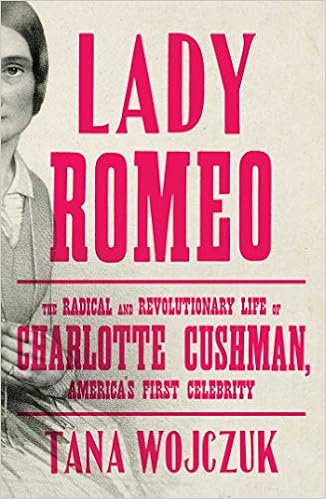
Lady Romeo


Lady Romeo: The Radical and Revolutionary Life of Charlotte Cushman, America's First Celebrity- Tana Wojczuk  
Avid Reader/Simon & Schuster
Release Date: July 7, 2020

Rating:
📚📚📚

Synopsis: From the very beginning, she was a radical. At age nineteen, Charlotte Cushman, America’s beloved actress and the country’s first true celebrity, left her life—and countless suitors—behind to make it as a Shakespearean actress. After revolutionizing the role of Lady Macbeth in front of many adoring fans, she went on the road, performing in cities across a dividing America and building her fame. She was everywhere. And yet, her name has faded in the shadows of history.

Now, for the first time in decades, Cushman’s story comes to full and brilliant life in this definitive, exhilarating, and enlightening biography of the 19th-century icon. With rarely seen letters, Wojczuk reconstructs the formative years of Cushman’s life, set against the excitement and drama of New York City in the 1800s, featuring a cast of luminaries and revolutionaries that changed the cultural landscape of America forever.

A vivid portrait of an astonishing and uniquely American life, Lady Romeo reveals one of the most remarkable women in United States history, and restores her to the center stage where she belongs.


______________________________________________________________________
The story of a little known, but pioneering actress, Lady Romeo introduces the reader to Charlotte Cushman- perhaps the greatest actress of her age and a woman who proved to the world that America was ready to embrace culture, theater, and especially Shakespeare.  Her triumphs and setbacks built Charlotte into a strong and determined woman- determined to provide for her family, determined to prove her own talent, and determined to prove America's cultural place in the world.  She befriended politicians and authors, actors and sculptors, and helped support other women in their professions.  Described here by Tana Wojczuk as America's first celebrity, Charlotte Cushman also had to learn to balance her public and private lives.  Especially when she was young, Charlotte worried about the effect on her American career if it was discovered that she had married another woman.  But in Europe as a leading actress her relationships with women and tendency to wear men's clothes were less remarked on.

I loved learning about the enterprising, determined, and pioneering Charlotte Cushman.  Wojczuk is at her best when writing about Charlotte's time on stage, bringing to life Shakespeare's Lady Macbeth or Romeo.  At these times Charlotte herself comes to life, much as she breathed life into her characters.  Wojczuk describes how Cushman left an entire generation of women (including Louisa May Alcott) star-struck; redefined Romeo and reintroduced the original Shakespearean text of Romeo and Juliet to English audiences; and broke restricting 19th-century gender roles on both sides of the ocean.

 I would have enjoyed a deeper exploration of Cushman's inner life- her emotions and thoughts, her family, and her romantic relationships- instead of the often flat or surface look we get here.  Lady Romeo is often so fast-paced that it feels like we've skipped years of Cushman's life and development.  At other times repetition or time-period hopping take away some of the emotional impact of scenes like Cushman's final performance- beautifully written and detailed but put in the beginning of the book, before we get to know Cushman, and then ignored completely at the end when it might have had an even larger emotional impact.  The people around Charlotte had no life to them, we get no real idea why Charlotte loved someone, what attracted her to a person (platonically or romantically).  Whether this is because there wasn't anything in the resources used to flesh out the people, or often Charlotte herself,  is impossible to say. But Lady Romeo definitely left me wanting to know more about Charlotte and her world- how she fit into it and how she changed it to fit her.

I received an ARC of this book from NetGalley in exchange for an honest review

Sunday, May 24, 2020

James Monroe: A Life


James Monroe: A Life- Tim McGrath
Dutton/Penguin Group
Release Date: May 5, 2020

Rating: ðŸ“šðŸ“šðŸ“šðŸ“š


Synopsis: Monroe lived a life defined by revolutions. From the battlefields of the War for Independence, to his ambassadorship in Paris in the days of the guillotine, to his own role in the creation of Congress's partisan divide, he was a man who embodied the restless spirit of the age. He was never one to back down from a fight, whether it be with Alexander Hamilton, with whom he nearly engaged in a duel (prevented, ironically, by Aaron Burr), or George Washington, his hero turned political opponent. 
 
This magnificent new biography vividly recreates the epic sweep of Monroe’s life: his near-death wounding at Trenton and a brutal winter at Valley Forge; his pivotal negotiations with France over the Louisiana Purchase; his deep, complex friendships with Thomas Jefferson and James Madison; his valiant leadership when the British ransacked the nation’s capital and burned down the Executive Mansion; and Monroe’s lifelong struggle to reckon with his own complicity in slavery. Elected the fifth president of the United States in 1816, this fiercest of partisans sought to bridge divisions and sow unity, calming turbulent political seas and inheriting Washington's mantle of placing country above party. Over his two terms, Monroe transformed the nation, strengthening American power both at home and abroad. 

Critically-acclaimed author Tim McGrath has consulted an extensive array of primary sources, many rarely seen since Monroe's own time, to conjure up this fascinating portrait of an essential American statesman and president.
________________________________________________________________________


James Monroe is one of those presidents you can usually name, but otherwise probably don't know too much about.  That was the case for me at least.  Tim McGrath's new biography on Monroe is a brilliant introduction to the man, the politician, and the world he lived and worked in.  Monroe's early life is covered without getting into the minutiae that some biographers enjoy- McGrath knows that in Monroe's case at least, the man Monroe would become formed not in his childhood, but as a young lawyer studying under Thomas Jefferson and as a soldier crossing the Delaware with General Washington.

Monroe is pictured from the beginning as a man who believes in doing his duty by his country, despite what that may cost him personally and financially.  The intricacies of politics might not have come as naturally as the job of soldiering, but Monroe learns as he goes, not only from friends like Jefferson and Madison but from opponents, even enemies, and never forgets the lessons that he learned.

McGrath does a brilliant job showing Monroe's development as a politician- from highly partisan to trying to follow in Washington's steps and erase the two-party system. He brings to life the partisan and highly personal fights in Congress as Monroe's enemies work to prevent Monroe and his Cabinet from accomplishing anything, and brings the reader behind the scenes into Cabinet meetings where Monroe takes the slightly unusual approach of listening to all of his Cabinet members and letting free speech and debate fly across the table before asking questions, and allowing himself to have his mind and policies changed if he truly hears convincing arguments.

James Monroe was not a perfect man, and McGrath doesn't try to convince us that he was.  Apologies are not made, although by understanding the world and time he lived in, maybe some of what today we would call his mistakes are more understandable.   Modern readers will cringe at Monroe's thoughts on slavery and Native American policy- but McGrath reminds us that for his time Monroe was considered progressive, especially compared with someone like the up and coming Andrew Jackson.

This is a well-written, well-researched, and thorough biography of a little known president.  Despite the seemingly daunting length of the book (750 pages) the pace flows well and doesn't get bogged down with extraneous details and lectures.  Although McGrath does fall into the trap of foreshadowing-especially at the end of chapters- his "of only Monroe knew then" approach doesn't happen often enough to get truly aggravating.

A definite win for history lovers seeking to learn more about the founding of America and James Monroe, one of the often overlooked founding fathers.

I received an ARC of this book from NetGalley in exchange for an honest review

Thursday, March 5, 2020

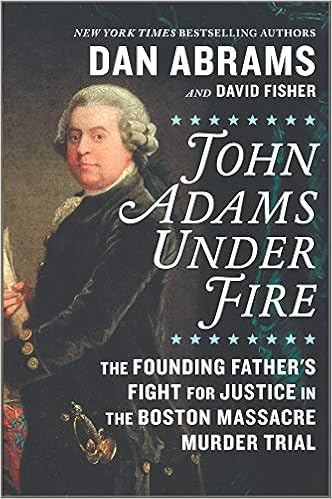
John Adams Under Fire


John Adams Under Fire: The Founding Father's Fight for Justice in the Boston Massacre Murder Trial- Dan Abrams & David Fisher
Hanover Square Press
Release Date: March 3, 2020

Rating:
📚📚📚📚📚

Synopsis: History remembers John Adams as a Founding Father and our country’s second president. But in the tense years before the American Revolution, he was still just a lawyer, fighting for justice in one of the most explosive murder trials of the era.

On the night of March 5, 1770, shots were fired by British soldiers on the streets of Boston, killing five civilians. The Boston Massacre has often been called the first shots of the American Revolution. As John Adams would later remember, “On that night the formation of American independence was born.” Yet when the British soldiers faced trial, the young lawyer Adams was determined that they receive a fair one. He volunteered to represent them, keeping the peace in a powder keg of a colony, and in the process created some of the foundations of what would become United States law.

In this book, New York Times bestselling authors Dan Abrams and David Fisher draw on the trial transcript, using Adams’s own words to transport readers to colonial Boston, a city roiling with rebellion, where British military forces and American colonists lived side by side, waiting for the spark that would start a war.

_____________________________________________________________________

250 years after the Boston Massacre, most people couldn't really tell you anything about it.  Maybe they assume it was a battle during the Revolutionary War.  And in a way, it was.  Years before shots were fired at Lexington and Concord, they were fired in Boston's King Street.  When the smoke cleared, five Boston civilians were dead.  But what happened before that has never satisfactorily been explained. And the importance this incident had to the developing country of America and its legal system has not been acknowledged.

In John Adams Under Fire authors Dan Abrams and David Fisher shine new light on the events leading up to the shooting, but also use trial transcripts to bring the reader into the courtroom as "Loyalists' and 'Patriots' are asked to put aside their personal political feelings as well as all of the rhetoric they've heard in newspapers and on the streets.  Instead, the jury is asked to focus only on what they hear in the court to decide if eight British soldiers and their captain committed murder on the night of March 5, 1770 or protected themselves against a rioting mob. In a clear example of everyone having the right to an attorney, the soldiers find themselves defended by lawyers who are 'Patriots', including new lawyer John Adams (who would go on to sign the Declaration of Independence) while the prosecutors were well-known British 'Loyalists.  While social pressure pushed for quick 'guilty' verdicts, the judges, lawyers, and juries were asked to ignore the popular view in favor of the legal view.

 What results is a well-written, fast-paced, and fascinating account of America's longest trial at the time.  I especially appreciated the attention to detail as the trial continued, including explaining new developments in the legal system that made the trials closer to what modern readers are used to than previous court cases.  That by itself makes this book worth reading, but Abrams and Fisher place the case in context in such a way that readers are able to understand exactly the role the case played in the development of the American legal system, and American independence.

A surprisingly fast and smooth read, this is a book history lovers will appreciate, and students of the legal system should read, yet at the same time, everyone else will still enjoy for it's down to earth writing, well-crafted descriptions, and attention to detail.   


I received an ARC of this book from NetGalley in exchange for an honest review