Showing posts with label military history. Show all posts

Sunday, February 23, 2020

The Splendid and the Vile


The Splendid and the Vile: A Saga of Churchill, Family, and Defiance During the Blitz by [Larson, Erik]


The Splendid and the Vile: A Saga of Churchill, Family, and Defiance During the Blitz- Erik Larson
Crown/Random House
Release Date: February 25, 2020

Rating:
📚📚📚📚📚

Synopsis: On Winston Churchill’s first day as prime minister, Adolf Hitler invaded Holland and Belgium. Poland and Czechoslovakia had already fallen, and the Dunkirk evacuation was just two weeks away. For the next twelve months, Hitler would wage a relentless bombing campaign, killing 45,000 Britons. It was up to Churchill to hold his country together and persuade President Franklin Roosevelt that Britain was a worthy ally—and willing to fight to the end.

In The Splendid and the Vile, Erik Larson shows, in cinematic detail, how Churchill taught the British people “the art of being fearless.” It is a story of political brinkmanship, but it’s also an intimate domestic drama, set against the backdrop of Churchill’s prime-ministerial country home, Chequers; his wartime retreat, Ditchley, where he and his entourage go when the moon is brightest and the bombing threat is highest; and of course 10 Downing Street in London. Drawing on diaries, original archival documents, and once-secret intelligence reports—some released only recently—Larson provides a new lens on London’s darkest year through the day-to-day experience of Churchill and his family: his wife, Clementine; their youngest daughter, Mary, who chafes against her parents’ wartime protectiveness; their son, Randolph, and his beautiful, unhappy wife, Pamela; Pamela’s illicit lover, a dashing American emissary; and the advisers in Churchill’s “Secret Circle,” to whom he turns in the hardest moments.
 
The Splendid and the Vile takes readers out of today’s political dysfunction and back to a time of true leadership, when, in the face of unrelenting horror, Churchill’s eloquence, courage, and perseverance bound a country, and a family, together.
_________________________________________________________________


Erik Larson has done it again! There is no other way to start a discussion of Larson's (Dead Wake) newest book: The Splendid and the Vile.  This is the story of Churchill and his family in his first year as prime minister as Hitler not only takes over swathes of Europe, but also begins bombing England in what would become known as the Blitz.  

Not solely a military or political history, Splendid seeks to answer the question: what was it like for people living through the Blitz?  How did Churchill's family balance politics and personal lives?  Using personal diaries and archival documents, Larson is able to tell these stories using the words of people like Mary Churchill, Winston's youngest daughter; Pamela Churchill, his unhappy daughter-in-law; and John Colville, one of his personal secretaries.  Their loves and losses show attempts to carry on normal lives while also dealing with bombings that often came quite close to killing them. Although I hadn't really thought about it before reading Splendid, I knew very little about Churchill's family and quickly became fascinated to learn about them and their experiences.  I found myself asking the book (in the middle of tense military action when I hadn't heard from the family in awhile) "but how is Pamela coping?  Is Mary really going to marry that guy? What the heck is Randolph thinking?" every bit as anxiously as I found myself worrying over where the next bomb would fall. 

Larson's eye for detail and talent for descriptions create a cinematic effect: the reader can see the moonlit countryside from the view of a Luftwaffe pilot, smell the cordite and taste the dust and grit of bombed out buildings. This should appeal to the casual reader every bit as much as the history devotee.

 My favorite histories are ones that look at the day-to-day experience of regular people as well as the movers and shakers.  Thanks to extensive diaries kept by people across England, those details are available to us and Larson uses these diaries every bit as much as the diaries of Churchill's private secretaries. Because of this, as well as Larson's excellent writing style, readers will be drawn in from page one and held, enthralled, until the very end.


I received an ARC of this book from NetGalley in exchange for an honest review

Tuesday, July 2, 2019

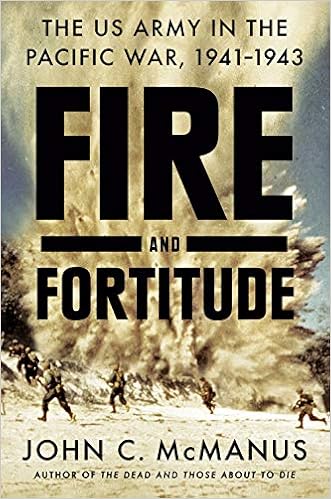
Fire and Fortitude


Fire and Fortitude: The US Army in the Pacific War, 1941-1943- John C. McManus
Dutton Caliber
Release Date: July 30, 2019

Rating:
📚📚

Synopsis: John C. McManus, one of our most highly acclaimed historians of World War II, takes readers from Pearl Harbor—a rude awakening for a military woefully unprepared for war—to Makin, a sliver of coral reef where the Army was tested against the increasingly desperate Japanese. In between were nearly two years of punishing combat as the Army transformed, at times unsteadily, from an undertrained garrison force into an unstoppable juggernaut, and America evolved from an inward-looking nation into a global superpower.
 At the pinnacle of this richly told story are the generals: Douglas MacArthur, a military autocrat driven by his dysfunctional lust for fame and power; Robert Eichelberger, perhaps the greatest commander in the theater yet consigned to obscurity by MacArthur's jealousy; "Vinegar Joe" Stillwell, a prickly soldier miscast in a diplomat's role; and Walter Krueger, a German-born officer who came to lead the largest American ground force in the Pacific. Enriching the narrative are the voices of men otherwise lost to history: the uncelebrated Army grunts who endured stifling temperatures, apocalyptic tropical storms, rampant malaria and other diseases, as well as a fanatical enemy bent on total destruction. 
___________________________________________________________

Reading about World War II generally begins with the European theater: Normandy, the Battle of Britain, Dunkirk, etc. For Americans, Pearl Harbor may be as far into the Pacific theater as they go.  Further reading generally focuses on the Navy and sea battles.  So I was very interested to read John C. McManus' Fire and Fortitude: The US Army in the Pacific War, 1941-1943 and learn more about the early Pacific war and the army.

Spoiler alert: for readers like me who know very little going in, Fire and Fortitude is not the book for you.  After reading the "Prologue" I almost decided not to continue reading the book. Written as if a college professor is giving a lecture, it put me off the author and made me worry the book was going to be written in the same style: McManus seems to want to show the reader that he knows his military history and compares World War II Pacific army work with both historic and modern day situations.  He 'talks' down to the reader, trying to impress them (one assumes) with his knowledge and the introduction to the book and its topics felt almost secondary to me.  

If you can make it past the prologue and still want to read the book, the writing style at least gets better.  There are fewer comparisons to situations past and future to distract from the present of the 1940s.  Beginning at Pearl Harbor and going to Makin in 1943, McManus provides carefully researched minute details to make the reader feel as if they are experiencing every hardship alongside the soldiers.  For anyone wanting to find out about the intense miseries of jungle warfare, this is your book. From marches along ridges to the psychological terror of being in foxholes at night, Fire and Fortitude had you covered.  It makes you wonder how anyone experiencing it (on both the American and Japanese side) came out even halfway sane.  

What Fire and Fortitude didn't do was give you the bigger picture of the Pacific theater.  When you do get some of the overall plans and decision making from the generals, it quickly gets buried again in the tiny details.  I know I read about McArthur's experiences in the Philippines and why he was obsessed with returning there after evacuating, but after a few chapters I was so bogged down in minutiae that I couldn't remember his reasons for the rest of the book.  As much as I appreciated the miseries that the soldiers went through, I could have handled fewer of the repetitious details of those miseries on every island fight and more of the big picture on why they were fighting on the islands to come away with a better understanding of the war in the Pacific.

Overall, Fire and Fortitude is not a book for a reader new to the Pacific theater.  From ship tonnage to what each soldier carried to the specific divisions and regiments who went to different places, this is a book for historians who already know an enormous amount about this theater and are looking for even more details. For the beginner, like me, McManus spends so much time focusing on the details that the bigger picture is completely lost on you.  Because of this, I found the book an ordeal to get through, and not an author I would go back to for future reading.


I received an ARC of this book from NetGalley in exchange for an honest review
Monday, April 1, 2019

True Story of the Great Escape


The True Story of the Great Escape: Stalag Luft III, March 1944 by [Vance, Jonathan]


The True Story of the Great Escape: Stalag Luft III, March 1944- Jonathan Vance
Greenhill Books
Release Date: March 31, 2019

Rating:
📚📚📚📚📚

Synopsis: Between dusk and dawn on the night of March 24th–25th 1944, a small army of Allied soldiers crawled through tunnels in Germany in a covert operation the likes of which the Third Reich had never seen before.The prison break from Stalag Luft III in eastern Germany was the largest of its kind in the Second World War. Seventy-nine Allied soldiers and airmen made it outside the wire – but only three made it outside Nazi Germany. Fifty were executed by the Gestapo.Jonathan Vance tells the incredible story that was made famous by the 1963 film The Great Escape. The escape is a classic tale of prisoner and their wardens in a battle of wits and wills.The brilliantly conceived escape plan is overshadowed only by the colourful, daring (and sometimes very funny) crew who executed it – literally under the noses of German guards.From their first days in Stalag Luft III and the forming of bonds key to such exploits, to the tunnel building, amazing escape and eventual capture, Vance's history is a vivid, compelling look at one of the greatest 'exfiltration' missions of all time.
_______________________________________________________________________

In honor of the 75th anniversary of the "Great Escape", Jonathan Vance's book, originally privately published as A Gallant Company, has been updated and reissued by Greenhill Books.  My first reaction on finishing this book was "Wow. Just. Wow."  

The True Story of the Great Escape is a detailed, carefully researched, and finely crafted account of the men of Stalag Luft III and their daring escape attempt on the night of March 24-25, 1944.  Vance gives the reader brief accounts of all of the principal POWs- their pre-war lives, how they came to be pilots, as well as the mission when they were captured- in between describing life at the camp.  What I found the most fascinating were his descriptions of how the prisoners made things.  When the plan for the great escape went underway an entire committee of prisoners made perfectly crafted clothes, forged papers, handheld compasses, maps, and anything else that might be needed- made them from materials they scrounged from the camp or bribed from guards. 

As much as this is a book about perseverance and ingenuity in the face of overwhelming odds, it is also a tribute to the men themselves.  Vance honors them all for their bravery and achievements from Roger "Big X" Bushell who masterminded the scheme down to escapees like Canadian pilot George Wiley (my grandfather's cousin).  Even though there is no surprise about how this escape will end for most of the men, I found myself hoping for the best and near tears reading what would be final goodbyes in the camp, let alone the orders for fifty of the recaptured escapers to be shot.  This is a very human story, from the pilots to the prison guards, Vance refuses to let us imagine any of them as stereotypes from a movie. 

Poignant and powerful, The True Story of the Great Escape is a must read for any history lover.     


I received an ARC of this book from NetGalley in exchange for an honest review

Tuesday, March 26, 2019

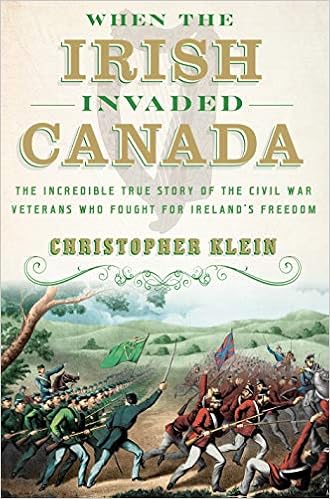
When the Irish Invaded Canada


When the Irish Invaded Canada: The Incredible True Story of the Civil War Veterans Who Fought for Ireland's Freedom- Christopher Klein
Doublday
Release Date: March 12, 2019

Rating:
📚📚📚📚

Synopsis: Just over a year after Robert E. Lee relinquished his sword, a band of Union and Confederate veterans dusted off their guns. But these former foes had no intention of reigniting the Civil War. Instead, they fought side by side to undertake one of the most fantastical missions in military history: to seize the British province of Canada and to hold it hostage until the independence of Ireland was secured.

By the time that these invasions--known collectively as the Fenian raids--began in 1866, Ireland had been Britain's unwilling colony for seven hundred years. Thousands of Civil War veterans who had fled to the United States rather than perish in the wake of the Great Hunger still considered themselves Irishmen first, Americans second. With the tacit support of the U.S. government and inspired by a previous generation of successful American revolutionaries, the group that carried out a series of five attacks on Canada--the Fenian Brotherhood--established a state in exile, planned prison breaks, weathered infighting, stockpiled weapons, and assassinated enemies. Defiantly, this motley group, including a one-armed war hero, an English spy infiltrating rebel forces, and a radical who staged his own funeral, managed to seize a piece of Canada--if only for three days.

When the Irish Invaded Canada is the untold tale of a band of fiercely patriotic Irish Americans and their chapter in Ireland's centuries-long fight for independence. Inspiring, lively, and often undeniably comic, this is a story of fighting for what's right in the face of impossible odds.

__________________________________________________________

An interesting, well-researched book, Klein tells the little known story of Irishmen fighting for Ireland's freedom in America. Plenty of context is provided to understand Irish and English feelings (both politically and personally), culminating in the Great Hunger when millions of Irish died and millions travelled to America to avoid the potato famine. Irishmen fought on both sides of the American Civil War, but many saw this battle as a training ground for a larger, more important, war- the war for Irish freedom from England.

As with any story of a large group of people, political and idealogical differences divided those planning to free Ireland. The focus here, as the title suggests, is the decision by Irish nationalists to hurt England by invading Canada. Three main invasion plans over a few years led to battles, the breaking of neutrality laws, political fighting, and eventually the largest unintended consequence of all: Canada as a separate nation. The political maneuverings were fascinating, with America working secretly (or not) to claim Canada for itself, Irish nationalists trying to hold land hostage to negotiate for Ireland's independence, and individuals searching for glory.

Klein does an excellent job showing the reader how the seemingly ridiculous plan to take Canada by a group of overly optimistic individuals directly influenced the twentieth century Irish rebellions and led to the country we know today. Fascinating and fast-paced, "When the Irish Invaded Canada" is a must read for anyone interested in nineteenth century America and Canada, let alone the evolution of the Irish national movement towards independence.

I received an ARC of this book from NetGalley in exchange for an honest review

Tuesday, October 16, 2018

Napoleon


Napoleon: A Life by [Zamoyski, Adam]


Napoleon: A Life- Adam Zamoyski
Basic Books/ Hachette
Release Date: October 16, 2018

Rating:
📚📚📚📚

Synopsis: "What a novel my life has been!" Napoleon once said of himself. Born into a poor family, the callow young man was, by twenty-six, an army general. Seduced by an older woman, his marriage transformed him into a galvanizing military commander. The Pope crowned him as Emperor of the French when he was only thirty-five. Within a few years, he became the effective master of Europe, his power unparalleled in modern history. His downfall was no less dramatic.
____________________________________________________________

Napoleon Bonaparte is one of those larger than life figures who becomes a myth, a hero, and a villain, and in the process the true human being often disappears.  In Napoleon: A Life Adam Zamoyski works to discover the man behind the legend.  Zamoyski works to place Napoleon in the context of his time period, both politically and philosophically. He works to explain the occasionally unexplainable mindset of the French Revolution and French Republic so that readers can understand how ready France was to accept someone like Napoleon as their leader.  

Zamoskyi warns readers in his introduction that he examines the military aspects of Napoleon's life only as he feels they effected his political and personal situation.  This leads to an uneven study of the military aspect of Napoleon, heavily emphasized in the beginning and much less so by the 1812 campaigns in Russia.  Waterloo receives barely a page and a half.  But since these are well researched and frequently written about in other books, I think the unevenness worked in the book's favor.  More is certainly known about those times than about Napoleon's family, his work on restoring France, or his behavior to enemies and colleagues.  

Here we discover Napoleon's formative years on Corsica and his work to define his life on his own terms.  Corsican traditions emphasized family above all and Napoleon followed this throughout his life- while his brothers and sisters only considered family when it benefitted them directly.  Napoleon was a man who grew up despising the idea of love, only to fall head over heels in love with Josephine- who I also learned far more about in this book than I had ever known before!  He was not a man who was comfortable delegating authority, which became a serious problem when he was on campaign and trying to run an empire. Even when he wanted peace, he felt his only true claim to the throne of France was as a general. 

A well-written and well researched book, Zampyshki's Napoleon delves behind the myths to get as close to the man as possible.  Neither a saint nor a demon, Napoleon is instead presented as a man with both genius and faults, who retained until the end of his life an incredible charisma that caused men to devote their lives to his star, even when it seemed hopeless.  Which is perhaps a large part of why he is still so fascinating today.

An excellent biography for those interested in learning more about French history and the Napoleonic Wars, as well as the self-made man behind the legend.

I received an ARC of this book from NetGalley in exchange for an honest review

Sunday, July 8, 2018

Indianapolis


Indianapolis: The True Story of the Worst Sea Disaster in U.S. Naval History and the Fifty-Year Fight to Exonerate an Innocent Man by [Vincent, Lynn, Vladic, Sara]


The Indianapolis: The True Story of the Worst Sea Disaster in U.S. Naval History and the Fifty-Year Fight to Exonerate an Innocent Man- Lynn Vincent & Sara Vladic
Simon & Schuster
Release Date: July 10, 2018

Rating:
📚📚📚📚📚

Synopsis: Just after midnight on July 30, 1945, days after delivering the components of the atomic bomb from California to the Pacific Islands in the most highly classified naval mission of the war, USS Indianapolis is sailing alone in the center of the Philippine Sea when she is struck by two Japanese torpedoes. The ship is instantly transformed into a fiery cauldron and sinks within minutes. Some 300 men go down with the ship. Nearly 900 make it into the water alive. For the next five nights and four days, almost three hundred miles from the nearest land, the men battle injuries, sharks, dehydration, insanity, and eventually each other. Only 316 will survive.

For the better part of a century, the story of USS Indianapolis has been understood as a sinking tale. The reality, however, is far more complicated—and compelling. Now, for the first time, thanks to a decade of original research and interviews with 107 survivors and eyewit­nesses, Lynn Vincent and Sara Vladic tell the complete story of the ship, her crew, and their final mission to save one of their own.

______________________________________________________________

Most people today know the story of the Indianapolis, if they know it at all, from the movie Jaws.  While hunting a great white shark, boat captain Quint tells Hooper and Brody of being on the Indy (as she was known by the crew) when she sunk, sharks circling until the men were pulled from the water after delivering "the bomb".  The full story, told here for the first time, is much more complex, dramatic, and heartbreaking.  Lynn Vincent and Sara Vladic do full justice to the story of the Indy, her crew, and her captain in this new book, The Indianapolis: The True Story of the Worst Sea Disaster in U.S. Naval History and the Fifty-Year Fight to Exonerate an Innocent Man.  

Vincent and Vladic have done incredible, in-depth research with only primary sources- including speaking with survivors- to piece together a saga every bit as gripping and full of personal drama as the sinking of the Titanic or Lusitania.  The stories of the crew, how they lived, how they came to be on Indy in the first place, their families and plans for the future connect you to them intimately.  Indy's final, famous mission was a series of coincidences and Naval negligence from first to last.  Originally she was not slated to carry uranium for the first atomic bomb, but due to damage from a kamikaze strike she was in California finishing repairs and called into action because of the sterling reputation of her captain, Charles McVay III.  After successfully delivering the uranium, Indy was slated to travel to Guam for training. Despite knowing there was submarine activity in the route McVay was to take, he was told by authorities the route was safe, and given no escort.  The recounting of the torpedo strikes, the sinking, and the five nights the survivors spent in the water are told in a straightforward piecing together of memories.  No additional drama is needed to make the tale emotional, dramatic,, and viscerally terrifying and heartbreaking.

The story of the Indianapolis does not end when the 316 survivors were pulled out of the water.  Vincent and Vladic follow the crew back to the States, and then all too troubling tale of the courtmarshal of Captain McVay for negligence in allowing his ship to be sunk.  It took over fifty years and an amazing amount of intense battling before this injustice was rectified and McVay's record cleared.  

Thoroughly researched and deeply moving, the story of the Indianapolis is a tale of courage, strength, and determination in the face of overwhelming odds. Despite Vincent and Vladic's prose occasionally falling victim to non-fiction book's tendency of dramatically foreshadowing what is to come (the typical "it was a mistake they would soon come to regret" type of chapter ending) and the fact that they can't seem to go more than three sentences without using similes or metaphors in describing anything, The Indianapolis is a well told, compelling story. 

Fans of Erik Larson's Dead Wake will appreciate the attention to detail not only from the American point of view, but the Japanese as well.  An absolute must-read for military history buffs, naval history buffs, or anyone curious about the story behind the tale told in Jaws, The Indianapolis is a powerful, fast-paced, emotionally moving, account of the greatest disaster in U.S. naval history.  


I received an ARC of this book from NetGalley in exchange for an honest review

Thursday, October 12, 2017

Grant

Grant by [Chernow, Ron]


Grant- Ron Chernow
Penguin Group
Release Date: October 10, 2017

Rating (out of 5):
📚📚📚📚

Synopsis: Ulysses S. Grant's life has typically been misunderstood. All too often he is caricatured as a chronic loser and an inept businessman, or as the triumphant but brutal Union general of the Civil War. But these stereotypes don't come close to capturing him, as Chernow shows in his masterful biography, the first to provide a complete understanding of the general and president whose fortunes rose and fell with dizzying speed and frequency.

With lucidity, breadth, and meticulousness, Chernow finds the threads that bind these disparate stories together, shedding new light on the man whom Walt Whitman described as “nothing heroic... and yet the greatest hero.” Chernow’s probing portrait of Grant's lifelong struggle with alcoholism transforms our understanding of the man at the deepest level. This is America's greatest biographer, bringing movingly to life one of our finest but most underappreciated presidents. The definitive biography, Grant is a grand synthesis of painstaking research and literary brilliance that makes sense of all sides of Grant's life, explaining how this simple Midwesterner could at once be so ordinary and so extraordinary.

_______________________________

As someone who loves history, I have a terrible confession to make: Grant is the first Ron Chernow book I've ever read.  It will certainly not be the last.  Chernow's Grant is meticulously researched, well-written, with an easy style and flow that make a biography feel less like a lecture and more like an intimate conversation.  He provides descriptions and details that bring the time period and the people to vivid life.

Grant was a complex man: both brilliant and naive; overly trusting in civilian life while able to perfectly predict what others would do on the battlefield; a man who claimed to have no great political ambitions yet was a rare (at the time) two term president.  Chernow reminds us of the personal connections of the generals of both the North and South- Grant attended West Point and fought in the Mexican War alongside William T. Sherman, Robert E Lee, and a veritable who's who of later Civil War leaders.  The best man at his wedding was James Longstreet, who would go on to be a great Southern general in the war.  Chernow also brings front and center Grant's hard work for African Americans, supporting the 13th, 14th, and 15th Amendments, with equality and voting rights among his lifelong crusades.  While Lincoln is remembered in American history as the President who ended slavery, readers of Grant will see that President U.S. Grant should be remembered as a tireless proponent of civil rights and militant enemy of the Ku Klux Klan.

Chernow doesn't turn away from Grant's failures in civilian life: his poverty before rejoining the army for the Civil War, his constant struggle with alcoholism, or Grant's repeated mistakes in trusting the wrong people in matters of finance- and occasionally in government.  Grant's personal traits: pride, stubbornness, loyalty among others are shown as what made him the greatest general of his time, but also caused a steep learning curve as President.  

Readers of Stephen W. Sears' Lincoln's Lieutenants will find this a perfect companion to their understanding of the generals of the Civil War, their successes and failures, radically different personalities, and their relationships with Lincoln. It continues to amaze me how individual personalities and personal ambitions shape the course of military history.

Fans of history, biographies, and military history will rejoice in this new biography of General Grant- which will stand unchallenged as his definitive biography for a long time. An easy, flowing narrative, Ron Chernow's Grant will change the average American's view of Grant forever.

I received an ARC of this book from NetGalley in exchange for an honest review

Wednesday, September 20, 2017

Alone


Alone: Britain, Churchill, and Dunkirk: Defeat Into Victory by [Korda, Michael]


Alone: Britain, Churchill, and Dunkirk: Defeat into Victory- Michael Korda
Liveright Publishing Co
Release Date: September 19, 2017

Rating (out of 5):
📚📚

Synopsis: Bringing to vivid life the world leaders, generals, and ordinary citizens who fought on both sides of the war, Michael Korda, best-selling author of Clouds of Glory, chronicles the outbreak of hostilities, recalling as a prescient young boy the enveloping tension that defined pre-Blitz London, and then as a military historian the great events that would alter the course of the twentieth century.

May 1940 was a month like no other. The superior German war machine blazed into France, as the Maginot Line, supposedly "as firmly fixed in place as the Pyramids," crumbled in days. With the fall of Holland and Belgium, the imminent fall of Paris, the British Army stranded at Dunkirk, and Neville Chamberlain’s government in political freefall, Winston Churchill became prime minister on this historical nadir of May 10, 1941. Britain, diplomatically isolated, was suddenly the only nation with the courage and the resolve to defy Hitler.


No one, after all, could have ever imagined that the most unlikely flotilla of destroyers—Dutch barges, fishing boats, yachts, and even rowboats— would rescue over 300,000 men off the beach at Dunkirk and home to England. The miraculous return of the army was greeted with a renewed call for courage, and in the months that followed, the lives of tens of millions would be inexorably transformed, often tragically so, by these epochal weeks of May 1940.
It is this pivotal turning point in world history that Korda captures with such immediacy in Alone, a work that triumphantly demonstrates that even the most calamitous defeats can become the most legendary victories.
________________________________

Michael Korda's new book Alone: Britain, Churchill, and Dunkirk: Defeat into Victory examines the the early days of World War II.  Alone covers a lot of events, mostly from the British point of view but also French and German: Chamberlain's failed appeasement policy, France and England reluctantly being drawn back into war, Churchill becoming Prime Minister, Germany rewriting the use of tanks in warfare, conflicting personalities and agendas among allied generals.  All leading up to the evacuation of over 300,000 English and French troops from the beach of Dunkirk, late May 1940.  Scattered throughout the researched history are personal stories and a bit of family history as Korda reflects on his own memories as a 6 year old in a wealthy family of actors and movie makers.

Based on the book blurb for Alone, I had high hopes this would be a World War II history along the lines of Lynne Olson's Last Hope Island- meticulously researched, written with vivid detail and an eye for making individuals and their experiences leap off the page and into your mind.  Alone is certainly well researched.  I now have a much better understanding of the creation and purpose of the famed French Maginot Line after reading the early part of Alone.  The research into the French and British military leaders, their different approaches, their conflicts among themselves, and the difficulties they had in communicating with each other (not only with radios, and phones, but personal dislikes that often meant one man in charge wasn't on speaking terms with another) was well done and gave you a sense of what the chaos on the ground must have been like. How they accomplished any successes with so many personal clashes going on is (as is the case in most military histories I've read recently) amazing.

The Korda family moments interspersed within Alone were occasionally interesting, but generally felt like they belonged in a separate book.  Instead of showing what life on the home front was normally like, more often than not they showed how money could soften difficulties. Korda frequently mentions how his uncle Alex worked with Churchill and the government to make his (then current) movies into subtle propaganda designed to gain the sympathy and support of the United States.  The Thief of Baghdad and That Hamilton Woman were eventually made in the US to seem like 'regular' big budget Hollywood movies instead of British propaganda.  But the reader never gets an idea of what that meant, or if it worked- which would have made me much more interested in it.  The actual telling of the evacuation from Dunkirk only takes place in the last 100 or so pages of Alone and often seemed scattered and disorienting.  I'm sure that this is what the people on the ground experienced at the time, but I was hoping for a more coherent and understandable account to this interesting and unique moment in history.

Overall I was disappointed in Alone.  Instead of being a vivid account of a slice of history it was often repetitive, and choppily written.  Personal family stories didn't blend in to give us a better feeling for the time but mostly jarred the reader from the military narrative.  Military leaders and personalities blended together, making it hard to remember who was who (often even what side they were on) and even Winston Churchill didn't spring to life here.  The evacuation story itself almost seemed like an afterthought, with a few good, clear moments.  People who have seen Chris Nolan's 2017 movie Dunkirk will recognize the inspiration for the "sea" story of The Moonstone, and find the original story ( in my opinion) even more interesting and gripping- one of the few moments I could say that about Alone.
     

I received an ARC of this book from NetGalley in exchange for an honest review

Wednesday, September 13, 2017

Whispers Across the Atlantick

Whispers Across the Atlantick: General William Howe and the American Revolution by [Smith, David]


Whispers Across the Atlantick: General William Howe and the American Revolution- David Smith
Osprey Publishing
Release Date: September 27, 2017

Rating (out of 5):
📚📚

Synopsis:  General William Howe was the commander-in-chief of the British forces during the early campaigns of the American Revolutionary War (1775-1783). Howe evoked passionate reactions in the people he worked with – his men loved him, his second-in-command detested him, his enemies feared him, his political masters despaired of him. There was even a plot to murder him, in which British officers as well as Americans were implicated. 

Howe's story includes intrigue, romance and betrayal, played out on the battlefields of North America and concluding in a courtroom at the House of Commons, where Howe defended his decisions with his reputation and possibly his life on the line. The inquiry, complete with witness testimonies and savage debate between the bitterly divided factions of the British Parliament, gives Howe's story the flavour of a courtroom drama. Using extensive research and recent archival discoveries, this book tells the thrilling story of the man who always seemed to be on the verge of winning the American Revolutionary War for Britain, only to repeatedly fail to deliver the final blow.
________________________________

David Smith's Whispers Across the Atlantick what he calls an "unapologetically narrow view of the first two campaigns of the War of Independence, mostly considering events through Howe's eyes."  His preface opens by giving us the idea that within Whispers we will discover more about Howe, the general who commanded two successful years of campaigning in the American War of Independence.    He questions how it is possible that Howe is a nearly forgotten general among the British military annals, and posits that the lack of primary material from Howe and his family available to us today (the Howe family papers having been destroyed in a fire) are what have kept him in the shadows, seen only through the eyes of others. Smith then says that newly discovered draft of Howe's speech to the House of Commons in 1779 will help offer "telling insights into some of Howe's biggest decisions" and the Ph.D thesis he had been working on turned into a book attempting to make Howe a more complex historical figure for the reader.

A highly promising beginning for any history lover!  However, Smith largely fails to deliver on his promises.  Chapter by chapter we follow Howe through taking command of the British armies in America, through the capture of New York, to Philadelphia and White Plains.  Two years of campaigns are briefly touched on, the details of any given engagement largely left out.  Presumably the author thinks that if you're reading Whispers, you have already read extensively on these battles, their conditions, and the importance to both sides.  Each chapter begins with a quote from Howe's House of Commons speech and then an imagining of what his audience thought or might have reacted.  Readers like me, who picked up Whispers knowing virtually nothing about Howe except his name, may spend as much time wondering why he's going to be presenting to the House in 1779 as we do wondering what he's doing in 1777.  The answer comes at the very end of the book: Howe's resignation has been accepted and he has returned to England, but is unhappy with how things have been left.  It is hard for a modern reader to understand, based on Smith's explanation, exactly what Howe was so upset about that he pushed to have a hearing in the House, or what that hearing was supposed to resolve.  You get the feeling that Howe and his contemporaries may not have known either. 

There are some brief, interesting comparisons between the speech Howe originally wrote and the one he actually gave, although despite Smith's tantalizing promises nothing really comes from it.  Howe does not become a fully formed person for the reader, there are no striking insights into his character. The conclusion Smith comes to seems, to me at least, to be a confirmation of what Smith expected to find and what others had already deduced: Howe is not recognized as a British military genius because he wasn't one.  He knew how to play the game and say the right words to the right people to get the promotion, but in fact had no idea what he was doing when he took command.  The only real question seems to be: why did Howe want a job he was so supremely unqualified for, and why did he feel insulted when it became obvious to everyone else that he didn't know what he was doing?

A book with an interesting premise, Whispers Across the Atlantick fails to deliver on any front. While Whispers may provide minute new details to readers already intimately familiar with the battles and the players, it is largely a dry and uninteresting read that delivers nothing special to the casual American Revolution/military history reader.


I received an ARC of this book from NetGalley in exchange for an honest review.

Sunday, May 7, 2017

Last Hope Island

Last Hope Island: Britain, Occupied Europe, and the Brotherhood That Helped Turn the Tide of War by [Olson, Lynne]


Last Hope Island: Britain's Brotherhood with Occupied Europe, and the Unsung Heroes Who Turned the Tide of War- Lynne Olson
Random House
Release Date: April 25, 2017

Rating (out of 5):
📚📚📚📚📚

Synopsis: When the Nazi blitzkrieg rolled over continental Europe in the early days of World War II, the city of London became a refuge for the governments and armed forces of six occupied nations who escaped there to continue the fight. So, too, did General Charles de Gaulle, the self-appointed representative of free France.     

As the only European democracy still holding out against Hitler, Britain became known to occupied countries as “Last Hope Island.” Getting there, one young emigré declared, was “like getting to heaven.”

In this epic, character-driven narrative, acclaimed historian Lynne Olson takes us back to those perilous days when the British and their European guests joined forces to combat the mightiest military force in history. Here we meet the courageous King Haakon of Norway, whose distinctive “H7” monogram became a symbol of his country’s resistance to Nazi rule, and his fiery Dutch counterpart, Queen Wilhelmina, whose antifascist radio broadcasts rallied the spirits of her defeated people. Here, too, is the Earl of Suffolk, a swashbuckling British aristocrat whose rescue of two nuclear physicists from France helped make the Manhattan Project possible.

Last Hope Island also recounts some of the Europeans’ heretofore unsung exploits that helped tilt the balance against the Axis: the crucial efforts of Polish pilots during the Battle of Britain; the vital role played by French and Polish code breakers in cracking the Germans’ reputedly indecipherable Enigma code; and the flood of top-secret intelligence about German operations—gathered by spies throughout occupied Europe—that helped ensure the success of the 1944 Allied invasion.


________________________________

Last Hope Island is a powerfully written amalgamation of stories of a Europe occupied by Nazi Germany and the men, women, and governments who joined forces to resist a common enemy.  I was fascinated to learn these new aspects to World War II- many of them unknown or poorly understood by myself and (probably) many others.  Olson takes a dauntingly large saga and humanizes it, introducing us to King Haakon of Norway and the Dutch Queen Wilhemina, both standing strong against Hitler and becoming symbols of strength for their countries.  We meet heroes like Andree de Jongh and the de Nooij sisters, among others who helped smuggle Allied soldiers out to safety or hid wounded soldiers, protecting them from Nazis.  Especially important are the stories of Polish and Czech soldiers and pilots who helped turn the Battle of Britain, the Polish cryptographers who broke the "unbreakable" Enigma code and the intelligence agents who smuggled out information vital for the D-Day beach landings.

Olson does her best not to idolize or whitewash any of the history she examines.  Along with the heroic victories are plenty of defeats, and Olson takes an honest look at the British and American leaders who refused to accept assistance or believe information coming from Europeans- leading to such disasters as the Allied defeat at Arnhem in 1944.  The popular myth of Britain's Secret Service as being a brilliant and unbeatable spy operation is smashed to bits as Olson examines MI6 and the Special Operations Executive (SOE).  Originally underfunded operations recruiting young aristocrats and providing little to no training before sending them into the field, the groups seemed to put more emphasis on fighting each other for credit and funding than focusing on improving their intelligence operations to defeat Hitler. 

The BBC gets special notice in Last Hope Island, as a beacon of hope as well as providing the public with a separation from propaganda and focusing on telling the news- the truth, the whole truth, no matter how awful it might be.  I found the chapters focusing on the BBC especially poignant and inspirational because they focused on the every day, and inspiring and encouraging people through even small actions.  The story of the "avalanche of Vs" might seem like the kind of thing you'd see in a movie, but was a perfect example of how a small action could help people feel like they were not just giving up.  In a world as inundated with news as ours is, Last Hope Island helps us understand the power of the radio when it was almost the only way of connecting with the outside world.

Lynne Olson does a wonderful job of immersing the reader in the world of Occupied Europe and wartime London, and the mindset of the people living there.  Last Hope Island is a riveting book, and certainly a must-read for history lovers.

I received an ARC of this book from NetGalley in exchange for an honest review.