Showing posts with label Hitler. Show all posts

Monday, April 9, 2018

Death of Democracy


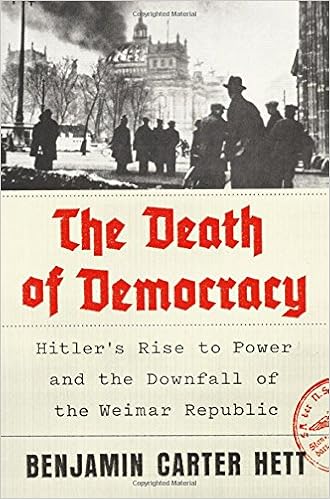
The Death of Democracy: Hitler's Rise to Power and the Downfall of the Weimar Republic- Benjamin Carter Hett
Henry Holt & Co.
Release Date: April 3, 2018

Rating:
📚

Synopsis: Why did democracy fall apart so quickly and completely in Germany in the 1930s? How did a democratic government allow Adolf Hitler to seize power? In The Death of Democracy, Benjamin Carter Hett answers these questions, and the story he tells has disturbing resonances for our own time.


To say that Hitler was elected is too simple. He would never have come to power if Germany’s leading politicians had not responded to a spate of populist insurgencies by trying to co-opt him, a strategy that backed them into a corner from which the only way out was to bring the Nazis in. Hett lays bare the misguided confidence of conservative politicians who believed that Hitler and his followers would willingly support them, not recognizing that their efforts to use the Nazis actually played into Hitler’s hands. They had willingly given him the tools to turn Germany into a vicious dictatorship.
________________________________________________

How Hitler was able to come into power in Germany has always been an interesting debate.  What could have been differently? How much of our debates are 20-20 hindsight versus what was actually seen and known at the time?  Could something like that ever happen again?  Benjamin Carter Hett's The Death of Democracy: Hitler's Rise to Power and the Downfall of the Weimar Republic is the latest look into the Germany of the 1920s and 1930s and an attempt to understand what happened.  

Unfortunately, for as potentially interesting as the topic is, Hett completely failed to keep me engaged in the book.  He assumes his reader is familiar with the Weimar republic and much of the German condition post World War I, and mentions conspiracies and people that he only later goes back to explain.  There was a level of back and forth to his timeline that kept me uncertain of the order of many of the events he was talking about.  I found it hard to keep track of the different political parties in Germany for most of the book, thought whether that was a lack of understanding on my part or Hett's to explain in memorable detail I still don't know.  Often repetitive, hammering in points that the readers easily grasps and remembers while glancing off topics you wish he's spent more time on, Hett explores how no one single event created the situation, but decades of cultural, political, and economic change and unrest.  By the end of the book I didn't feel like I had a much clearer grasp on the topic as when I started, but Hett did write one idea that stuck out to me, and probably summed up much of the situation: sometimes it isn't about reality.  Statements can be demonstrably untrue, but it is all about what people emotionally need to believe, even in the face of evidence to the contrary.

For a book that was only a little over 200 pages, reading it seemed to be an uphill slog the whole way, and much more work than it was worth.  Hett spent as much time making comparisons between Germany in the 1930s and the Nazi methods and today's American political climate (while carefully not naming names) that it seemed to me the end point of his book was not so much to explain how Hitler and the Nazis managed to come into power (which he had only limited success with for me) as showing how it can happen again today.  Anyone who really wants to give this book a try to see what they can learn should just read the last chapter, which is as much a summary of the rest of the book as a wrap up and lead in to World War II.  It gives you the clearest ideas without actually making you read the entire book.

I received an ARC of this book from NetGalley in exchange for an honest review

Wednesday, September 20, 2017

Alone


Alone: Britain, Churchill, and Dunkirk: Defeat Into Victory by [Korda, Michael]


Alone: Britain, Churchill, and Dunkirk: Defeat into Victory- Michael Korda
Liveright Publishing Co
Release Date: September 19, 2017

Rating (out of 5):
📚📚

Synopsis: Bringing to vivid life the world leaders, generals, and ordinary citizens who fought on both sides of the war, Michael Korda, best-selling author of Clouds of Glory, chronicles the outbreak of hostilities, recalling as a prescient young boy the enveloping tension that defined pre-Blitz London, and then as a military historian the great events that would alter the course of the twentieth century.

May 1940 was a month like no other. The superior German war machine blazed into France, as the Maginot Line, supposedly "as firmly fixed in place as the Pyramids," crumbled in days. With the fall of Holland and Belgium, the imminent fall of Paris, the British Army stranded at Dunkirk, and Neville Chamberlain’s government in political freefall, Winston Churchill became prime minister on this historical nadir of May 10, 1941. Britain, diplomatically isolated, was suddenly the only nation with the courage and the resolve to defy Hitler.


No one, after all, could have ever imagined that the most unlikely flotilla of destroyers—Dutch barges, fishing boats, yachts, and even rowboats— would rescue over 300,000 men off the beach at Dunkirk and home to England. The miraculous return of the army was greeted with a renewed call for courage, and in the months that followed, the lives of tens of millions would be inexorably transformed, often tragically so, by these epochal weeks of May 1940.
It is this pivotal turning point in world history that Korda captures with such immediacy in Alone, a work that triumphantly demonstrates that even the most calamitous defeats can become the most legendary victories.
________________________________

Michael Korda's new book Alone: Britain, Churchill, and Dunkirk: Defeat into Victory examines the the early days of World War II.  Alone covers a lot of events, mostly from the British point of view but also French and German: Chamberlain's failed appeasement policy, France and England reluctantly being drawn back into war, Churchill becoming Prime Minister, Germany rewriting the use of tanks in warfare, conflicting personalities and agendas among allied generals.  All leading up to the evacuation of over 300,000 English and French troops from the beach of Dunkirk, late May 1940.  Scattered throughout the researched history are personal stories and a bit of family history as Korda reflects on his own memories as a 6 year old in a wealthy family of actors and movie makers.

Based on the book blurb for Alone, I had high hopes this would be a World War II history along the lines of Lynne Olson's Last Hope Island- meticulously researched, written with vivid detail and an eye for making individuals and their experiences leap off the page and into your mind.  Alone is certainly well researched.  I now have a much better understanding of the creation and purpose of the famed French Maginot Line after reading the early part of Alone.  The research into the French and British military leaders, their different approaches, their conflicts among themselves, and the difficulties they had in communicating with each other (not only with radios, and phones, but personal dislikes that often meant one man in charge wasn't on speaking terms with another) was well done and gave you a sense of what the chaos on the ground must have been like. How they accomplished any successes with so many personal clashes going on is (as is the case in most military histories I've read recently) amazing.

The Korda family moments interspersed within Alone were occasionally interesting, but generally felt like they belonged in a separate book.  Instead of showing what life on the home front was normally like, more often than not they showed how money could soften difficulties. Korda frequently mentions how his uncle Alex worked with Churchill and the government to make his (then current) movies into subtle propaganda designed to gain the sympathy and support of the United States.  The Thief of Baghdad and That Hamilton Woman were eventually made in the US to seem like 'regular' big budget Hollywood movies instead of British propaganda.  But the reader never gets an idea of what that meant, or if it worked- which would have made me much more interested in it.  The actual telling of the evacuation from Dunkirk only takes place in the last 100 or so pages of Alone and often seemed scattered and disorienting.  I'm sure that this is what the people on the ground experienced at the time, but I was hoping for a more coherent and understandable account to this interesting and unique moment in history.

Overall I was disappointed in Alone.  Instead of being a vivid account of a slice of history it was often repetitive, and choppily written.  Personal family stories didn't blend in to give us a better feeling for the time but mostly jarred the reader from the military narrative.  Military leaders and personalities blended together, making it hard to remember who was who (often even what side they were on) and even Winston Churchill didn't spring to life here.  The evacuation story itself almost seemed like an afterthought, with a few good, clear moments.  People who have seen Chris Nolan's 2017 movie Dunkirk will recognize the inspiration for the "sea" story of The Moonstone, and find the original story ( in my opinion) even more interesting and gripping- one of the few moments I could say that about Alone.
     

I received an ARC of this book from NetGalley in exchange for an honest review

Monday, October 24, 2016

Plots Against Hitler

The Plots Against Hitler by [Orbach, Danny]


The Plots Against Hitler- Danny Orbach
Houghton Mifflin Harcourt
Release Date: October 11, 2016

Rating (Out of 5):
📚📚📚📚

Synopsis:  In 1933, Adolf Hitler became Chancellor of Germany. A year later, all parties but the Nazis had been outlawed, freedom of the press was but a memory, and Hitler’s dominance seemed complete. Yet over the next few years, an unlikely clutch of conspirators emerged – soldiers, schoolteachers, politicians, diplomats, theologians, even a carpenter – who would try repeatedly to end the Fuhrer’s genocidal reign. This dramatic and deeply researched book tells the full story of those noble, ingenious, and doomed efforts. This is history at its most suspenseful, as we witness secret midnight meetings, crises of conscience, fierce debates among old friends about whether and how to dismantle Nazism, and the various plots themselves being devised and executed.  Though we know how this story ends, we’ve had no idea until now how close it came – several times – to ending very differently

____________________


The Plots Against Hitler is a well written and well researched new look at the stories of different Germans- both military and civilian- who plotted against Hitler throughout the course of his reign.  Even knowing the end of the story, the book was full of drama, intrigue, and suspense.  I knew very little about any of this before reading Orbach's book and came away from it with a deeper understanding of Germany during World War II.  Although I sometimes had trouble keeping track of individuals and their roles in the resistance, and the book sometimes fell into repeating itself, I enjoyed this informative and suspenseful history.

Plots is a balanced look at German resistance against Hitler from 1933 through 1945 and looks not only at famous attempts like Operation Valkyrie, but other serious attempts as well. I was often amazed at how many of these plots, including attempts by individual civilians, came very close to working and it was only sheer bad luck that kept them from succeeding. 

One of the most interesting parts of the book for me was the end.  After exploring the various conspiracies and attempts from military and practical views, Orbach spends the last few chapters analyzing the motivations and, to a degree, the characters of members of the resistance.  He tries to discover what their motives were in terms of their own morals and ethics, whether that means they were driven by religion, patriotism, or empathy.  And he does this by analyzing everything not through the lens of 21st century hindsight and morals, but from the morals and characters of the men and women in 1930s and 1940s Germany.  The results are thought-provoking and fascinating. The Plots Against Hitler are not the stories of kings and tyrants, but of individuals making hard decisions and struggling to decide what they can live with and what sacrifices they are willing to make for what they saw as the greater good.

A must read for any history lover, especially those interested in World War II history.

I received an ARC of this book from NetGalley in exchange for an honest review