Showing posts with label Winston Churchill. Show all posts

Friday, October 17, 2025

Winston and the Windsors


Winston and the Windsors: How Churchill Shaped a Royal Dynasty- Andrew Morton

Hanover Square Press

Release Date: October 21, 2025

Rating: 📚📚📚📚

Synopsis: Few figures in British history have been so deeply and consequentially involved with the British royal family as Winston Churchill. Churchill was unique in his helping to shape not only a single reign but an entire royal dynasty.

However, it was by no means a seamless relationship. At times, the royals treated him with suspicion and contempt; at others they were avuncular, competitive and cheering. Yet whether he was playing the role of antagonist to the royal family or that of trusted confidante, the Prime Minister's influence was central to the twentieth-century history of the monarchy. This is drama of the first order, at times thrilling and always compelling.

Winston and the Windsors marks the first dual biography of Winston Churchill alongside the royal family. Having unearthed much under-appreciated archival material – including diary entries, postcards and letters to and from Kings, Queens and princes – Morton presents a meticulously researched biography of a royal house and a beloved Prime Minister.
______________________________________________

I've read many books on Winston Churchill, but this is the first I've read that focuses specifically on his relationship with the royal family- not as The Monarchy, but as individuals. In following his career there are certainly cases where his influence did help shape the monarchy's path, particularly during World War II, but it was the individual stories I found most interesting.
  
Churchill was born during the reign of Queen Victoria and his parents were close friends with her eldest son, the Prince of Wales and future King Edward VII. While I knew Edward and Churchill's mother Jennie had a close friendship, I'd never known how close the relationship between Edward and Winston was. Even after becoming king, Edward took the time to offer nearly parternal advise and praise to young Winston- something he never received from his own father. That section was perhaps my favorite to read for the new knowledge I gained and the stories it shared. 

As a rising politician Churchill frequently clashed in his thoughts and policy ideals with the reigning monarch (especially George V!) and Morton includes notes and diary entries from George V with his thoughts on Churchill that were less than complementary at times. But each man was able to separate politics from the personal and it was fascinating to watch their developing relationships on different fronts.

Much of the information covering the Abdication Crisis, Winston's relationship with David (Edward VIII) and George VI wasn't new but still presented well. And within the context of the book it put a different spin on things I already knew. Morton goes deeply, if briefly into Churchill's relationship with Queen Elizabeth II and I greatly enjoyed that section- again the context of the book helped me see things I knew as well as new information (maybe just new to me) in new and interesting ways.

Winston and the Windsors is more than a new biography of Winston Churchill. It is a biography of the Windsor family and the monarchy throughout the first part of the 20th century, and the huge part that Churchill played in keeping it a strong institution in trying times. Anyone interested in Churchill, the British royal family, and 20th century Briish history should read the carefully researched and entertainingly written book.

I received an ARC of this book from NetGalley in exchange for an honest review


Thursday, December 2, 2021

The Churchill Sisters


 The Churchill Sisters: The Extraordinary Lives of Winston and Clementine's Daughters- Rachel Trethewey 

St. Martin's Press

Release Date: December  7, 2021

Rating: ðŸ“šðŸ“šðŸ“š

Synopsis:  Bright, attractive and well-connected, in any other family the Churchill girls – Diana, Sarah, Marigold and Mary – would have shone. But they were not in another family, they were Churchills, and neither they nor anyone else could ever forget it. From their father – ‘the greatest Englishman’ – to their brother, golden boy Randolph, to their eccentric and exciting cousins, the Mitford Girls, they were surrounded by a clan of larger-than-life characters which often saw them overlooked. While Marigold died too young to achieve her potential, the other daughters lived lives full of passion, drama and tragedy.

Diana, intense and diffident; Sarah, glamorous and stubborn; Mary, dependable yet determined – each so different but each imbued with a sense of responsibility toward each other and their country. Far from being cosseted debutantes, these women were eyewitnesses at some of the most important events in world history, at Tehran, Yalta and Potsdam. Yet this is not a story set on the battlefields or in Parliament; it is an intimate saga that sheds light on the complex dynamics of family set against the backdrop of a tumultuous century.

Drawing on previously unpublished family letters from the Churchill archives, The Churchill Sisters brings Winston’s daughters out of the shadows and tells their remarkable stories for the first time

__________________________________________________________________________

The Churchill Sisters is the first book I've read devoted solely to the daughters of Winston Churchill, where they are the focus instead of mentioned on the sides, as in Lynne Olson's fabulous books Citizens of London and Erik Larson's The Splendid and the Vile. Diana, Sarah, and Mary Churchill each lived in a world where women were, at least initially, considered second to men- and as a man of his era Winston thought this way too.  It was exposure to strong women like his wife Clementine and his daughters that made Winston change his mind. But also in the Churchill house, Winston came first always. Everyone believed his career and his work came first. This, combined with being the children of a great man and being children in a time when their class rarely were raised by their parents, and the childhood the younger generation of Churchills had was quite different from one we would recognize today. Their mother, Clementine, was like many others of her generation and class and was distant from her children, especially when they were young, which all of them came to regret later in life.  

I was a little disappointed with the first half of the book, as it didn't tell me anything particularly new. Anyone who has read The Splendid and the Vile or Citizens of London will know most of the early stories of the girls, particularly the war years as they came into their own helping in the war effort. Author Tretheway lingers a bit on each daughter's psychological need to live up to their parent's expectations but beyond that I didn't learn anything new. The second half, post World War II, however, I found more interesting because that was uncharted territory for me. The tragic stories of Diana and Sarah- each trying to find fulfillment in their own ways and never quite reaching their goals or happiness- were heartbreaking. Sarah and Mary taking turns being the one the others leaned on as the others fell apart, the mental illnesses and emotional collapses each sister experienced but tried to keep from their parents . . . the Churchills seems to be a family ahead of their time in accepting the idea of mental illness and treating it as an illness, one to be handled by doctors and not ignored with a 'stiff upper lip', which I was impressed by. 

Each daughter tried to live up to the father their worshipped as a hero and wanted to have look proudly on them, each wanted to make their mother's life a bit easier in caring for that father. Yet they also wanted to be their own person, and went in separate ways to discover who they were and what they might do with their lives. Although constrained at times by the society they grew up in and by the shadow of their father, they each faced life's challenges head on- whether that became constructive or destructive. 

While the writing wasn't always top level and was occasionally repetitive, I would certainly recommend The Churchill Sisters to anyone interested in women's lives over the course of the twentieth century, history buffs, and, of course, Churchill fans. A good new addition to the library, using archives newly opened to researchers.

I received an ARC of this book from NetGalley in exchange for an honest review 

Thursday, April 1, 2021

Churchill and Son


Churchill and Son- Josh Ireland

Penguin Group/Dutton

Release Date: March 30, 2021

Rating: ðŸ“šðŸ“šðŸ“šðŸ“šðŸ“š

Synopsis: We think we know Winston Churchill: the bulldog grimace, the ever-present cigar, the wit and wisdom that led Great Britain through the Second World War. Yet away from the House of Commons and the Cabinet War Rooms, Churchill was a loving family man who doted on his children, none more so than Randolph, his only boy and Winston's anointed heir to the Churchill legacy.

Randolph may have been born in his father's shadow, but his father, who had been neglected by his own parents, was determined to see him go far. For decades, throughout Winston's climb to greatness, father and son were inseparable--dining with Britain's elite, gossiping and swilling Champagne at high society parties, holidaying on the French Riviera, touring Prohibition-era America. Captivated by Winston's power, bravery, and charisma, Randolph worshipped his father, and Winston obsessed over his son's future. But their love was complex and combustible, complicated by money, class, and privilege, shaded with ambition, outsize expectations, resentments, and failures.
__________________________________________________________________

Winston Churchill is one of those fascinating people who you are always learning something new about, and who we will always want to read more about. Look in any bookstore and you'll probably see more books about him than anyone else. I am definitely one of the people helping to fuel this industry- always eager to read the next book on this complex man. After reading Erik Larson's wonderful The Splendid and the Vile I grew curious about his family members- especially his son, Randolph.  So when Josh Ireland came out with Churchill and Son I jumped on it.

Churchill and Son describes the fascinating, emotional, and volatile relationship between Winston and Randolph.  After being neglected by his own father (probably the best thing he ever did for Winston, in my opinion) Winston was determined to have a close bond with his own son. He lavished praise and affection on the boy, encouraged him to always speak his mind, and to bow down to no-one. Randolph, in return, worshipped Winston and supported his every political stance. Randolph inherited all of Winston's good qualities: intelligence, brilliant public speaking ability, and charisma.  But Josh Ireland doesn't pull any punches or sugarcoat Randolph's or Winston's bad qualities.  Their worst qualities are also on display- temper, frequent lack of empathy, ignoring all others to focus on themselves. Winston spoiled Randolph as a child and indulged him to the point of his being uncontrollable as a youth- and Randolph never grew out of this. Hard drinking, hard gambling, frequently cruel to friends as well as enemies and never one to forget a grudge, Randolph grew up being told he was heir to the Churchill dynasty- and believed himself entitled to be handed all that and more without having to work for it.  

Ireland does a brilliant job of putting readers into the center of the Churchill family dynamics.  You sympathize with the long suffering Clementine and their daughters as they are pushed to the side and Winston focuses on Randolph.  You want to reach into the pages and shake Randolph for some of his worst episodes and while feeling pity for Winston for having this wretched son, you are also tempted to point out to him that spoiling the boy led to some of this behavior in the adult. The explosive fights between Winston and Randolph are as shocking to the reader as to those who witnessed them- even though after awhile you know exactly what is coming. I especially appreciated that Ireland doesn't focus only on specific time periods, like World War II, but covers their entire lives- paying special attention to Churchill's "wilderness years" between the wars, which I had not read much about before. 

Meticulously researched, fascinating, brilliantly and sympathetically written without pulling any punches, Churchill and Son is the behind the scenes story of Churchill family dynamics.  It's the age-old story of a man trying to make up for his own poor relationship with his father by giving his son everything. And the age-old story of a son who can never step out of the shadow of his famous father.


I received an ARC of this book from NetGalley in exchange for an honest review

Sunday, February 23, 2020

The Splendid and the Vile


The Splendid and the Vile: A Saga of Churchill, Family, and Defiance During the Blitz by [Larson, Erik]


The Splendid and the Vile: A Saga of Churchill, Family, and Defiance During the Blitz- Erik Larson
Crown/Random House
Release Date: February 25, 2020

Rating:
📚📚📚📚📚

Synopsis: On Winston Churchill’s first day as prime minister, Adolf Hitler invaded Holland and Belgium. Poland and Czechoslovakia had already fallen, and the Dunkirk evacuation was just two weeks away. For the next twelve months, Hitler would wage a relentless bombing campaign, killing 45,000 Britons. It was up to Churchill to hold his country together and persuade President Franklin Roosevelt that Britain was a worthy ally—and willing to fight to the end.

In The Splendid and the Vile, Erik Larson shows, in cinematic detail, how Churchill taught the British people “the art of being fearless.” It is a story of political brinkmanship, but it’s also an intimate domestic drama, set against the backdrop of Churchill’s prime-ministerial country home, Chequers; his wartime retreat, Ditchley, where he and his entourage go when the moon is brightest and the bombing threat is highest; and of course 10 Downing Street in London. Drawing on diaries, original archival documents, and once-secret intelligence reports—some released only recently—Larson provides a new lens on London’s darkest year through the day-to-day experience of Churchill and his family: his wife, Clementine; their youngest daughter, Mary, who chafes against her parents’ wartime protectiveness; their son, Randolph, and his beautiful, unhappy wife, Pamela; Pamela’s illicit lover, a dashing American emissary; and the advisers in Churchill’s “Secret Circle,” to whom he turns in the hardest moments.
 
The Splendid and the Vile takes readers out of today’s political dysfunction and back to a time of true leadership, when, in the face of unrelenting horror, Churchill’s eloquence, courage, and perseverance bound a country, and a family, together.
_________________________________________________________________


Erik Larson has done it again! There is no other way to start a discussion of Larson's (Dead Wake) newest book: The Splendid and the Vile.  This is the story of Churchill and his family in his first year as prime minister as Hitler not only takes over swathes of Europe, but also begins bombing England in what would become known as the Blitz.  

Not solely a military or political history, Splendid seeks to answer the question: what was it like for people living through the Blitz?  How did Churchill's family balance politics and personal lives?  Using personal diaries and archival documents, Larson is able to tell these stories using the words of people like Mary Churchill, Winston's youngest daughter; Pamela Churchill, his unhappy daughter-in-law; and John Colville, one of his personal secretaries.  Their loves and losses show attempts to carry on normal lives while also dealing with bombings that often came quite close to killing them. Although I hadn't really thought about it before reading Splendid, I knew very little about Churchill's family and quickly became fascinated to learn about them and their experiences.  I found myself asking the book (in the middle of tense military action when I hadn't heard from the family in awhile) "but how is Pamela coping?  Is Mary really going to marry that guy? What the heck is Randolph thinking?" every bit as anxiously as I found myself worrying over where the next bomb would fall. 

Larson's eye for detail and talent for descriptions create a cinematic effect: the reader can see the moonlit countryside from the view of a Luftwaffe pilot, smell the cordite and taste the dust and grit of bombed out buildings. This should appeal to the casual reader every bit as much as the history devotee.

 My favorite histories are ones that look at the day-to-day experience of regular people as well as the movers and shakers.  Thanks to extensive diaries kept by people across England, those details are available to us and Larson uses these diaries every bit as much as the diaries of Churchill's private secretaries. Because of this, as well as Larson's excellent writing style, readers will be drawn in from page one and held, enthralled, until the very end.


I received an ARC of this book from NetGalley in exchange for an honest review

Wednesday, September 20, 2017

Alone


Alone: Britain, Churchill, and Dunkirk: Defeat Into Victory by [Korda, Michael]


Alone: Britain, Churchill, and Dunkirk: Defeat into Victory- Michael Korda
Liveright Publishing Co
Release Date: September 19, 2017

Rating (out of 5):
📚📚

Synopsis: Bringing to vivid life the world leaders, generals, and ordinary citizens who fought on both sides of the war, Michael Korda, best-selling author of Clouds of Glory, chronicles the outbreak of hostilities, recalling as a prescient young boy the enveloping tension that defined pre-Blitz London, and then as a military historian the great events that would alter the course of the twentieth century.

May 1940 was a month like no other. The superior German war machine blazed into France, as the Maginot Line, supposedly "as firmly fixed in place as the Pyramids," crumbled in days. With the fall of Holland and Belgium, the imminent fall of Paris, the British Army stranded at Dunkirk, and Neville Chamberlain’s government in political freefall, Winston Churchill became prime minister on this historical nadir of May 10, 1941. Britain, diplomatically isolated, was suddenly the only nation with the courage and the resolve to defy Hitler.


No one, after all, could have ever imagined that the most unlikely flotilla of destroyers—Dutch barges, fishing boats, yachts, and even rowboats— would rescue over 300,000 men off the beach at Dunkirk and home to England. The miraculous return of the army was greeted with a renewed call for courage, and in the months that followed, the lives of tens of millions would be inexorably transformed, often tragically so, by these epochal weeks of May 1940.
It is this pivotal turning point in world history that Korda captures with such immediacy in Alone, a work that triumphantly demonstrates that even the most calamitous defeats can become the most legendary victories.
________________________________

Michael Korda's new book Alone: Britain, Churchill, and Dunkirk: Defeat into Victory examines the the early days of World War II.  Alone covers a lot of events, mostly from the British point of view but also French and German: Chamberlain's failed appeasement policy, France and England reluctantly being drawn back into war, Churchill becoming Prime Minister, Germany rewriting the use of tanks in warfare, conflicting personalities and agendas among allied generals.  All leading up to the evacuation of over 300,000 English and French troops from the beach of Dunkirk, late May 1940.  Scattered throughout the researched history are personal stories and a bit of family history as Korda reflects on his own memories as a 6 year old in a wealthy family of actors and movie makers.

Based on the book blurb for Alone, I had high hopes this would be a World War II history along the lines of Lynne Olson's Last Hope Island- meticulously researched, written with vivid detail and an eye for making individuals and their experiences leap off the page and into your mind.  Alone is certainly well researched.  I now have a much better understanding of the creation and purpose of the famed French Maginot Line after reading the early part of Alone.  The research into the French and British military leaders, their different approaches, their conflicts among themselves, and the difficulties they had in communicating with each other (not only with radios, and phones, but personal dislikes that often meant one man in charge wasn't on speaking terms with another) was well done and gave you a sense of what the chaos on the ground must have been like. How they accomplished any successes with so many personal clashes going on is (as is the case in most military histories I've read recently) amazing.

The Korda family moments interspersed within Alone were occasionally interesting, but generally felt like they belonged in a separate book.  Instead of showing what life on the home front was normally like, more often than not they showed how money could soften difficulties. Korda frequently mentions how his uncle Alex worked with Churchill and the government to make his (then current) movies into subtle propaganda designed to gain the sympathy and support of the United States.  The Thief of Baghdad and That Hamilton Woman were eventually made in the US to seem like 'regular' big budget Hollywood movies instead of British propaganda.  But the reader never gets an idea of what that meant, or if it worked- which would have made me much more interested in it.  The actual telling of the evacuation from Dunkirk only takes place in the last 100 or so pages of Alone and often seemed scattered and disorienting.  I'm sure that this is what the people on the ground experienced at the time, but I was hoping for a more coherent and understandable account to this interesting and unique moment in history.

Overall I was disappointed in Alone.  Instead of being a vivid account of a slice of history it was often repetitive, and choppily written.  Personal family stories didn't blend in to give us a better feeling for the time but mostly jarred the reader from the military narrative.  Military leaders and personalities blended together, making it hard to remember who was who (often even what side they were on) and even Winston Churchill didn't spring to life here.  The evacuation story itself almost seemed like an afterthought, with a few good, clear moments.  People who have seen Chris Nolan's 2017 movie Dunkirk will recognize the inspiration for the "sea" story of The Moonstone, and find the original story ( in my opinion) even more interesting and gripping- one of the few moments I could say that about Alone.
     

I received an ARC of this book from NetGalley in exchange for an honest review

Sunday, May 7, 2017

Last Hope Island

Last Hope Island: Britain, Occupied Europe, and the Brotherhood That Helped Turn the Tide of War by [Olson, Lynne]


Last Hope Island: Britain's Brotherhood with Occupied Europe, and the Unsung Heroes Who Turned the Tide of War- Lynne Olson
Random House
Release Date: April 25, 2017

Rating (out of 5):
📚📚📚📚📚

Synopsis: When the Nazi blitzkrieg rolled over continental Europe in the early days of World War II, the city of London became a refuge for the governments and armed forces of six occupied nations who escaped there to continue the fight. So, too, did General Charles de Gaulle, the self-appointed representative of free France.     

As the only European democracy still holding out against Hitler, Britain became known to occupied countries as “Last Hope Island.” Getting there, one young emigré declared, was “like getting to heaven.”

In this epic, character-driven narrative, acclaimed historian Lynne Olson takes us back to those perilous days when the British and their European guests joined forces to combat the mightiest military force in history. Here we meet the courageous King Haakon of Norway, whose distinctive “H7” monogram became a symbol of his country’s resistance to Nazi rule, and his fiery Dutch counterpart, Queen Wilhelmina, whose antifascist radio broadcasts rallied the spirits of her defeated people. Here, too, is the Earl of Suffolk, a swashbuckling British aristocrat whose rescue of two nuclear physicists from France helped make the Manhattan Project possible.

Last Hope Island also recounts some of the Europeans’ heretofore unsung exploits that helped tilt the balance against the Axis: the crucial efforts of Polish pilots during the Battle of Britain; the vital role played by French and Polish code breakers in cracking the Germans’ reputedly indecipherable Enigma code; and the flood of top-secret intelligence about German operations—gathered by spies throughout occupied Europe—that helped ensure the success of the 1944 Allied invasion.


________________________________

Last Hope Island is a powerfully written amalgamation of stories of a Europe occupied by Nazi Germany and the men, women, and governments who joined forces to resist a common enemy.  I was fascinated to learn these new aspects to World War II- many of them unknown or poorly understood by myself and (probably) many others.  Olson takes a dauntingly large saga and humanizes it, introducing us to King Haakon of Norway and the Dutch Queen Wilhemina, both standing strong against Hitler and becoming symbols of strength for their countries.  We meet heroes like Andree de Jongh and the de Nooij sisters, among others who helped smuggle Allied soldiers out to safety or hid wounded soldiers, protecting them from Nazis.  Especially important are the stories of Polish and Czech soldiers and pilots who helped turn the Battle of Britain, the Polish cryptographers who broke the "unbreakable" Enigma code and the intelligence agents who smuggled out information vital for the D-Day beach landings.

Olson does her best not to idolize or whitewash any of the history she examines.  Along with the heroic victories are plenty of defeats, and Olson takes an honest look at the British and American leaders who refused to accept assistance or believe information coming from Europeans- leading to such disasters as the Allied defeat at Arnhem in 1944.  The popular myth of Britain's Secret Service as being a brilliant and unbeatable spy operation is smashed to bits as Olson examines MI6 and the Special Operations Executive (SOE).  Originally underfunded operations recruiting young aristocrats and providing little to no training before sending them into the field, the groups seemed to put more emphasis on fighting each other for credit and funding than focusing on improving their intelligence operations to defeat Hitler. 

The BBC gets special notice in Last Hope Island, as a beacon of hope as well as providing the public with a separation from propaganda and focusing on telling the news- the truth, the whole truth, no matter how awful it might be.  I found the chapters focusing on the BBC especially poignant and inspirational because they focused on the every day, and inspiring and encouraging people through even small actions.  The story of the "avalanche of Vs" might seem like the kind of thing you'd see in a movie, but was a perfect example of how a small action could help people feel like they were not just giving up.  In a world as inundated with news as ours is, Last Hope Island helps us understand the power of the radio when it was almost the only way of connecting with the outside world.

Lynne Olson does a wonderful job of immersing the reader in the world of Occupied Europe and wartime London, and the mindset of the people living there.  Last Hope Island is a riveting book, and certainly a must-read for history lovers.

I received an ARC of this book from NetGalley in exchange for an honest review.


Monday, September 19, 2016

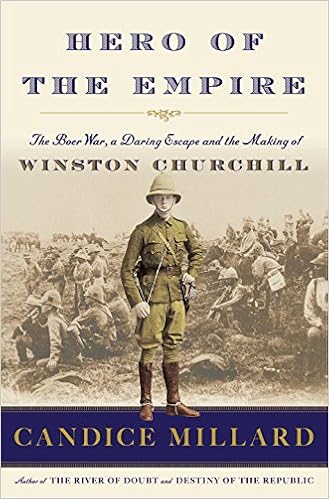
Hero of the Empire


Hero of the Empire: The Boer War, a Daring Escape and the Making of Winston Churchill- Candice Millard
Doubleday
Release Date: September 20, 2016

Rating (out of 5):
📚📚📚📚📚

Synopsis: At age twenty-four, Winston Churchill was utterly convinced it was his destiny to become prime minister of England one day, despite the fact he had just lost his first election campaign for Parliament.  He believed that to achieve his goal he must do something spectacular on the battlefield.  Despite deliberately putting himself in extreme danger as a British Army officer in colonial wars in India and Sudan, and as a journalist covering a Cuban uprising against the Spanish, glory and fame had eluded him.
 
Churchill arrived in South Africa in 1899, valet and crates of vintage wine in tow, there to cover the brutal colonial war the British were fighting with Boer rebels. But just two weeks after his arrival, the soldiers he was accompanying on an armored train were ambushed, and Churchill was taken prisoner.  Remarkably, he pulled off a daring escape--but then had to traverse hundreds of miles of enemy territory, alone, with nothing but a crumpled wad of cash, four slabs of chocolate, and his wits to guide him.
            
The story of his escape is incredible enough, but then Churchill enlisted, returned to South Africa, fought in several battles, and ultimately liberated the men with whom he had been imprisoned.

_________________________________________________________________________

I have always been interested in Winston Churchill- his life, adventures, and dry wit have appealed to me since reading My Early Life for a first year college history class.  While in many ways a man of the Victorian Era in his thoughts on colonialism, foreigners, and war, he was also often ahead of his time, and certainly never suffered from lack of self-confidence against all odds.  While most people know him as a politician and leader, he was also a great writer, and threw himself into life and every adventure he could find.

Hero of the Empire focuses on one of Churchill's youthful adventures: His time as a war correspondent during the Boer War, his captivity, and his daring escape. Millard gives us background not only on Churchill, but also the British Empire and the Boers, providing excellent context for the war itself.  While the story centers on Churchill and his experiences, some of the main burghers in government and leading the Boer army are equally on stage.  We come to understand how it was that the British Empire and its soldiers, feared as the best troops in the world, were so devastated against this 'uncivilized' colonial uprising.  The circumstances and strategies of both sides were explained in a way I have never read before, helping me to understand the war and the Empire at the turn of the century in a way I hadn't yet managed through other books.

Even people not normally interested in history will find Hero of the Empire a dramatic read, often more adventure story that the 'dry and boring' biography they might expect.   Intensely researched, written in gripping detail, Millard brings to life the heat of battles, the conditions in South Africa, Winston's enthusiasm and frenzy to make his mark on the world, and his fear during his escape.

This exciting, wonderfully written, book is a must read for Churchill fans, British history enthusiasts, and anyone looking for a gripping true-story of luck, bravery, and adventure.

I received an ARC of this book through NetGalley for an honest review.