Showing posts with label Roman Empire. Show all posts

Tuesday, August 6, 2019

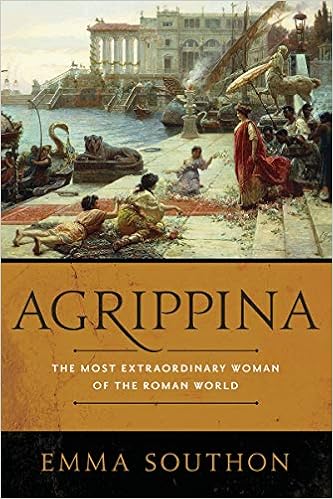
Agrippina


Agrippina: The Most Extraordinary Woman in the Roman World- Emma Southon
Pegasus Books
Release Date: August 6, 2019

Rating:
📚📚📚📚📚

SynopsisSister of Caligula. Wife of Claudius. Mother of Nero. The story of Agrippina, at the center of imperial power for three generations, is the story of the Julio-Claudia dynasty―and of Rome itself, at its bloody, extravagant, chaotic, ruthless, and political zenith.


In her own time, she was recognized as a woman of unparalleled power. Beautiful and intelligent, she was portrayed as alternately a ruthless murderer and helpless victim, the most loving mother and the most powerful woman of the Roman empire, using sex, motherhood, manipulation, and violence to get her way, and single-minded in her pursuit of power for herself and her son, Nero.
This book follows Agrippina as a daughter, born in Cologne, to the expected heir to Augustus’s throne; as a sister to Caligula who raped his sisters and showered them with honors until they attempted rebellion against him and were exiled; as a seductive niece and then wife to Claudius who gave her access to near unlimited power; and then as a mother to Nero―who adored her until he had  her assassinated.
Through senatorial political intrigue, assassination attempts, and exile to a small island, to the heights of imperial power, thrones, and golden cloaks and games and adoration, Agrippina scaled the absolute limits of female power in Rome. Her biography is also the story of the first Roman imperial family―the Julio-Claudians―and of the glory and corruption of the empire itself.
____________________________________________________________________________


Agrippina: The Most Extraordinary Woman in the Roman World gives readers something that is hard to find: a biography of a Roman woman.  Agrippina: sister of Caligula, wife of Claudius, mother of Nero.  She was loved and reviled, praised and curse- both today and during her lifetime. Agrippina created new roles for imperial women, and pushed (or outright broke) the accepted role of women in Roman life.

 Emma Southon looks at Agrippina's life as it can be pieced together from ancient sources, but she also gives readers perfect examples of why those sources can't necessarily be trusted.  She immerses the reader in the culture of the Roman world so we can see how our modern views on women, politics, and life in general were not those of Tacitus, Seutonius, and the histories they wrote.That True History can't always be discovered and sometimes the historian has to make their best assumptions- but should also be willing to admit that they are assumptions.

It is clear that Southon is an expert in all things Aggripina and ancient Rome and has done her research.  But her writing style isn't designed to overwhelm the reader with how much she knows or how amazingly academic she is.  Instead, Southon writes as if she is a friend trying to describe Agrippina's life to you over a pint at the local pub.  She is in full casual, brilliant,  story-telling mode; she shreds her original sources for their clear prejudices and unreliability; and presents it all with sparkling English humor, wit, and occasional vulgarity that left me laughing at many of her opinions and insights.  Southon reconstructs Agrippina's life through ancient sources, gives her views on what was mostly likely to happen when Agrippina wasn't being written about, and does a wonderful job of explaining why she thinks that way while reminding the reader when something is only herl speculation or opinion.     


If you only read one book in your life on Agrippina, or the Roman Empire as a whole, it needs to be Emma Southon's Agrippina: The Most Extraordinary Woman in the Roman World. It is a book for people who love history and are looking for a more feminist light to be shone on ancient sources, for those who love history and want to celebrate powerful women the Romans tried to hide in the shadows.  It is also a book for people who think they don't like history and that history is boring.  Just a few pages into Agrippina will convert even the most hardened "history isn't for me" believers. 


I received an ARC of this book from NetGalley in exchange for an honest review

Wednesday, March 6, 2019

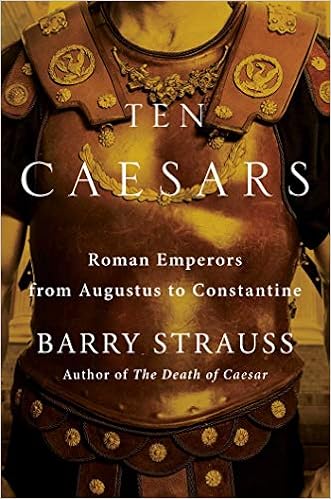
Ten Caesars


Ten Caesars: Roman Emperors from Augustus to Constantine- Barry Strauss
Simon & Schuster
Release Date: March 5, 2019

Rating:
📚📚📚📚

Synopsis: Barry Strauss’s Ten Caesars is the story of the Roman Empire from rise to reinvention, from Augustus, who founded the empire, to Constantine, who made it Christian and moved the capital east to Constantinople.

During these centuries Rome gained in splendor and territory, then lost both. The empire reached from modern-day Britain to Iraq, and gradually emperors came not from the old families of the first century but from men born in the provinces, some of whom had never even seen Rome. By the fourth century, the time of Constantine, the Roman Empire had changed so dramatically in geography, ethnicity, religion, and culture that it would have been virtually unrecognizable to Augustus.

In the imperial era Roman women—mothers, wives, mistresses—had substantial influence over the emperors, and Strauss also profiles the most important among them, from Livia, Augustus’s wife, to Helena, Constantine’s mother. But even women in the imperial family faced limits and the emperors often forced them to marry or divorce for purely political reasons.

Rome’s legacy remains today in so many ways, from language, law, and architecture to the seat of the Roman Catholic Church. Strauss examines this enduring heritage through the lives of the men who shaped it: Augustus, Tiberius, Nero, Vespasian, Trajan, Hadrian, Marcus Aurelius, Septimius Severus, Diocletian and Constantine. Over the ages, they learned to maintain the family business—the government of an empire—by adapting when necessary and always persevering no matter the cost. Ten Caesars is essential history as well as fascinating biography.
_________________________________________________________________

A concise, yet detailed, history of the Roman Empire and its emperors in one book seems like it would be impossible.  Yet in Ten Emperors: Roman Emperors from Augustus to Constantine Barry Strauss manages the feat.  Structuring his book around ten of the most influential of the Roman emperors (Augustus, Tiberius, Nero, Vespasian, Trajan, Hadrian, Marcus Aurelius, Septimius Severus, Diocletian, and Constantine) Strauss provides readers with a comprehensible, detailed view of the Roman Empire: its rise, its fall, and everything in between.

Each chapter provides a biography of an emperor, examines the larger world he grew up in, how he came to the throne, and the impacts he had on the empire- whether for better or worse.  Strauss also explores the sources this information comes from and reminds us that many of the more famous stories (like Nero fiddling while Rome burned) were written by people with their own agendas and not a recording of unbiased facts.  Whether today we can believe what is generally "known" about many of these figures is often up for debate and Strauss does not hesitate to say so.

Another excellent highlight of Ten Caesars is Strauss' crediting the powerful women involved in the empire.  Mothers, sisters, and wives of emperors get their due here as influential people- even if women technically played no part in Roman politics.  Strauss is upfront about the idea that Roman society itself often felt threatened by powerful women, and so stories of women poisoning their emperors husbands, fathers, brothers, etc abounded.  The reality probably involved far less poisoning.  Although since women around the emperors were used as pawns to strengthen dynastic alliances, and those alliances often involved the emperors than murdering the men their women married, one can see the temptation.

Although often repetitive, Ten Caesars is well-researched, well written, and maintains a steady pace.  Whether novice or expert on the Roman Empire and its emperors, any reader will enjoy Strauss' Ten Emperors and come away from it with a more detailed understanding of this fascinating and complicated period of history, and the men and women who influenced it.


I received an ARC of this book from NetGalley in exchange for an honest review