Showing posts with label mythology. Show all posts

Saturday, January 7, 2023

Phaedra


Phaedra-Laura Shepperson

Alcove Press/Penguin Random House

Release Date: January 10, 2023

Rating: πŸ“šπŸ“šπŸ“š

Trigger Warning: Rape, violence, suicide

Synopsis: Phaedra has been cast to the side all her life: daughter of an adulteress, sister of a monster, and now unwilling bride to the much-older, power-hungry Theseus. Young, naΓ―ve, and idealistic, she has accepted her lot in life, resigned to existing under the sinister weight of Theseus’s control and the constant watchful eye of her handsome stepson Hippolytus. 

When supposedly pious Hippolytus assaults her, Phaedra’s world is darkened in the face of untouchable, prideful power. In the face of injustice, Phaedra refuses to remain quiet any longer: such an awful truth demands to be brought to light. When Phaedra publicly accuses Hippolytus of rape, she sparks an overdue reckoning.
 
The men of Athens gather to determine the truth. Meanwhile, the women of the city, who have no vote, are gathering in the shadows. The women know truth is a slippery thing in the hands of men. There are two sides to every story, and theirs has gone unheard. Until now.
_____________________________________________________________

As a fan of Natalie Haynes, I enjoy giving mythological retellings a chance- seeing Greek, Norse, etc. stories from more feminist perspectives and bringing to life the women who were left in the silent shadows of the original stories has lots of potential. Phaedra is a story that had lots of potential, but never quite lived up to it for me. A lot of it was the writing style. Despite having multiple POVs- many, many characters tell this story- all of them sound exactly the same. There is virtually no way of differentiating any of the voices if you just closed your eyes and opened to a page. There is almost no character development among the characters, including the main women, Phaedra and Medea, although I had high hopes for Medea and personally thought some of her scenes were among the best in the book. Phaedra starts out as a young and naive princess who ends up married to Theseus and is in Athens really as a hostage instead of a wife. She is sure she is supposed to witness the gods' justice against the terrible wrongs Theseus has done on Crete. There is hatred in her early on, but that gets banked and we don't get to see it again until pretty much the end. The rest of the time she's . . . not much. You'd think she couldn't be as naive as she acts sometimes, that she'd figure out her status doesn't save her from the terrible things that happen in the Athenian palace. But she never seems to change, or to grow up from the girl we first meet.

When she accuses Hippolytus of rape and the statesman Trypho convinces her to bring it to trial, the modern reader sees plenty of the MeToo movement trying to rise up in ancient Athens. The problem being, of course, women have no voice in ancient Athens and the men who will do the voting are the men who are behaving just the same to the servants in the palace. Maybe Phaedra's status will mean something to them, maybe not. One of the most realistic and heartbreaking scenes in the book is between Phaedra and Theseus when he comes to ask her to stop the trial before his son can be judged. After all, why should his life be ruined because she suffered for a few minutes? It made me want to cry and be sick at the same time, because you know this was genuinely how this man understood the situation, and how generations since have and still do think.

By the end of the book we see the limited choices women in this world have: the vast majority, the 'night chorus', choose to silently accept the violence done to them and find small ways of avoiding the worst of it-working in pairs, putting sleeping draughts in men's wine, moving in shadows to avoid being seen. Medea has made choices others condemn her for, but she believes were right. What will Phaedra choose?


I received an ARC of this book from NetGalley in exchange for an honest review


Monday, February 8, 2021

The Witch's Heart


The Witch's Heart- Genevieve Gornichec

Berkley

Release Date: February 9, 2021

Rating: πŸ“šπŸ“šπŸ“šπŸ“š

Synopsis: Angrboda’s story begins where most witches' tales end: with a burning. A punishment from Odin for refusing to provide him with knowledge of the future, the fire leaves Angrboda injured and powerless, and she flees into the farthest reaches of a remote forest. There she is found by a man who reveals himself to be Loki, and her initial distrust of him transforms into a deep and abiding love.

 
Their union produces three unusual children, each with a secret destiny, who Angrboda is keen to raise at the edge of the world, safely hidden from Odin’s all-seeing eye. But as Angrboda slowly recovers her prophetic powers, she learns that her blissful life—and possibly all of existence—is in danger.
 
With help from the fierce huntress Skadi, with whom she shares a growing bond, Angrboda must choose whether she’ll accept the fate that she’s foreseen for her beloved family...or rise to remake their future. From the most ancient of tales this novel forges a story of love, loss, and hope for the modern age.
__________________________________________________________________

Recent interest in telling the classic myths from the women's point of view and telling the stories of little know Greek women, like Madeline Miller has done in Circe, now enters the world of Norse myths with Genevieve Gornichec's excellent The Witch's Heart.

We all know Loki and his children Hel, the ruler of the Norse underworld, and Fenrir, the wolf. We all know Norse Mythology included a snake who circled the world, though we sometimes forget his name is Jormungand and he is also one of the children Loki had with his giantess wife.  But the myths only mention the name of Loki's giantess wife and the mother of his children once. Genevieve Gornichec imagines what life was like for Angrboda, the Ironwood Witch: wife of Loki, mother of Hel, Fenrir, and Jormungard, and otherwise unremembered in the stories.

Gornichec imagines Angrboda as a woman trying to rebuild a life that has been taken from her over and over by the gods. She may be a powerful witch, but she isn't a warrior and isn't looking for glory or fame- just peace. When she meets Loki she is drawn back into the world of Asgard and the gods, if only on the edge.  She hears tales from Loki and her friend Skadi that anyone reading Neil Gaiman's Norse Mythology, or any other version of the tales, would be familiar with. Tales of Thor and Odin, Baldur and Freyja, but from a different point of view- the giant's view. The view of the 'monster'. It's a fascinating tale with the twist that perhaps it isn't the events themselves that matter, but why they happen. Anyone vaguely familiar with the stories knows what will happen to Loki and his sons. But why? Angrboda herself has visions about the what, but not the why. Her questions become what can be prevented and what can be changed. What does eternity mean and who are gods who aren't remembered? Are we our actions, or the hidden reasons behind them? These are questions all the main characters struggle with, with varying degrees of success in answering them. 

The Witch's Heart is a beautiful story of deep love and sacrifice and (like the myths themselves) pain and joy.  Gornichec's debut novel is a complex, emotional masterpiece that will have you reading it again and again to discover new nuances every time. 

An excellent story for those interested in twists on well known myths and seeing new women's voices soaring.

I received an ARC of this book from NetGalley in exchange for an honest review


Monday, July 22, 2019

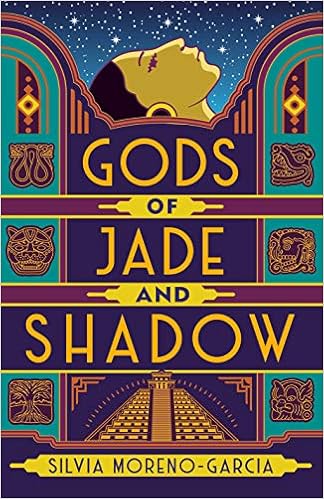
Gods of Jade and Shadows


Gods of Jade and Shadows- Silvia Moreno-Garcia
Del Ray
Release Date: July 23, 2019

Rating:
πŸ“šπŸ“šπŸ“šπŸ“š

Synopsis: The Jazz Age is in full swing, but Casiopea Tun is too busy cleaning the floors of her wealthy grandfather’s house to listen to any fast tunes. Nevertheless, she dreams of a life far from her dusty small town in southern Mexico. A life she can call her own. 

Yet this new life seems as distant as the stars, until the day she finds a curious wooden box in her grandfather’s room. She opens it—and accidentally frees the spirit of the Mayan god of death, who requests her help in recovering his throne from his treacherous brother. Failure will mean Casiopea’s demise, but success could make her dreams come true.

In the company of the strangely alluring god and armed with her wits, Casiopea begins an adventure that will take her on a cross-country odyssey from the jungles of YucatΓ‘n to the bright lights of Mexico City—and deep into the darkness of the Mayan underworld.

__________________________________________________________


Casiopea Tun is the poor relation of the wealthiest family in a small town in southern Mexico.  She resents every cruelty aimed at her, and dreams of escaping to live a life of her own.  What she doesn't expect is to accidentally free a trapped god and travel with him on a cross-country quest to return him to the throne stolen by his brother.  From small dusty towns in the Yucatan to the bright lights of Mexico City to the shadowy realm of the Mayan underworld, Casiopea's greatest journey may be the realm of the mortal, and immortal, heart.

Gods of Jade and Shadow is a book for anyone who loves fantasy and loves to imagine the crossing paths of ancient gods and the modern world.  Here the modern world is Jazz Age Mexico, with short hair, fast cars, and bright lights; while the ancient world is Xibalba, the Mayan Underworld, and the struggle between twin brothers Hun-KamΓ© and Vucub-KamΓ©, the Gods of Death.  Moreno-Garcia uses a beautiful, almost lyric, style of writing that reminded me of hearing classic myths and fairy tales spoken aloud.  She paints the world in brilliant colors of jewels and shadows and you can feel the heat of the sun and the dust of Casiopea's travels on your skin.  Casiopea delights in seeing the exciting world outside of her tiny village and the reader- and Hun-KamΓ©- cannot help but share in her innocent delight.  We also easily share in her terror as Hun-KamΓ© draws her further in his quest to regain his throne and she faces sorcerers and ghosts straight out of horror stories.

Above all, Gods of Jade and Shadow is a story about building your own world and choosing your own path, even when you are sure that you have no choices.  Casiopea learns who she is and her own inner strength in ways that are both heart-breaking and heart-filling.  A story full of duality every step of the way, it had me smiling and crying, fearful and hopeful, and seeing the characters and their worlds change along with the adventure was completely wonderful.  

It would not be wrong to call this a modern classic, and a must-read tale for fantasy lovers, those who love myths and legends, from Beauty and the Beast to The Odyssey to Neil Gaiman's American Gods.

I received an ARC of this book from NetGalley in exchange for an honest review
Saturday, February 4, 2017

Norse Mythology


Norse Mythology by [Gaiman, Neil]


Norse Mythology- Neil Gaiman
W.W. Norton  Co
Release Date: February 7, 2017

Rating (out of 5):
πŸ“šπŸ“šπŸ“šπŸ“šπŸ“š

Synopsis: In Norse Mythology, Gaiman stays true to the myths in envisioning the major Norse pantheon: Odin, the highest of the high, wise, daring, and cunning; Thor, Odin’s son, incredibly strong yet not the wisest of gods; and Loki—son of a giant—blood brother to Odin and a trickster and unsurpassable manipulator.

Gaiman fashions these primeval stories into a novelistic arc that begins with the genesis of the legendary nine worlds and delves into the exploits of deities, dwarfs, and giants. Once, when Thor’s hammer is stolen, Thor must disguise himself as a woman—difficult with his beard and huge appetite—to steal it back. More poignant is the tale in which the blood of Kvasir—the most sagacious of gods—is turned into a mead that infuses drinkers with poetry. The work culminates in Ragnarok, the twilight of the gods and rebirth of a new time and people.
_______________________________

The much anticipated Norse Mythology by Neil Gaiman brings new life to many of the traditional Norse myths, ranging from the creation of the world to the inevitable Ragnarok.  Gaiman says in his introduction that he was first introduced to Norse mythology in a way that would be familiar to many today: Marvel comics.  The success of the current movies with Chris Hemsworth and Tom Hiddleston    probably has as much to do with interest in the book as the original Mighty Thor Marvel comics had for Gaiman.  Gaiman's introduction gives readers a taste of the research that must have gone into the writing of this book, original sources and theories, connecting the myths to the geography of the people who told them.  However, it is done in an approachable way that will not scare off young readers or those not sure about the book.

The book itself is a collection of traditional myths, mostly focusing around some of the most familiar of the Norse gods: Odin, Thor, and Loki.  We learn how Thor got his hammer, Mjollnir; how Odin sacrificed himself on the world-tree Yggdrasil to gain knowledge; and how Loki tricked a giant into building the walls of Asgard without being paid.  There are stories of dwarfs and giants, monsters and magic, Fenrir the wolf who will eat the sun during the final battle and the Midgard serpent Thor will battle. We learn the Norse explanation for earthquakes and why salmon are shaped as they are.  We watch with a sense of inevitable doom as the gods make poor choices and alienate those who could have been their allies but will instead fight against them in Ragnarok.  Deception and betrayal, love, greed, intrigue, and complicated family life show us not only the world of Asgard but give us hints of the world of the Norsemen who first told these tales.  

The most striking feature of Norse Mythology is Gaiman's beautiful writing.  Gaiman surpasses his reputation as a brilliant story-teller with tales that manage to both retain their original, epic, flavor and blend a subtle modern feel that will ensure they appeal to today's readers- young and old.  The gentle cadence of each story nearly demands they be read aloud (whether you have an audience or not).  Adventure and emotion infuse each tale and by the last stories "The Last Days of Loki" and "Ragnarok: The Final Destiny of the Gods" I was moved to tears by battles both grand and individual.  But Gaiman ends on a gentle note of hope- Ragnarok may be an end, but it is also a beginning.  You close the book wondering what happens next.  The answer Gaiman hints at is that all things are possible and what comes next is what we make of it.

Neil Gaiman brings to life the tales of the ancient Norse sagas with every bit as much talent, wit, and emotion as any of the fictional novels he is so well known for.  Fans of any age, of American Gods and Marvel alike, will love the new life Gaiman infuses into these classic stories and be left hoping for more.

I received an ARC of this book from NetGalley in exchange for an honest review.