Showing posts with label women in mythology. Show all posts

Tuesday, June 10, 2025

Penelope's Bones

Penelope's Bones: A New History of Homer's World Through the Women Written Out of It- Emily Hauser

University of Chicago Press

Release Date: June 13, 2025

Rating: πŸ“šπŸ“šπŸ“š

Synopsis: In Mythica Emily Hauser tells, for the first time, the extraordinary stories of the real women behind some of the western world’s greatest legends. Following in their footsteps, digging into the history behind Homer’s epic poems, piecing together evidence from the original texts, recent astonishing archaeological finds and the latest DNA studies, she reveals who these women – queens, mothers, warriors, slaves – were, how they lived, and how history has (or has not – until now) remembered them.

A riveting new history of the Bronze Age Aegean and a journey through Homer’s epics charted entirely by women – from Helen of Troy, Briseis, Cassandra and Aphrodite to Circe, Athena, Hera, Calypso and Penelope – Mythica is a ground-breaking reassessment of the reality behind the often-mythologized women of Greece’s greatest epics, and of the ancient world itself as we learn ever more about it.
___________________________________________________

I had very mixed feelings with this book. On the one hand, there was some very cool information on the latest archaeaolgical research and discoveries. New technology means DNA can tell us about travel in the Late Bronze Age, if families are buried together, or prove that more warrior gravesites are women warriors than were earlier believed. Texts unearthed through the Hittite Empire introduce powerful queens helping to rule the Hittite world next to Troy, and letters and tablets have been unearthed that suggest enough similarities between pieces of Homer's poems and real life to make Hauser's arguments plausible that the epics contain fragments of memories for ways of life that would have probably been old when the Iliad and the Odyssey were written down. I enjoyed most of the archaeological information, because I like reading about that kind of thing. 

Other parts of the book were, to me, more of a stretch. There was a lot of repetition. Hauser clearly didn't trust her audience to remember who any of the characters were, so would remind you every single time- especially the women already less well known like Briseis. Once or twice I can understand, but it was really annoying having her do it all the time. Each chapter would start with a short fictional story, which I know is the current fad, but personally I find throws me out of the nonfiction narrative and I always find off-putting. Some chapters were a stretch in terms of subject matter. In Circe's chapter, for example, I expected to learn about the ancient world's views on magic, or women living alone, or something else that might focus on women. Instead it is mostly about pigs. Yes, Circe and pigs go together and Hauser manages to connect them to religion and briefly to the mystery cults, but I was hoping for more. 

Frequently in the chapters Hauser brings up the modern retellings we see that are so popular today. Madeline Miller, Natalie Haynes, and some of her own books as well. These additions missed the mark for me. The readers of those books may be part of the audience she's trying to reach with this book, but adding the retellings here in the chapters themselves isn't part of the story of Homer's world. It would have worked better in the introduction or conclusion as part of the conversation on why women are now retelling the stories and focusing on reclaiming the lives and voices of the women in Homer's world.

I had high hopes going into Penelope's Bones, and while I would overall recommend reading it, I can't say I was as impressed with the book as I had hoped to be. Maybe I was expecting too much out if it. After all, Trying to uncover what has been pushed to the margins for thousands of years, both by the erosion of time, the men of the time period and by male archeologists until fairly recently, doesn't give you a lot to work with.

I received an ARC of this boon from NetGalley in exchange for an honest review


Friday, April 28, 2023

Clytemnestra

 Clytemnestra- Constanza Casati

Sourcebooks Landmark

Release Date: May 2, 2023

Rating: πŸ“šπŸ“šπŸ“šπŸ“š

Synopsis: As for queens, they are either hated or forgotten. She already knows which option suits her best…

You were born to a king, but you marry a tyrant. You stand by helplessly as he sacrifices your child to placate the gods. You watch him wage war on a foreign shore, and you comfort yourself with violent thoughts of your own. Because this was not the first offence against you. This was not the life you ever deserved. And this will not be your undoing. Slowly, you plot.

But when your husband returns in triumph, you become a woman with a choice.

Acceptance or vengeance, infamy follows both. So, you bide your time and force the gods' hands in the game of retribution. For you understood something long ago that the others never did.

If power isn't given to you, you have to take it for yourself.

_______________________________________________________________________

In a world where women are considered more property than people, when the myths we know are never about women (and if they are, they aren't good stories), ancient Greece in no place to be a strong and independent woman. Current retellings of ancient myths are giving us new voices for women who have lived too long in the shadows, either voiceless or villains, and Clytemnestra is certainly one of them. Constanza Casati's debut novel wipes away any other attempt to tell Clytemnestra's story and should, in my opinion, become THE go-to retelling of the Queen of Mycenae's story.

A princess of Sparta, Clytemnestra grew up strong, learning to fight, hunt, and wrestle just like all the other children. The only rule? Don't get caught. She protects her younger sisters, physically and emotionally, but is always closest to Helen. Her husband Tantalus is a king, and unlike the men she knows-he listens to her, respects her strength, and doesn't try to overshadow her. But when Agamemnon and Menelaus come to Sparta, things change and Clytemnestra's world changes too. Seeing a strong woman as a challenge, Agamemnon decides to have her for himself and kills Tantalus and their baby, forcing her to marry him. As queen of Mycenae, wife of a man she hates, and mother to his children, she tries to live a new life- but when Helen runs away to Troy and gives Agamemnon the excuse he wants to start a war with Troy, disaster strikes again. 

If you know any of the stories of Clytemnestra, or the Trojan War, you won't be surprised by the basic plot. What I found wonderful was how well the author drew the reader into Clytemnestra's emotional life, easily making you feel her rage, pain, and grief and how it shaped her over her life. It balanced with her warrior nature and aggravation with the Greeks who felt they were better than her just because she was a woman. Over and over she has to prove herself, and does, and reminds them that her actions are the same as a man's- and a king's- so should be treated as such. 

There is a short, sweet, set of letters between the siblings late in the book where they are trying to console Clytemnestra and you really get each sibling's thoughts and feelings (as opposed to Clytemnestra's) for the first time. This might be my favorite part of the book. It is completely different from the rest of the book, and feels a bit like we're looking behind the scenes at something personal and private that Clytemnestra would keep to herself. It is also a nice reminder that not all men in this world are horrible, since one of the letters is from her brother Polydeuces.

Clytemnestra is an absolute must read for anyone who enjoys retellings or even just stories about strong women. This is a book that doesn't read as if it was a debut novel- the writing is more confident and polished than you often read in a first book. I would love to see Casati write her next book for Medea, since we might be able to trust her to tell Medea's story with the same emotional honesty she showed Clytemnestra. Here's hoping!


I received an ARC of this book from NetGalley in exchange for an honest review 

Saturday, January 7, 2023

Phaedra


Phaedra-Laura Shepperson

Alcove Press/Penguin Random House

Release Date: January 10, 2023

Rating: πŸ“šπŸ“šπŸ“š

Trigger Warning: Rape, violence, suicide

Synopsis: Phaedra has been cast to the side all her life: daughter of an adulteress, sister of a monster, and now unwilling bride to the much-older, power-hungry Theseus. Young, naΓ―ve, and idealistic, she has accepted her lot in life, resigned to existing under the sinister weight of Theseus’s control and the constant watchful eye of her handsome stepson Hippolytus. 

When supposedly pious Hippolytus assaults her, Phaedra’s world is darkened in the face of untouchable, prideful power. In the face of injustice, Phaedra refuses to remain quiet any longer: such an awful truth demands to be brought to light. When Phaedra publicly accuses Hippolytus of rape, she sparks an overdue reckoning.
 
The men of Athens gather to determine the truth. Meanwhile, the women of the city, who have no vote, are gathering in the shadows. The women know truth is a slippery thing in the hands of men. There are two sides to every story, and theirs has gone unheard. Until now.
_____________________________________________________________

As a fan of Natalie Haynes, I enjoy giving mythological retellings a chance- seeing Greek, Norse, etc. stories from more feminist perspectives and bringing to life the women who were left in the silent shadows of the original stories has lots of potential. Phaedra is a story that had lots of potential, but never quite lived up to it for me. A lot of it was the writing style. Despite having multiple POVs- many, many characters tell this story- all of them sound exactly the same. There is virtually no way of differentiating any of the voices if you just closed your eyes and opened to a page. There is almost no character development among the characters, including the main women, Phaedra and Medea, although I had high hopes for Medea and personally thought some of her scenes were among the best in the book. Phaedra starts out as a young and naive princess who ends up married to Theseus and is in Athens really as a hostage instead of a wife. She is sure she is supposed to witness the gods' justice against the terrible wrongs Theseus has done on Crete. There is hatred in her early on, but that gets banked and we don't get to see it again until pretty much the end. The rest of the time she's . . . not much. You'd think she couldn't be as naive as she acts sometimes, that she'd figure out her status doesn't save her from the terrible things that happen in the Athenian palace. But she never seems to change, or to grow up from the girl we first meet.

When she accuses Hippolytus of rape and the statesman Trypho convinces her to bring it to trial, the modern reader sees plenty of the MeToo movement trying to rise up in ancient Athens. The problem being, of course, women have no voice in ancient Athens and the men who will do the voting are the men who are behaving just the same to the servants in the palace. Maybe Phaedra's status will mean something to them, maybe not. One of the most realistic and heartbreaking scenes in the book is between Phaedra and Theseus when he comes to ask her to stop the trial before his son can be judged. After all, why should his life be ruined because she suffered for a few minutes? It made me want to cry and be sick at the same time, because you know this was genuinely how this man understood the situation, and how generations since have and still do think.

By the end of the book we see the limited choices women in this world have: the vast majority, the 'night chorus', choose to silently accept the violence done to them and find small ways of avoiding the worst of it-working in pairs, putting sleeping draughts in men's wine, moving in shadows to avoid being seen. Medea has made choices others condemn her for, but she believes were right. What will Phaedra choose?


I received an ARC of this book from NetGalley in exchange for an honest review


Friday, April 15, 2022

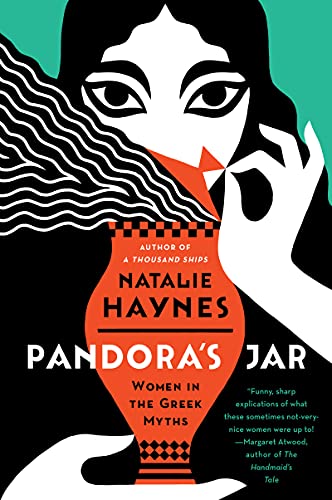
Pandora's Jar


Pandora's Jar: Women in the Greek Myths- Natalie Haynes

Harper Collins

Release Date: March 29, 2022

Rating: πŸ“šπŸ“šπŸ“šπŸ“š

Synopsis: The tellers of Greek myths—historically men—have routinely sidelined the female characters. When they do take a larger role, women are often portrayed as monstrous, vengeful or just plain evil—like Pandora, the woman of eternal scorn and damnation whose curiosity is tasked with causing all the world’s suffering and wickedness when she opened that forbidden box. But, as Natalie Haynes reveals, in ancient Greek myths there was no box. It was a jar . . . which is far more likely to tip over. 

In Pandora’s Jar, the broadcaster, writer, stand-up comedian, and passionate classicist turns the tables, putting the women of the Greek myths on an equal footing with the men. With wit, humor, and savvy, Haynes revolutionizes our understanding of epic poems, stories, and plays, resurrecting them from a woman’s perspective and tracing the origins of their mythic female characters. She looks at women such as Jocasta, Oedipus’ mother-turned-lover-and-wife (turned Freudian sticking point), at once the cleverest person in the story and yet often unnoticed. She considers Helen of Troy, whose marriage to Paris “caused” the Trojan war—a somewhat uneven response to her decision to leave her husband for another man. She demonstrates how the vilified Medea was like an ancient Beyonce—getting her revenge on the man who hurt and betrayed her, if by extreme measures. And she turns her eye to Medusa, the original monstered woman, whose stare turned men to stone, but who wasn’t always a monster, and had her hair turned to snakes as punishment for being raped.

Pandora’s Jar brings nuance and care to the millennia-old myths and legends and asks the question: Why are we so quick to villainize these women in the first place—and so eager to accept the stories we’ve been told?

_______________________________________________________________


In Pandora's Jar, author Natalie Haynes (A Thousand Ships) explores the different versions of some of the most well known of Greek women in mythology, and how those women have been changed throughout the generations, rarely for the better. Going back to the original Greek, to Homer, Ovid, and scaps of stories before them, Haynes looks at Medusa, Pandora, Helen, Jocasta, Penelope, Clytemnestra, Eurydice, Phaedra, Medea, and the Amazons. Who are these women, both in relation to their original stories, the stories we know best, plays or more modern movies, or perhaps even modern reincarnations or retellings? 


Some of my favorite chapters had to be the ones focused on Medusa, Medea, and the Amazons, although Penelope and Clytemnestra came close behind. With a sharp wit and occasional sarcasm to help keep her reader engaged, Haynes shreds whatever claims to the title hero men like Jason and Theseus have (and you really have to agree with her, especially about Theseus) to bring the story back around to the women. Medusa was hanging out in a cave not bothering anyone, having already suffered being sexually assaulted by Posiedon and cursed by Athene, she's sleeping and along comes this jerk with no personal grudge against her to chops off her head and weaponizes it. Every visual interpretation of this Haynes can find tends to make this moment both violent and sexual. What's that about, really?


Clytemnestra and Medea win Greece's awards for "worst wife" and "worst mother" because, Haynes points out, Greek men were terrified of powerful women. It kind of makes you want to travel back to when the plays were first performed and watch the male audience shake in their sandals- especially over Euripides' Medea. Or would they have been more afraid of Clytemnestra?  A woman with no magical power, no assistance from the gods, just ten years of rage over her husband sacrificing their daughter so he could go off to war and no one saying anything against it. He kills the kid, spends ten years at war making a name for himself and enjoying raping other women, then comes home (with his war "bride" in tow) and expects his wife to be happy about it? I'd have voted justifiable homicide if I was on that jury. 


There's something for everyone in these chapters- from original interpretations of Greek and how they can change meanings that stick with us down through the ages to the dangers of "sanitizing" myths to tell them to children. From descriptions of visual representations of myths in ancient pottery to what Medea's dragon chariot at the end of her play actually meant to the Greeks (which I thought was pretty great even if the male audience might not have); and modern operas of the story of Orpheus and Eurydice to modern Amazons together-we-are-powerful symbolism in Buffy the Vampire Slayer, the exploration into some of Greek mythology's well known (and a few lesser known) women should resonate with women across all levels. 


As Natalie Haynes says, we keep retelling these stories because we find new questions they raise and new voices wanting to be heard, and each generation will undoubtedly continue to do so. But discovering some of the origins makes those stories even more interesting to me.