Showing posts with label American Revolution. Show all posts

Sunday, May 24, 2020

James Monroe: A Life


James Monroe: A Life- Tim McGrath
Dutton/Penguin Group
Release Date: May 5, 2020

Rating: ðŸ“šðŸ“šðŸ“šðŸ“š


Synopsis: Monroe lived a life defined by revolutions. From the battlefields of the War for Independence, to his ambassadorship in Paris in the days of the guillotine, to his own role in the creation of Congress's partisan divide, he was a man who embodied the restless spirit of the age. He was never one to back down from a fight, whether it be with Alexander Hamilton, with whom he nearly engaged in a duel (prevented, ironically, by Aaron Burr), or George Washington, his hero turned political opponent. 
 
This magnificent new biography vividly recreates the epic sweep of Monroe’s life: his near-death wounding at Trenton and a brutal winter at Valley Forge; his pivotal negotiations with France over the Louisiana Purchase; his deep, complex friendships with Thomas Jefferson and James Madison; his valiant leadership when the British ransacked the nation’s capital and burned down the Executive Mansion; and Monroe’s lifelong struggle to reckon with his own complicity in slavery. Elected the fifth president of the United States in 1816, this fiercest of partisans sought to bridge divisions and sow unity, calming turbulent political seas and inheriting Washington's mantle of placing country above party. Over his two terms, Monroe transformed the nation, strengthening American power both at home and abroad. 

Critically-acclaimed author Tim McGrath has consulted an extensive array of primary sources, many rarely seen since Monroe's own time, to conjure up this fascinating portrait of an essential American statesman and president.
________________________________________________________________________


James Monroe is one of those presidents you can usually name, but otherwise probably don't know too much about.  That was the case for me at least.  Tim McGrath's new biography on Monroe is a brilliant introduction to the man, the politician, and the world he lived and worked in.  Monroe's early life is covered without getting into the minutiae that some biographers enjoy- McGrath knows that in Monroe's case at least, the man Monroe would become formed not in his childhood, but as a young lawyer studying under Thomas Jefferson and as a soldier crossing the Delaware with General Washington.

Monroe is pictured from the beginning as a man who believes in doing his duty by his country, despite what that may cost him personally and financially.  The intricacies of politics might not have come as naturally as the job of soldiering, but Monroe learns as he goes, not only from friends like Jefferson and Madison but from opponents, even enemies, and never forgets the lessons that he learned.

McGrath does a brilliant job showing Monroe's development as a politician- from highly partisan to trying to follow in Washington's steps and erase the two-party system. He brings to life the partisan and highly personal fights in Congress as Monroe's enemies work to prevent Monroe and his Cabinet from accomplishing anything, and brings the reader behind the scenes into Cabinet meetings where Monroe takes the slightly unusual approach of listening to all of his Cabinet members and letting free speech and debate fly across the table before asking questions, and allowing himself to have his mind and policies changed if he truly hears convincing arguments.

James Monroe was not a perfect man, and McGrath doesn't try to convince us that he was.  Apologies are not made, although by understanding the world and time he lived in, maybe some of what today we would call his mistakes are more understandable.   Modern readers will cringe at Monroe's thoughts on slavery and Native American policy- but McGrath reminds us that for his time Monroe was considered progressive, especially compared with someone like the up and coming Andrew Jackson.

This is a well-written, well-researched, and thorough biography of a little known president.  Despite the seemingly daunting length of the book (750 pages) the pace flows well and doesn't get bogged down with extraneous details and lectures.  Although McGrath does fall into the trap of foreshadowing-especially at the end of chapters- his "of only Monroe knew then" approach doesn't happen often enough to get truly aggravating.

A definite win for history lovers seeking to learn more about the founding of America and James Monroe, one of the often overlooked founding fathers.

I received an ARC of this book from NetGalley in exchange for an honest review

Tuesday, February 11, 2020

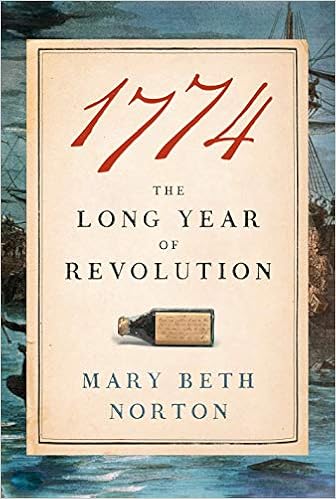
1774


1774: The Long Year of Revolution- Mary Beth Norton
Knopf
Release Date: February 11, 2020

Rating:
📚📚📚📚

Synopsis:  This masterly work of historical writing, Mary Beth Norton's first in almost a decade, looks at the sixteen months during which the traditional loyalists to King George III began their discordant "discussions" that led to their acceptance of the inevitability of war against the British Empire and to the clashes at Lexington and Concord in mid-April 1775.     
Drawing extensively on pamphlets, newspapers, and personal correspondence, Norton reconstructs colonial political discourse as it happened, showing the vigorous campaign mounted by conservatives criticizing congressional actions. But by then it was too late. In early 1775, governors throughout the colonies informed colonial officials in London that they were unable to thwart the increasing power of the committees and their allied provincial congresses. Although the Declaration of Independence would not be formally adopted until July 1776, Americans, even before the outbreak of war in April 1775, had in effect "declared independence" by obeying the decrees of their new provincial governments rather than colonial officials.
_____________________________________________________________


Readers interested in the details behind the larger picture of the American Revolution will thoroughly enjoy reading Mary Beth Norton's new book, 1774: The Long Year of Revolution.  Drawing extensively from letters, diaries, pamphlets and newspapers, Norton explores the true mindset of Colonial America during 1774.  Did the majority of people remain loyal to king and country?  Did most people think alternatives would bring England and America back into harmony?  

1774 offers some fascinating insights into incidents like the 'Boston Tea Party' and the reaction other colonies had to the Bostonians' radical destruction of property.  Tea became such a flashpoint politically that whether one drank tea or not said a great deal about their politics.  Yet men rarely included women as economic decision makers in debates behind things like whether to boycott tea.  What did women think about the boycott- and the patently false health claims made against drinking tea that were written to convince women to give it up voluntarily?  Mob rule and 'patriotic terrorism' were as debated then as they are now, and many of the points brought up against mob decisions could still apply today.  Free speech and free press versus an open press are flashpoint of contention, and then as now we see papers shift from showing both sides of an issue to focusing on only the side that paper supports.  

Although occasionally a little longer than necessary, the writing was good and the research is thorough. History lovers and teachers alike will be interested in the examples of daily life and political thought as it developed over the 'long year' leading up to the shots heard round the world and the war that changed everything. 


I received an ARC of this book from NetGalley in exchange for an honest review
Wednesday, September 13, 2017

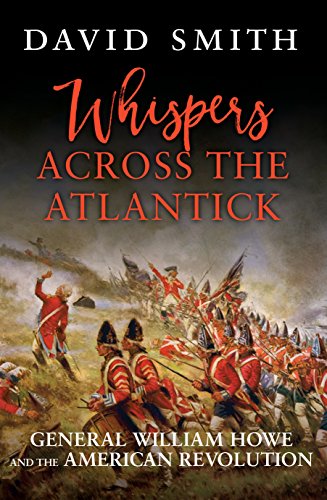
Whispers Across the Atlantick

Whispers Across the Atlantick: General William Howe and the American Revolution by [Smith, David]


Whispers Across the Atlantick: General William Howe and the American Revolution- David Smith
Osprey Publishing
Release Date: September 27, 2017

Rating (out of 5):
📚📚

Synopsis:  General William Howe was the commander-in-chief of the British forces during the early campaigns of the American Revolutionary War (1775-1783). Howe evoked passionate reactions in the people he worked with – his men loved him, his second-in-command detested him, his enemies feared him, his political masters despaired of him. There was even a plot to murder him, in which British officers as well as Americans were implicated. 

Howe's story includes intrigue, romance and betrayal, played out on the battlefields of North America and concluding in a courtroom at the House of Commons, where Howe defended his decisions with his reputation and possibly his life on the line. The inquiry, complete with witness testimonies and savage debate between the bitterly divided factions of the British Parliament, gives Howe's story the flavour of a courtroom drama. Using extensive research and recent archival discoveries, this book tells the thrilling story of the man who always seemed to be on the verge of winning the American Revolutionary War for Britain, only to repeatedly fail to deliver the final blow.
________________________________

David Smith's Whispers Across the Atlantick what he calls an "unapologetically narrow view of the first two campaigns of the War of Independence, mostly considering events through Howe's eyes."  His preface opens by giving us the idea that within Whispers we will discover more about Howe, the general who commanded two successful years of campaigning in the American War of Independence.    He questions how it is possible that Howe is a nearly forgotten general among the British military annals, and posits that the lack of primary material from Howe and his family available to us today (the Howe family papers having been destroyed in a fire) are what have kept him in the shadows, seen only through the eyes of others. Smith then says that newly discovered draft of Howe's speech to the House of Commons in 1779 will help offer "telling insights into some of Howe's biggest decisions" and the Ph.D thesis he had been working on turned into a book attempting to make Howe a more complex historical figure for the reader.

A highly promising beginning for any history lover!  However, Smith largely fails to deliver on his promises.  Chapter by chapter we follow Howe through taking command of the British armies in America, through the capture of New York, to Philadelphia and White Plains.  Two years of campaigns are briefly touched on, the details of any given engagement largely left out.  Presumably the author thinks that if you're reading Whispers, you have already read extensively on these battles, their conditions, and the importance to both sides.  Each chapter begins with a quote from Howe's House of Commons speech and then an imagining of what his audience thought or might have reacted.  Readers like me, who picked up Whispers knowing virtually nothing about Howe except his name, may spend as much time wondering why he's going to be presenting to the House in 1779 as we do wondering what he's doing in 1777.  The answer comes at the very end of the book: Howe's resignation has been accepted and he has returned to England, but is unhappy with how things have been left.  It is hard for a modern reader to understand, based on Smith's explanation, exactly what Howe was so upset about that he pushed to have a hearing in the House, or what that hearing was supposed to resolve.  You get the feeling that Howe and his contemporaries may not have known either. 

There are some brief, interesting comparisons between the speech Howe originally wrote and the one he actually gave, although despite Smith's tantalizing promises nothing really comes from it.  Howe does not become a fully formed person for the reader, there are no striking insights into his character. The conclusion Smith comes to seems, to me at least, to be a confirmation of what Smith expected to find and what others had already deduced: Howe is not recognized as a British military genius because he wasn't one.  He knew how to play the game and say the right words to the right people to get the promotion, but in fact had no idea what he was doing when he took command.  The only real question seems to be: why did Howe want a job he was so supremely unqualified for, and why did he feel insulted when it became obvious to everyone else that he didn't know what he was doing?

A book with an interesting premise, Whispers Across the Atlantick fails to deliver on any front. While Whispers may provide minute new details to readers already intimately familiar with the battles and the players, it is largely a dry and uninteresting read that delivers nothing special to the casual American Revolution/military history reader.


I received an ARC of this book from NetGalley in exchange for an honest review.

Saturday, October 8, 2016

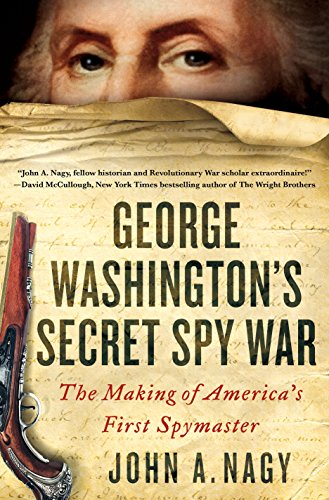
George Washington's Secret Spy War

George Washington's Secret Spy War: The Making of America's First Spymaster by [Nagy, John A.]


George Washington's Secret Spy War: The Making of America's First Spymaster- John A. Nagy
St. Martin's Press
Release Date: September 20, 2016

Rating (Out of 5):
📚

Synopsis: George Washington was America’s first spymaster, and his skill as a spymaster won the war for independence.
George Washington’s Secret Spy War is the untold story of how George Washington took a disorderly, ill-equipped rabble and defeated the best trained and best equipped army of its day in the Revolutionary War. Author John A. Nagy has become the nation’s leading expert on the subject, discovering hundreds of spies who went behind enemy lines to gather intelligence during the American Revolution, many of whom are completely unknown to most historians. 
Using George Washington’s diary as the primary source, Nagy tells the story of Washington’s experiences during the French and Indian War and his first steps in the field of espionage. Despite what many believe, Washington did not come to the American Revolution completely unskilled in this area of warfare. Espionage was a skill he honed during the French and Indian war and upon which he heavily depended during the Revolutionary War. He used espionage to level the playing field and then exploited it on to final victory.
           _________________

As someone who has only started to read in depth about the American Revolution I was very interested to try this book and learn about more about the battles that took place behind the scenes- of personalities and spy rings, and perhaps how some everyday people helped to influence the outcome of the war.

Sadly, the book ended up being a considerable disappointment.  While an enormous amount of research clearly went into this book, the advance copy I received contained so many problems as to be practically unreadable at times.  Abrupt topic changes and convoluted arrangement of subjects made it very difficult to follow the progress of events.  It would have been much easier to follow if the book had been arranged more in a linear timeline, so that the reader could follow the progress not only of the war, but of what Washington learned and how he grew his spy networks based on building experiences over the course of the war.  Often a great deal of detail would be given about something that didn't seem particularly important, then something that seemed very important would be mentioned with no follow through, leaving me to wonder why it was mentioned at all.  A large amount of repetition on certain topics, sometimes almost word for word, also made this a very frustrating book.  There are only so many times I needed to be told that Washington preferred to act on information from multiple, independent sources; or that spies often worked for whoever could pay them best; or how it was impossible to control smuggling and how spies could take advantage of smuggling to get information through enemy lines.

I have learned that the author passed away in April 2016, which might account for some of the lack of polish to the book.  The writing was uneven, transitions were nonexistent, and the books' sequence of events convoluted and incredibly difficult to follow.  Hopefully the final copy of the book was edited to improve on all of this.

Overall, this was a disappointing book and I ended up with virtually no more understanding of Washington's spy rings than I when I began, and was incredibly frustrated with the book.  It is quite possible that more advanced American Revolution scholars will get more out of the book than I did.  However for the amateur, like me, I would recommend if you pick up the book at all to read the conclusion only- a repeat of the book as a whole with no additional information to provide.  It will save you considerable frustration and you can then go on to find a book that might be more readable, informative, and enjoyable.

I received an ARC of this book from NetGalley for an honest review.