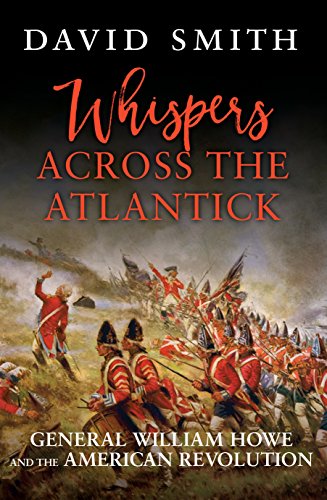
Whispers Across the Atlantick: General William Howe and the American Revolution- David Smith
Osprey Publishing
Release Date: September 27, 2017
Rating (out of 5):
📚📚
Synopsis: General William Howe was the commander-in-chief of the British forces during the early campaigns of the American Revolutionary War (1775-1783). Howe evoked passionate reactions in the people he worked with – his men loved him, his second-in-command detested him, his enemies feared him, his political masters despaired of him. There was even a plot to murder him, in which British officers as well as Americans were implicated.
Howe's story includes intrigue, romance and betrayal, played out on the battlefields of North America and concluding in a courtroom at the House of Commons, where Howe defended his decisions with his reputation and possibly his life on the line. The inquiry, complete with witness testimonies and savage debate between the bitterly divided factions of the British Parliament, gives Howe's story the flavour of a courtroom drama. Using extensive research and recent archival discoveries, this book tells the thrilling story of the man who always seemed to be on the verge of winning the American Revolutionary War for Britain, only to repeatedly fail to deliver the final blow.
________________________________
David Smith's Whispers Across the Atlantick what he calls an "unapologetically narrow view of the first two campaigns of the War of Independence, mostly considering events through Howe's eyes." His preface opens by giving us the idea that within Whispers we will discover more about Howe, the general who commanded two successful years of campaigning in the American War of Independence. He questions how it is possible that Howe is a nearly forgotten general among the British military annals, and posits that the lack of primary material from Howe and his family available to us today (the Howe family papers having been destroyed in a fire) are what have kept him in the shadows, seen only through the eyes of others. Smith then says that newly discovered draft of Howe's speech to the House of Commons in 1779 will help offer "telling insights into some of Howe's biggest decisions" and the Ph.D thesis he had been working on turned into a book attempting to make Howe a more complex historical figure for the reader.
A highly promising beginning for any history lover! However, Smith largely fails to deliver on his promises. Chapter by chapter we follow Howe through taking command of the British armies in America, through the capture of New York, to Philadelphia and White Plains. Two years of campaigns are briefly touched on, the details of any given engagement largely left out. Presumably the author thinks that if you're reading Whispers, you have already read extensively on these battles, their conditions, and the importance to both sides. Each chapter begins with a quote from Howe's House of Commons speech and then an imagining of what his audience thought or might have reacted. Readers like me, who picked up Whispers knowing virtually nothing about Howe except his name, may spend as much time wondering why he's going to be presenting to the House in 1779 as we do wondering what he's doing in 1777. The answer comes at the very end of the book: Howe's resignation has been accepted and he has returned to England, but is unhappy with how things have been left. It is hard for a modern reader to understand, based on Smith's explanation, exactly what Howe was so upset about that he pushed to have a hearing in the House, or what that hearing was supposed to resolve. You get the feeling that Howe and his contemporaries may not have known either.
There are some brief, interesting comparisons between the speech Howe originally wrote and the one he actually gave, although despite Smith's tantalizing promises nothing really comes from it. Howe does not become a fully formed person for the reader, there are no striking insights into his character. The conclusion Smith comes to seems, to me at least, to be a confirmation of what Smith expected to find and what others had already deduced: Howe is not recognized as a British military genius because he wasn't one. He knew how to play the game and say the right words to the right people to get the promotion, but in fact had no idea what he was doing when he took command. The only real question seems to be: why did Howe want a job he was so supremely unqualified for, and why did he feel insulted when it became obvious to everyone else that he didn't know what he was doing?
A book with an interesting premise, Whispers Across the Atlantick fails to deliver on any front. While Whispers may provide minute new details to readers already intimately familiar with the battles and the players, it is largely a dry and uninteresting read that delivers nothing special to the casual American Revolution/military history reader.
I received an ARC of this book from NetGalley in exchange for an honest review.