Showing posts with label French History. Show all posts

Saturday, February 26, 2022

After the Romanovs


After the Romanovs: Russian Exiles in Paris from the Belle Epoque Through Revolution and War- Helen Rappaport

St. Martin's Press

Release Date: March 8, 2022

Rating: πŸ“šπŸ“šπŸ“šπŸ“š

Synopsis: Paris has always been a city of cultural excellence, fine wine and food, and the latest fashions. But it has also been a place of refuge for those fleeing persecution, never more so than before and after the Russian Revolution and the fall of the Romanov dynasty. For years, Russian aristocrats had enjoyed all that Belle Γ‰poque Paris had to offer, spending lavishly when they visited. It was a place of artistic experimentation, such as Diaghilev’s Ballets Russes. But the brutality of the Bolshevik takeover forced Russians of all types to flee their homeland, sometimes leaving with only the clothes on their backs.

Arriving in Paris, former princes could be seen driving taxicabs, while their wives who could sew worked for the fashion houses, their unique Russian style serving as inspiration for designers like Coco Chanel. Talented intellectuals, artists, poets, philosophers, and writers struggled in exile, eking out a living at menial jobs. Some, like Bunin, Chagall and Stravinsky, encountered great success in the same Paris that welcomed Americans like Fitzgerald and Hemingway. Political activists sought to overthrow the Bolshevik regime from afar, while double agents from both sides plotted espionage and assassination. Others became trapped in a cycle of poverty and their all-consuming homesickness for Russia, the homeland they had been forced to abandon. 

This is their story.
________________________________________________________________

Helen Rappaport's latest book takes us to Paris. But not a Paris that most of us are familiar with. Starting in the early 1900s, the Paris of the Belle Γ‰poque was the Paris we may see in movies or books but can barely imagine- a Paris of limitless wealth, royalty, and endless parties. Russian Princes and Grand Dukes threw money around like it was water, bought homes and jewels for their mistresses, and catered to their highest tastes with no thought that the end could be in sight. When World War I arrived and they retreated to Russia, they had no idea of the changes that were to come. The Bolshevik Revolution that killed the tzar and his family, along with countless other hundreds of people, ended their Grand Russia. Hundreds of thousands of people fled for Europe, and tens of thousands ended up in Paris.

Rappaport does an excellent job of not getting sidetracked by all of the stories she could tell us. Instead, she stays focused on the few people or families she chose to follow to give the reader an overarching understanding of the conditions the Russian emigres faced.  She doesn't fall into the possible trap of describing in detail the Revolution or the fighting- that isn't the point of this book and you can look to her bibliography for suggestions if you want to read more (or read one of her other books on the time period). She wants to follow the emigration, and does a brilliant job of immersing the reader in the hellish conditions suffered by everyone escaping Russia, be they peasant or prince. Once back in Paris it is a different world from the first few chapters and the reader can only marvel at the strength of the people who survived such incredible changes. From riches to rags, generals and princes to dishwashers and taxi drivers.

The focus isn't only on the (formerly) ultra rich. There are the writers, the artists, the brilliant circles that Paris was known for, only when they escaped the Bolsheviks so many writers and painters were faced with the shock of never seeing Russia again that they were disconnected from their true muse. Bunin, Chagall, and Stravinsky managed to succeed where so many failed and Rappaport tells the failures as well as the successes with compassion and courage. 

After the Romanovs is in many ways a timely book, asking us to consider questions about success and failure, as well as having compassion for those displaced by political violence they had nothing to do with. It asks if it is possible to be a people, like Russians, if you are not living in Russia but exiled elsewhere- and if the Russia you and your generation remember disappears can you still be inspired by it? The generations of Russia's migration to Paris remained loyal to Russia to the end, a dream they held onto that kept them going, inspired their art and writing, their daily work, and their daily suffering. 

Helen Rappaport's well researched After the Romanovs brings early 20th century Paris and the men and women living there to life in each page. Beautifully written, this is a book that is both inspiring and heart breaking. A must read for history lovers.


I received an ARC of this book from NetGalley in exchange for an honest review

Tuesday, February 26, 2019

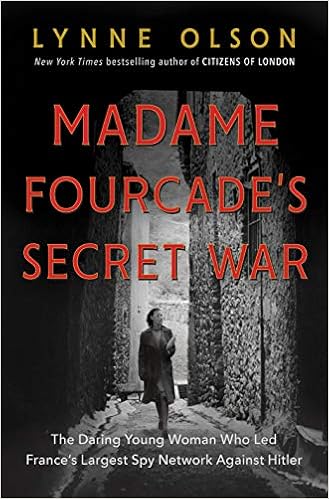
Madame Fourcade's Secret War


Madame Fourcade's Secret War: The Daring Young Woman Who Led France's Largest Spy Network Against Hitler- Lynne Olson
Random House 
Release Date: March 5, 2019

Rating:
πŸ“šπŸ“šπŸ“šπŸ“š

Synopsis: In 1941 a thirty-one-year-old Frenchwoman, a young mother born to privilege and known for her beauty and glamour, became the leader of a vast intelligence organization—the only woman to serve as a chef de rΓ©sistance during the war. Strong-willed, independent, and a lifelong rebel against her country’s conservative, patriarchal society, Marie-Madeleine Fourcade was temperamentally made for the job. Her group’s name was Alliance, but the Gestapo dubbed it Noah’s Ark because its agents used the names of animals as their aliases. The name Marie-Madeleine chose for herself was Hedgehog: a tough little animal, unthreatening in appearance, that, as a colleague of hers put it, “even a lion would hesitate to bite.”

No other French spy network lasted as long or supplied as much crucial intelligence—including providing American and British military commanders with a 55-foot-long map of the beaches and roads on which the Allies would land on D-Day—as Alliance. The Gestapo pursued them relentlessly, capturing, torturing, and executing hundreds of its three thousand agents, including Fourcade’s own lover and many of her key spies. Although Fourcade, the mother of two young children, moved her headquarters every few weeks, constantly changing her hair color, clothing, and identity, she was captured twice by the Nazis. Both times she managed to escape—once by slipping naked through the bars of her jail cell—and continued to hold her network together even as it repeatedly threatened to crumble around her.

Now, in this dramatic account of the war that split France in two and forced its people to live side by side with their hated German occupiers, Lynne Olson tells the fascinating story of a woman who stood up for her nation, her fellow citizens, and herself

_____________________________________________________________

Author Lynne Olson (Last Hope Island) specializes in bringing to life little known aspects of some of history's most powerful moments and Madame Fourcade's Secret War is a stellar addition.  Marie-Madeleine Fourcade is a young woman who rebelled against not only the Nazis but also the generally accepted role of women as second class citizens to become a major part of French resistance movement during World War II.  Fourcade's resistance network, Alliance, was the largest and most successful operation during German occupation of France and worked closely with MI6 during the entire war, attempting to stay out of politics and focus on freeing France at a time when so many other groups (both British and French) fought as hard against each other as they did against the Germans.

Fourcade recruited men and women from all parts of France and all walks of life into Alliance, which the Gestapo called Noah's Ark because all the members used the codenames of animals.  Olson is able to recreate the very human elements of this time- from the early days of occupied Paris to the heartbreaking final months of the war.  The reader feels Fourcade's triumphs, stresses, joys and sorrows as the spymaster known as "Hedgehog" tried to keep her people safely out of German hands.  We learn the little known stories of agents who risked their lives to deliver detailed maps and crucial information to MI6- including much of the information that made the Allies D-Day landing on Normandy possible.

Marie-Madeleine Fourcade might have been tailor made for the starring role in a new Hollywood spy movie or best-selling novel.  But Lynne Olson has once again proven that history can be just as fascinating as fiction.  Her clean, vibrant writing style adds no frills to a story that needs no embellishment.  Her research and attention to detail mean that events speak for themselves and the reader can't help but be swept along on Fourcade;s fight for freedom.

A must-read for history lovers!

I received an ARC of this book from NetGalley in exchange for an honest review

Tuesday, October 16, 2018

Napoleon


Napoleon: A Life by [Zamoyski, Adam]


Napoleon: A Life- Adam Zamoyski
Basic Books/ Hachette
Release Date: October 16, 2018

Rating:
πŸ“šπŸ“šπŸ“šπŸ“š

Synopsis: "What a novel my life has been!" Napoleon once said of himself. Born into a poor family, the callow young man was, by twenty-six, an army general. Seduced by an older woman, his marriage transformed him into a galvanizing military commander. The Pope crowned him as Emperor of the French when he was only thirty-five. Within a few years, he became the effective master of Europe, his power unparalleled in modern history. His downfall was no less dramatic.
____________________________________________________________

Napoleon Bonaparte is one of those larger than life figures who becomes a myth, a hero, and a villain, and in the process the true human being often disappears.  In Napoleon: A Life Adam Zamoyski works to discover the man behind the legend.  Zamoyski works to place Napoleon in the context of his time period, both politically and philosophically. He works to explain the occasionally unexplainable mindset of the French Revolution and French Republic so that readers can understand how ready France was to accept someone like Napoleon as their leader.  

Zamoskyi warns readers in his introduction that he examines the military aspects of Napoleon's life only as he feels they effected his political and personal situation.  This leads to an uneven study of the military aspect of Napoleon, heavily emphasized in the beginning and much less so by the 1812 campaigns in Russia.  Waterloo receives barely a page and a half.  But since these are well researched and frequently written about in other books, I think the unevenness worked in the book's favor.  More is certainly known about those times than about Napoleon's family, his work on restoring France, or his behavior to enemies and colleagues.  

Here we discover Napoleon's formative years on Corsica and his work to define his life on his own terms.  Corsican traditions emphasized family above all and Napoleon followed this throughout his life- while his brothers and sisters only considered family when it benefitted them directly.  Napoleon was a man who grew up despising the idea of love, only to fall head over heels in love with Josephine- who I also learned far more about in this book than I had ever known before!  He was not a man who was comfortable delegating authority, which became a serious problem when he was on campaign and trying to run an empire. Even when he wanted peace, he felt his only true claim to the throne of France was as a general. 

A well-written and well researched book, Zampyshki's Napoleon delves behind the myths to get as close to the man as possible.  Neither a saint nor a demon, Napoleon is instead presented as a man with both genius and faults, who retained until the end of his life an incredible charisma that caused men to devote their lives to his star, even when it seemed hopeless.  Which is perhaps a large part of why he is still so fascinating today.

An excellent biography for those interested in learning more about French history and the Napoleonic Wars, as well as the self-made man behind the legend.

I received an ARC of this book from NetGalley in exchange for an honest review
Wednesday, July 11, 2018

Bite-Sized History of France


A Bite-Sized History of France: Gastronomic Tales of Revolution, War, and Enlightenment by [Henaut, StΓ©phane, Mitchell, Jeni]


A Bite-Sized History of France: Gastronomic Tales of Revolution, War, and Enlightenment- StΓ©phane HΓ©naut & Jeni Mitchell
The New Press
Release Date: July 10, 2018

Rating:
πŸ“šπŸ“šπŸ“š

Synopsis: From the cassoulet that won a war to the crΓͺpe that doomed Napoleon, from the rebellions sparked by bread and salt to the new cuisines forged by empire, the history of France is intimately entwined with its gastronomic pursuits. A witty exploration of the facts and legends surrounding some of the most popular French foods and wines by a French cheesemonger and an American academic, A Bite-Sized History of France tells the compelling and often surprising story of France from the Roman era to modern times. Traversing the cuisines of France’s most famous cities as well as its underexplored regions, this innovative social history explores the impact of war and imperialism, the age-old tension between tradition and innovation, and the enduring use of food to prop up social and political identities.


The origins of the most legendary French foods and wines—from Roquefort and cognac to croissants and Calvados, from absinthe and oysters to Camembert and champagne—also reveal the social and political trends that propelled France’s rise upon the world stage. They help explain France’s dark history of war and conquest, as well as its most enlightened cultural achievements and the political and scientific innovations that transformed human history. These gastronomic tales will edify even the most seasoned lovers of food, history and all things French.
_____________________________________________________________________


How do you explore and understand the history of a country like France, which prides itself on being a Mecca of fine foods and wines?  Through the development of its' foods and wines of course! What started as stories told by a French cheesemonger to try and convince his (non-French) wife that the cheeses he wanted her to try were not smelly and disgusting once you knew the story behind them eventually became A Bite-Sized History of France: Gastronomic Tales of Revolution, War, and Enlightenment.

Told in small, bite-sized chapters, this book follows the history of France beginning with the Gauls and Romans to the modern day.  It explores the creation or increased popularity of foods from croissants to Camembert, seafoods to sauces.  Where did certain foods come from? Who are some dishes named after and why? What brought them to popularity?  Including both actual culinary history and the more apocryphal tales surrounding certain foods, HΓ©nault and Mitchell provide entertaining and informative vignettes linking food and French history.  

The history is told with a witty, often tongue-in-cheek approach that should appeal to foodies more interested in the story behind their favorite wine than the history of France, and the weaving of food into history will give historians a new light to shine on what they thought they knew.  As the book does literally cover almost the entire history of France, reading it in bite-sized pieces will keep it fresh and interesting instead of gorging on the entire book at one sitting.

Witty, entertaining, and informative, A Bite-Sized History of France allows readers a delightful new look at their favorite foods and the political and global story behind them- and still being formed to this day.


received an ARC of this book from NetGalley in exchange for an honest review