Showing posts with label France. Show all posts

Tuesday, February 28, 2023

Empress of the Nile


Empress of the Nile: The Daredevil Archaeologist Who Saved Egypt's Ancient Temples From Destruction- Lynne Olson

Random House

Release Date: February 28, 2023

Rating: πŸ“šπŸ“šπŸ“šπŸ“šπŸ“š

Synopsis: In the 1960s, the world’s attention was focused on a nail-biting race against time: Fifty countries contributed nearly a billion dollars to save a dozen ancient Egyptian temples, built during the height of the pharaohs’ rule, from drowning in the floodwaters of the massive new Aswan High Dam. But the extensive press coverage at the time overlooked the gutsy French archaeologist who made it all happen. Without the intervention of Christiane Desroches-Noblecourt, the temples would now be at the bottom of a vast reservoir. It was an unimaginably large and complex project that required the fragile sandstone temples to be dismantled, stone by stone, and rebuilt on higher ground.

A willful real-life version of Indiana Jones, Desroches-Noblecourt refused to be cowed by anyone or anything. During World War II she joined the French Resistance and was held by the Nazis; in her fight to save the temples she challenged two of the postwar world’s most daunting leaders, Egypt’s President Nasser and France’s President de Gaulle. As she told a reporter, “You don’t get anywhere without a fight, you know.”

Yet Desroches-Noblecourt was not the only woman who played an essential role in the historic endeavor. The other was Jacqueline Kennedy, who persuaded her husband to call on Congress to help fund the rescue effort. After years of Western plunder of Egypt’s ancient monuments, Desroches-Noblecourt did the opposite. She helped preserve a crucial part of Egypt’s cultural heritage, and made sure it remained in its homeland.
_____________________________________________________________

Historian Lynne Olson, best known for her fantastic books on little known aspects of World War II history,  (Last Hope Island) gives us another little known but hugely influential story in Empress of the Nile. Along the lines of Madame Fourcade's Secret War, Empress of the Nile focuses on a Frenchwoman- Christine Desroches-Noblecourt, a resistance fighter during World War II. But what I thought would be the most interesting part of her story ended up being only a small part, and by no means the most fascinating.

Christiane Desroches-Noblecourt was fascinated by Egypt from a young age and was fortunate enough to have parents who supported her in following her dreams. She became the first female archaeologist and Egyptologist in France, facing incredible hostility from the men in her field, who didn't want her on dig sites. They disliked her presence in general, her talent and intelligence, her familiarity and positive working relationship with the local Egyptian workers, and her successes. When not on a dig in Egypt she was working at the Louvre. As the Nazi threat began to loom, the Louvre packed up its treasures and shipped them to different places for protection, with Christiane helping catalog, pack, and transport the Egyptian collections. She remained in Paris during the occupation and was part of the first resistance group against the Nazis, a fascinating collection of men and women who were mostly museum workers but were able to help hide escaping POWs in their museums and get them to safety, among many other things. When Christiane was arrested, questioned, and then released by Nazi officers she knew she would be under surveillance and backed away from the group to keep her friends in the movement safe. While I thought this early part of her life would have been the most fascinating, what really captivated me was what came after the war. Christiane worked with Egyptian officials, UNESCO, and other agencies during the 1960s to save Abu Simbel, the Temple at Philae, and other priceless monuments from being lost to flooding with the building of the new Aswan High Dam. She was the visionary and the driving force behind the effort, even though she received little credit then or now. It was Desroches-Noblecourt who brought experts and professionals from around the world together to work on a project with no political motivation, just pure desire to save archaeological treasures for the good of humankind.

Lynne Olson describes the race to save Abu Simbel, the Temple of Philae, and the other endangered monuments in breathtaking details that leave the reader's heart racing, desperate to find out what will happen next and how they will succeed. What will go wrong? How will they triumph? What political disasters will get in the way? The reader feels some of what Desroches-Noblecourt must have felt as she worked nonstop to save the temples. Along the way I learned a lot about the politics of Egypt, from when France and England took over during the 1800s through the 1960s and how the world's politics affected Egyptology. And how this can be overcome when a few voices prove what really matters.  

Empress of the Nile is a fascinating story of the little known life of Christiane Desroche-Noblecourt and her life long dedication to discovering, interpreting, and preserving Egypt's past. Carefully researched and beautifully written, this is the story of a strong and dedicated woman who inspired generations of archaeologists, and should inspire future generations of people to go for their dreams, no matter how impossible they seem. Because sometimes, you can move mountains.

I received an ARC of this book from NetGalley in exchange for an honest review


Tuesday, February 26, 2019

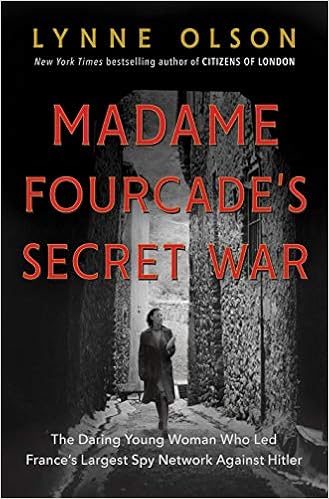
Madame Fourcade's Secret War


Madame Fourcade's Secret War: The Daring Young Woman Who Led France's Largest Spy Network Against Hitler- Lynne Olson
Random House 
Release Date: March 5, 2019

Rating:
πŸ“šπŸ“šπŸ“šπŸ“š

Synopsis: In 1941 a thirty-one-year-old Frenchwoman, a young mother born to privilege and known for her beauty and glamour, became the leader of a vast intelligence organization—the only woman to serve as a chef de rΓ©sistance during the war. Strong-willed, independent, and a lifelong rebel against her country’s conservative, patriarchal society, Marie-Madeleine Fourcade was temperamentally made for the job. Her group’s name was Alliance, but the Gestapo dubbed it Noah’s Ark because its agents used the names of animals as their aliases. The name Marie-Madeleine chose for herself was Hedgehog: a tough little animal, unthreatening in appearance, that, as a colleague of hers put it, “even a lion would hesitate to bite.”

No other French spy network lasted as long or supplied as much crucial intelligence—including providing American and British military commanders with a 55-foot-long map of the beaches and roads on which the Allies would land on D-Day—as Alliance. The Gestapo pursued them relentlessly, capturing, torturing, and executing hundreds of its three thousand agents, including Fourcade’s own lover and many of her key spies. Although Fourcade, the mother of two young children, moved her headquarters every few weeks, constantly changing her hair color, clothing, and identity, she was captured twice by the Nazis. Both times she managed to escape—once by slipping naked through the bars of her jail cell—and continued to hold her network together even as it repeatedly threatened to crumble around her.

Now, in this dramatic account of the war that split France in two and forced its people to live side by side with their hated German occupiers, Lynne Olson tells the fascinating story of a woman who stood up for her nation, her fellow citizens, and herself

_____________________________________________________________

Author Lynne Olson (Last Hope Island) specializes in bringing to life little known aspects of some of history's most powerful moments and Madame Fourcade's Secret War is a stellar addition.  Marie-Madeleine Fourcade is a young woman who rebelled against not only the Nazis but also the generally accepted role of women as second class citizens to become a major part of French resistance movement during World War II.  Fourcade's resistance network, Alliance, was the largest and most successful operation during German occupation of France and worked closely with MI6 during the entire war, attempting to stay out of politics and focus on freeing France at a time when so many other groups (both British and French) fought as hard against each other as they did against the Germans.

Fourcade recruited men and women from all parts of France and all walks of life into Alliance, which the Gestapo called Noah's Ark because all the members used the codenames of animals.  Olson is able to recreate the very human elements of this time- from the early days of occupied Paris to the heartbreaking final months of the war.  The reader feels Fourcade's triumphs, stresses, joys and sorrows as the spymaster known as "Hedgehog" tried to keep her people safely out of German hands.  We learn the little known stories of agents who risked their lives to deliver detailed maps and crucial information to MI6- including much of the information that made the Allies D-Day landing on Normandy possible.

Marie-Madeleine Fourcade might have been tailor made for the starring role in a new Hollywood spy movie or best-selling novel.  But Lynne Olson has once again proven that history can be just as fascinating as fiction.  Her clean, vibrant writing style adds no frills to a story that needs no embellishment.  Her research and attention to detail mean that events speak for themselves and the reader can't help but be swept along on Fourcade;s fight for freedom.

A must-read for history lovers!

I received an ARC of this book from NetGalley in exchange for an honest review
Tuesday, October 16, 2018

Napoleon


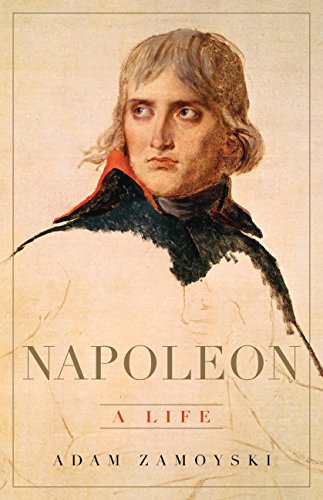
Napoleon: A Life by [Zamoyski, Adam]


Napoleon: A Life- Adam Zamoyski
Basic Books/ Hachette
Release Date: October 16, 2018

Rating:
πŸ“šπŸ“šπŸ“šπŸ“š

Synopsis: "What a novel my life has been!" Napoleon once said of himself. Born into a poor family, the callow young man was, by twenty-six, an army general. Seduced by an older woman, his marriage transformed him into a galvanizing military commander. The Pope crowned him as Emperor of the French when he was only thirty-five. Within a few years, he became the effective master of Europe, his power unparalleled in modern history. His downfall was no less dramatic.
____________________________________________________________

Napoleon Bonaparte is one of those larger than life figures who becomes a myth, a hero, and a villain, and in the process the true human being often disappears.  In Napoleon: A Life Adam Zamoyski works to discover the man behind the legend.  Zamoyski works to place Napoleon in the context of his time period, both politically and philosophically. He works to explain the occasionally unexplainable mindset of the French Revolution and French Republic so that readers can understand how ready France was to accept someone like Napoleon as their leader.  

Zamoskyi warns readers in his introduction that he examines the military aspects of Napoleon's life only as he feels they effected his political and personal situation.  This leads to an uneven study of the military aspect of Napoleon, heavily emphasized in the beginning and much less so by the 1812 campaigns in Russia.  Waterloo receives barely a page and a half.  But since these are well researched and frequently written about in other books, I think the unevenness worked in the book's favor.  More is certainly known about those times than about Napoleon's family, his work on restoring France, or his behavior to enemies and colleagues.  

Here we discover Napoleon's formative years on Corsica and his work to define his life on his own terms.  Corsican traditions emphasized family above all and Napoleon followed this throughout his life- while his brothers and sisters only considered family when it benefitted them directly.  Napoleon was a man who grew up despising the idea of love, only to fall head over heels in love with Josephine- who I also learned far more about in this book than I had ever known before!  He was not a man who was comfortable delegating authority, which became a serious problem when he was on campaign and trying to run an empire. Even when he wanted peace, he felt his only true claim to the throne of France was as a general. 

A well-written and well researched book, Zampyshki's Napoleon delves behind the myths to get as close to the man as possible.  Neither a saint nor a demon, Napoleon is instead presented as a man with both genius and faults, who retained until the end of his life an incredible charisma that caused men to devote their lives to his star, even when it seemed hopeless.  Which is perhaps a large part of why he is still so fascinating today.

An excellent biography for those interested in learning more about French history and the Napoleonic Wars, as well as the self-made man behind the legend.

I received an ARC of this book from NetGalley in exchange for an honest review
Wednesday, July 11, 2018

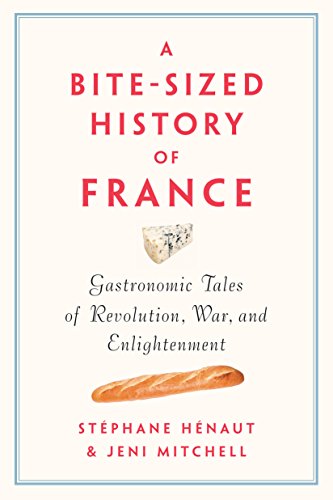
Bite-Sized History of France


A Bite-Sized History of France: Gastronomic Tales of Revolution, War, and Enlightenment by [Henaut, StΓ©phane, Mitchell, Jeni]


A Bite-Sized History of France: Gastronomic Tales of Revolution, War, and Enlightenment- StΓ©phane HΓ©naut & Jeni Mitchell
The New Press
Release Date: July 10, 2018

Rating:
πŸ“šπŸ“šπŸ“š

Synopsis: From the cassoulet that won a war to the crΓͺpe that doomed Napoleon, from the rebellions sparked by bread and salt to the new cuisines forged by empire, the history of France is intimately entwined with its gastronomic pursuits. A witty exploration of the facts and legends surrounding some of the most popular French foods and wines by a French cheesemonger and an American academic, A Bite-Sized History of France tells the compelling and often surprising story of France from the Roman era to modern times. Traversing the cuisines of France’s most famous cities as well as its underexplored regions, this innovative social history explores the impact of war and imperialism, the age-old tension between tradition and innovation, and the enduring use of food to prop up social and political identities.


The origins of the most legendary French foods and wines—from Roquefort and cognac to croissants and Calvados, from absinthe and oysters to Camembert and champagne—also reveal the social and political trends that propelled France’s rise upon the world stage. They help explain France’s dark history of war and conquest, as well as its most enlightened cultural achievements and the political and scientific innovations that transformed human history. These gastronomic tales will edify even the most seasoned lovers of food, history and all things French.
_____________________________________________________________________


How do you explore and understand the history of a country like France, which prides itself on being a Mecca of fine foods and wines?  Through the development of its' foods and wines of course! What started as stories told by a French cheesemonger to try and convince his (non-French) wife that the cheeses he wanted her to try were not smelly and disgusting once you knew the story behind them eventually became A Bite-Sized History of France: Gastronomic Tales of Revolution, War, and Enlightenment.

Told in small, bite-sized chapters, this book follows the history of France beginning with the Gauls and Romans to the modern day.  It explores the creation or increased popularity of foods from croissants to Camembert, seafoods to sauces.  Where did certain foods come from? Who are some dishes named after and why? What brought them to popularity?  Including both actual culinary history and the more apocryphal tales surrounding certain foods, HΓ©nault and Mitchell provide entertaining and informative vignettes linking food and French history.  

The history is told with a witty, often tongue-in-cheek approach that should appeal to foodies more interested in the story behind their favorite wine than the history of France, and the weaving of food into history will give historians a new light to shine on what they thought they knew.  As the book does literally cover almost the entire history of France, reading it in bite-sized pieces will keep it fresh and interesting instead of gorging on the entire book at one sitting.

Witty, entertaining, and informative, A Bite-Sized History of France allows readers a delightful new look at their favorite foods and the political and global story behind them- and still being formed to this day.


I received an ARC of this book from NetGalley in exchange for an honest review