Showing posts with label Lynne Olson. Show all posts

Tuesday, May 27, 2025

Sisterhood of Ravensbruck


The Sisterhood of Ravensbruck: How an Intrepid Band of Frenchwomen Resisted the Nazis in Hitler's All-Femal Concentration Camp- Lynne Olson

Random House

Release Date: June 3, 2025

Rating:πŸ“šπŸ“šπŸ“šπŸ“šπŸ“š

Synopsis: For decades after World War II, histories of the French Resistance were written almost exclusively by men and largely ignored the contributions of women. Many current overviews of the subject continue to underplay the extent and importance of women’s participation in the Resistance, treating the subject, in the words of one historian, as ‘an anonymous background element in an essentially male story’.

The Sisterhood of RavensbrΓΌck corrects that omission, surveying the bond between four women — Germaine Tillion, Anise Girard, Genevieve de Gaulle, and Jacqueline d’Alincourt — who fought valiantly against Nazi oppression. While the women belonged to different Resistance movements and networks, they were united by a common they were arrested by the Gestapo, underwent merciless interrogations and beatings, were jailed — and, most significantly, survived, if just barely, the hell of RavensbrΓΌck, the only concentration camp designed specifically for women. In an institution designed to dehumanise and kill, the sisterhood maintained their sense of self and joined together to face down death.
____________________________________________________________

Lynne Olson is one of my favorite historians, and has a wonderful talent for bringing out hidden voices and stories during World War 2 that help us discover so many new aspects to that time. Her last two books (Madame Fourcarde's Secret War and Empress of the Nile) explore the lives of two women who were trail-blazers both during and after the war, but who during the war helped build the French resistance against the Nazis. The Sisterhood of Ravensbruck follows the lives of four women: Germaine Tillion, Anise Girard, Genevieve de Gaulle, and Jacqueline d'Alincourt who were also part of the French Resistance- and who were sent to (and survived) Ravensbruck camp for that resistance.

The book is divided into three sections: before, during, and after Ravensbruck, and I was a little surprised at much of it focused on the after. As you'd expect with any book dealing with Nazis, concentration camps, etc. there are some parts that are hard to read. But the sisterhood that developed among the women in the camp, particularly the French women Olson focuses on, brought with it such surprising hope as well. They helped each other survive through so many acts that it brought tears to my eyes as I was reading. The Polish women (called "rabbits") who were used as medical experiments in the camp were helped by everyone, including being hidden when the order to kill them came at the end of the war (if you've read Martha Hall Kelly's Lilac Girls, it's based on the rabbit's story). The prisoners knew they all faced death for defying their captors, but they resisted the Nazis again. The strength of the women, sharing their tiny amounts of food, medicine, gathering evidence of the crimes against them in the hope that one day they would be free to use it, was staggering to me. As I read I could only wonder if I would have been that brave, and hope the answer would have been yes.

It should come as no surprise that none of the Ravensbruck women stopped being amazing after leaving the camp. They continued to stand together to ensure whoever needed medical help got it, to help each other reintergrate into post-War life. They stood as witnesses for the dead against the crimes the Ravensbruck Nazis had committed. They helped the "rabbits" get to America for medical tretment. And continued to stand up against injustices and crimes against humanity wherever they saw them for the rest of their lives. 

The inspiration brought to me by this story leaves me speechless. It is hard and uplifting, often at the same time– and absolutely a book we should all read and learn from. As we should learn from these women.

I received an ARC from NetGalley in exchange for an honest review


Tuesday, February 28, 2023

Empress of the Nile


Empress of the Nile: The Daredevil Archaeologist Who Saved Egypt's Ancient Temples From Destruction- Lynne Olson

Random House

Release Date: February 28, 2023

Rating: πŸ“šπŸ“šπŸ“šπŸ“šπŸ“š

Synopsis: In the 1960s, the world’s attention was focused on a nail-biting race against time: Fifty countries contributed nearly a billion dollars to save a dozen ancient Egyptian temples, built during the height of the pharaohs’ rule, from drowning in the floodwaters of the massive new Aswan High Dam. But the extensive press coverage at the time overlooked the gutsy French archaeologist who made it all happen. Without the intervention of Christiane Desroches-Noblecourt, the temples would now be at the bottom of a vast reservoir. It was an unimaginably large and complex project that required the fragile sandstone temples to be dismantled, stone by stone, and rebuilt on higher ground.

A willful real-life version of Indiana Jones, Desroches-Noblecourt refused to be cowed by anyone or anything. During World War II she joined the French Resistance and was held by the Nazis; in her fight to save the temples she challenged two of the postwar world’s most daunting leaders, Egypt’s President Nasser and France’s President de Gaulle. As she told a reporter, “You don’t get anywhere without a fight, you know.”

Yet Desroches-Noblecourt was not the only woman who played an essential role in the historic endeavor. The other was Jacqueline Kennedy, who persuaded her husband to call on Congress to help fund the rescue effort. After years of Western plunder of Egypt’s ancient monuments, Desroches-Noblecourt did the opposite. She helped preserve a crucial part of Egypt’s cultural heritage, and made sure it remained in its homeland.
_____________________________________________________________

Historian Lynne Olson, best known for her fantastic books on little known aspects of World War II history,  (Last Hope Island) gives us another little known but hugely influential story in Empress of the Nile. Along the lines of Madame Fourcade's Secret War, Empress of the Nile focuses on a Frenchwoman- Christine Desroches-Noblecourt, a resistance fighter during World War II. But what I thought would be the most interesting part of her story ended up being only a small part, and by no means the most fascinating.

Christiane Desroches-Noblecourt was fascinated by Egypt from a young age and was fortunate enough to have parents who supported her in following her dreams. She became the first female archaeologist and Egyptologist in France, facing incredible hostility from the men in her field, who didn't want her on dig sites. They disliked her presence in general, her talent and intelligence, her familiarity and positive working relationship with the local Egyptian workers, and her successes. When not on a dig in Egypt she was working at the Louvre. As the Nazi threat began to loom, the Louvre packed up its treasures and shipped them to different places for protection, with Christiane helping catalog, pack, and transport the Egyptian collections. She remained in Paris during the occupation and was part of the first resistance group against the Nazis, a fascinating collection of men and women who were mostly museum workers but were able to help hide escaping POWs in their museums and get them to safety, among many other things. When Christiane was arrested, questioned, and then released by Nazi officers she knew she would be under surveillance and backed away from the group to keep her friends in the movement safe. While I thought this early part of her life would have been the most fascinating, what really captivated me was what came after the war. Christiane worked with Egyptian officials, UNESCO, and other agencies during the 1960s to save Abu Simbel, the Temple at Philae, and other priceless monuments from being lost to flooding with the building of the new Aswan High Dam. She was the visionary and the driving force behind the effort, even though she received little credit then or now. It was Desroches-Noblecourt who brought experts and professionals from around the world together to work on a project with no political motivation, just pure desire to save archaeological treasures for the good of humankind.

Lynne Olson describes the race to save Abu Simbel, the Temple of Philae, and the other endangered monuments in breathtaking details that leave the reader's heart racing, desperate to find out what will happen next and how they will succeed. What will go wrong? How will they triumph? What political disasters will get in the way? The reader feels some of what Desroches-Noblecourt must have felt as she worked nonstop to save the temples. Along the way I learned a lot about the politics of Egypt, from when France and England took over during the 1800s through the 1960s and how the world's politics affected Egyptology. And how this can be overcome when a few voices prove what really matters.  

Empress of the Nile is a fascinating story of the little known life of Christiane Desroche-Noblecourt and her life long dedication to discovering, interpreting, and preserving Egypt's past. Carefully researched and beautifully written, this is the story of a strong and dedicated woman who inspired generations of archaeologists, and should inspire future generations of people to go for their dreams, no matter how impossible they seem. Because sometimes, you can move mountains.

I received an ARC of this book from NetGalley in exchange for an honest review


Tuesday, February 26, 2019

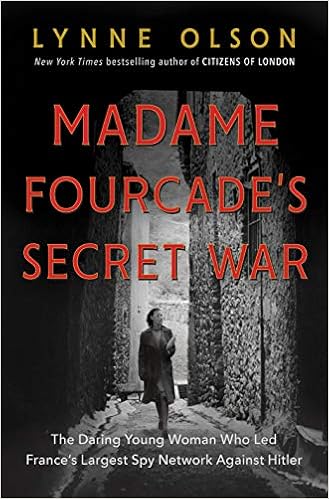
Madame Fourcade's Secret War


Madame Fourcade's Secret War: The Daring Young Woman Who Led France's Largest Spy Network Against Hitler- Lynne Olson
Random House 
Release Date: March 5, 2019

Rating:
πŸ“šπŸ“šπŸ“šπŸ“š

Synopsis: In 1941 a thirty-one-year-old Frenchwoman, a young mother born to privilege and known for her beauty and glamour, became the leader of a vast intelligence organization—the only woman to serve as a chef de rΓ©sistance during the war. Strong-willed, independent, and a lifelong rebel against her country’s conservative, patriarchal society, Marie-Madeleine Fourcade was temperamentally made for the job. Her group’s name was Alliance, but the Gestapo dubbed it Noah’s Ark because its agents used the names of animals as their aliases. The name Marie-Madeleine chose for herself was Hedgehog: a tough little animal, unthreatening in appearance, that, as a colleague of hers put it, “even a lion would hesitate to bite.”

No other French spy network lasted as long or supplied as much crucial intelligence—including providing American and British military commanders with a 55-foot-long map of the beaches and roads on which the Allies would land on D-Day—as Alliance. The Gestapo pursued them relentlessly, capturing, torturing, and executing hundreds of its three thousand agents, including Fourcade’s own lover and many of her key spies. Although Fourcade, the mother of two young children, moved her headquarters every few weeks, constantly changing her hair color, clothing, and identity, she was captured twice by the Nazis. Both times she managed to escape—once by slipping naked through the bars of her jail cell—and continued to hold her network together even as it repeatedly threatened to crumble around her.

Now, in this dramatic account of the war that split France in two and forced its people to live side by side with their hated German occupiers, Lynne Olson tells the fascinating story of a woman who stood up for her nation, her fellow citizens, and herself

_____________________________________________________________

Author Lynne Olson (Last Hope Island) specializes in bringing to life little known aspects of some of history's most powerful moments and Madame Fourcade's Secret War is a stellar addition.  Marie-Madeleine Fourcade is a young woman who rebelled against not only the Nazis but also the generally accepted role of women as second class citizens to become a major part of French resistance movement during World War II.  Fourcade's resistance network, Alliance, was the largest and most successful operation during German occupation of France and worked closely with MI6 during the entire war, attempting to stay out of politics and focus on freeing France at a time when so many other groups (both British and French) fought as hard against each other as they did against the Germans.

Fourcade recruited men and women from all parts of France and all walks of life into Alliance, which the Gestapo called Noah's Ark because all the members used the codenames of animals.  Olson is able to recreate the very human elements of this time- from the early days of occupied Paris to the heartbreaking final months of the war.  The reader feels Fourcade's triumphs, stresses, joys and sorrows as the spymaster known as "Hedgehog" tried to keep her people safely out of German hands.  We learn the little known stories of agents who risked their lives to deliver detailed maps and crucial information to MI6- including much of the information that made the Allies D-Day landing on Normandy possible.

Marie-Madeleine Fourcade might have been tailor made for the starring role in a new Hollywood spy movie or best-selling novel.  But Lynne Olson has once again proven that history can be just as fascinating as fiction.  Her clean, vibrant writing style adds no frills to a story that needs no embellishment.  Her research and attention to detail mean that events speak for themselves and the reader can't help but be swept along on Fourcade;s fight for freedom.

A must-read for history lovers!

I received an ARC of this book from NetGalley in exchange for an honest review

Sunday, May 7, 2017

Last Hope Island

Last Hope Island: Britain, Occupied Europe, and the Brotherhood That Helped Turn the Tide of War by [Olson, Lynne]


Last Hope Island: Britain's Brotherhood with Occupied Europe, and the Unsung Heroes Who Turned the Tide of War- Lynne Olson
Random House
Release Date: April 25, 2017

Rating (out of 5):
πŸ“šπŸ“šπŸ“šπŸ“šπŸ“š

Synopsis: When the Nazi blitzkrieg rolled over continental Europe in the early days of World War II, the city of London became a refuge for the governments and armed forces of six occupied nations who escaped there to continue the fight. So, too, did General Charles de Gaulle, the self-appointed representative of free France.     

As the only European democracy still holding out against Hitler, Britain became known to occupied countries as “Last Hope Island.” Getting there, one young emigrΓ© declared, was “like getting to heaven.”

In this epic, character-driven narrative, acclaimed historian Lynne Olson takes us back to those perilous days when the British and their European guests joined forces to combat the mightiest military force in history. Here we meet the courageous King Haakon of Norway, whose distinctive “H7” monogram became a symbol of his country’s resistance to Nazi rule, and his fiery Dutch counterpart, Queen Wilhelmina, whose antifascist radio broadcasts rallied the spirits of her defeated people. Here, too, is the Earl of Suffolk, a swashbuckling British aristocrat whose rescue of two nuclear physicists from France helped make the Manhattan Project possible.

Last Hope Island also recounts some of the Europeans’ heretofore unsung exploits that helped tilt the balance against the Axis: the crucial efforts of Polish pilots during the Battle of Britain; the vital role played by French and Polish code breakers in cracking the Germans’ reputedly indecipherable Enigma code; and the flood of top-secret intelligence about German operations—gathered by spies throughout occupied Europe—that helped ensure the success of the 1944 Allied invasion.


________________________________

Last Hope Island is a powerfully written amalgamation of stories of a Europe occupied by Nazi Germany and the men, women, and governments who joined forces to resist a common enemy.  I was fascinated to learn these new aspects to World War II- many of them unknown or poorly understood by myself and (probably) many others.  Olson takes a dauntingly large saga and humanizes it, introducing us to King Haakon of Norway and the Dutch Queen Wilhemina, both standing strong against Hitler and becoming symbols of strength for their countries.  We meet heroes like Andree de Jongh and the de Nooij sisters, among others who helped smuggle Allied soldiers out to safety or hid wounded soldiers, protecting them from Nazis.  Especially important are the stories of Polish and Czech soldiers and pilots who helped turn the Battle of Britain, the Polish cryptographers who broke the "unbreakable" Enigma code and the intelligence agents who smuggled out information vital for the D-Day beach landings.

Olson does her best not to idolize or whitewash any of the history she examines.  Along with the heroic victories are plenty of defeats, and Olson takes an honest look at the British and American leaders who refused to accept assistance or believe information coming from Europeans- leading to such disasters as the Allied defeat at Arnhem in 1944.  The popular myth of Britain's Secret Service as being a brilliant and unbeatable spy operation is smashed to bits as Olson examines MI6 and the Special Operations Executive (SOE).  Originally underfunded operations recruiting young aristocrats and providing little to no training before sending them into the field, the groups seemed to put more emphasis on fighting each other for credit and funding than focusing on improving their intelligence operations to defeat Hitler. 

The BBC gets special notice in Last Hope Island, as a beacon of hope as well as providing the public with a separation from propaganda and focusing on telling the news- the truth, the whole truth, no matter how awful it might be.  I found the chapters focusing on the BBC especially poignant and inspirational because they focused on the every day, and inspiring and encouraging people through even small actions.  The story of the "avalanche of Vs" might seem like the kind of thing you'd see in a movie, but was a perfect example of how a small action could help people feel like they were not just giving up.  In a world as inundated with news as ours is, Last Hope Island helps us understand the power of the radio when it was almost the only way of connecting with the outside world.

Lynne Olson does a wonderful job of immersing the reader in the world of Occupied Europe and wartime London, and the mindset of the people living there.  Last Hope Island is a riveting book, and certainly a must-read for history lovers.

I received an ARC of this book from NetGalley in exchange for an honest review.