Showing posts with label Viking. Show all posts

Friday, August 27, 2021

The Real Valkyrie


The Real Valkyrie: The Hidden History of Viking Warrior Women- Nancy Marie Brown

St. Martin's Press

Release Date: August 31, 2021

Rating: ðŸ“šðŸ“šðŸ“šðŸ“š

Synopsis: In 2017, DNA tests revealed to the collective shock of many scholars that a Viking warrior in a high-status grave in Birka, Sweden was actually a woman. The Real Valkyrie weaves together archaeology, history, and literature to imagine her life and times, showing that Viking women had more power and agency than historians have imagined.

Nancy Marie Brown uses science to link the Birka warrior, whom she names Hervor, to Viking trading towns and to their great trade route east to Byzantium and beyond. She imagines her life intersecting with larger-than-life but real women, including Queen Gunnhild Mother-of-Kings, the Viking leader known as The Red Girl, and Queen Olga of Kyiv. Hervor’s short, dramatic life shows that much of what we have taken as truth about women in the Viking Age is based not on data, but on nineteenth-century Victorian biases. Rather than holding the household keys, Viking women in history, law, saga, poetry, and myth carry weapons. These women brag, “As heroes we were widely known—with keen spears we cut blood from bone.” In this compelling narrative Brown brings the world of those valkyries and shield-maids to vivid life.

______________________________________________________________________

"The Real Valkyrie" studies the history of the Vikings as we know it through a new lens: modern archaeology, free of the Victorian limitations we have allowed to color our thoughts of their world for so long. Others will call it feminist. How about both- as well as extremely interesting and well-written. 

Modern technology has been used to go over bones buried in Birka Bj581, a warrior's grave in Birka, Sweden.  Because of the weapons and others items traditional archaeology has associated with men, this grave was identified as a war leader, a brilliant warrior, and a man.  Today we know the bones are of a woman. Does that make the rest of the story the burial told, that of a well respected warrior, less true? Brown uses modern archaeology to analyze myths, legends, and history to search for the "real valkyrie"- who she argues was not a mythical being but in fact a warrior woman. Brown argues that women in the Viking age had a much larger role than has previously been assigned to them- that they were capable leaders, rulers, merchants, and warriors just like men. I found her arguments very interesting and certainly found myself agreeing that we cannot look at history through the filter of those who wrote about other people. In the case of the Vikings, this would mean men, Christian men, telling about a world that was already hundreds of years in the past when they were writing, and whose world view they could no longer understand. 

The multiethnic society of the Viking world, Brown argues, was a world where power did not come from one person (the pope) and filter down, it was not a world organized by kings as we would come to understand it later. It was a world where talent, need, and opportunity should focus your path and your gender did not limit you.  The idea of the Viking woman as the key-holder and mistress of the house is, according to Brown, the Victorian interpretation of the Vikings because that was how the Victorians viewed the world. And we haven't updated them since.  Here, Brown argues successfully that we should look at what archaeological sites tell us without preconceived notions, and we should not ignore the evidence that goes against what we think we already know.  Because Birka Bj581 is not the only grave of a warrior who has been reexamined and found to be a woman.  

Brown's The Real Valkyrie: The Hidden History of Viking Warrior Women turns traditional images of the Viking world on its head and presents a vivid, well-researched, and fascinating exploration of life in the Viking Age through  a new lens. From the everyday to the afterlife, this is the world as archaeological finds show it might have been.

I received an ARC of this book in exchange for an honest review 


Wednesday, April 10, 2019

Cities


Cities: The First 6,000 Years by [Smith, Monica L.]


Cities: The First 6,000 Years- Monica L. Smith
Viking/Penguin Group
Release Date: April 16, 2019

Rating:
📚📚📚

Synopsis:Six thousand years ago, there were no cities on the planet. Today, more than half of the world's population lives in urban areas, and that number is growing. Weaving together archeology, history, and contemporary observations, Monica Smith explains the rise of the first urban developments and their connection to our own. She takes readers on a journey through the ancient world of Tell Brak in modern-day Syria; Teotihuacan and Tenochtitlan in Mexico; her own digs in India; as well as the more well-known Pompeii, Rome, and Athens. Along the way, she presents the unique properties that made cities singularly responsible for the flowering of humankind: the development of networked infrastructure, the rise of an entrepreneurial middle class, and the culture of consumption that results in everything from take-out food to the tell-tale secrets of trash.

Cities is an impassioned and learned account full of fascinating details of daily life in ancient urban centers, using archaeological perspectives to show that the aspects of cities we find most irresistible (and the most annoying) have been with us since the very beginnings of urbanism itself. She also proves the rise of cities was hardly inevitable, yet it was crucial to the eventual global dominance of our species--and that cities are here to stay.

_____________________________________________________________________

In her book Cities: The First 6,000 Years, archaeologist Monica L. Smith gives us the story of cities: how people built them and why, how ancient cities compare to modern cities, and how cities impact the people who live in them.  It is a fascinating look at the urban environments that so many of us take for granted, unquestioningly walking streets everyday without considering why or what went before.

Smith's love of archaeology and discovery shine clearly off of each page- she seems as eager to share her discoveries with us as we are to read about them.  What I found most interesting was that Smith's views on the development of cities were such a seamless flow between the physical and the psychological.  She describes what a city needs: infrastructure of roads, water, food, planning, but also what a city does: it provides humans with exposure to people, ideas, and consumer goods that they would never see in a rural setting.  Much of the book examines how consumer habits are both created by the environment but also create the environment and the people's mindsets in turn.

There is also the inevitable discussion of what comes next.  What about the collapse of cities?  Looking at the question from an archaeologist's point of view, Smith argues that perhaps this isn't as inevitable as we often think.  Cities may grow and change with the times, the environment, and the people in them, but historically very few simply end.  And even if a city ends (like Pompeii), its people may survive, move on, integrate and influence other cities.

Although occasionally repetitive, Cities is a book full of fascinating information and new ways for people to look at the urban environments around them.  An excellent read for history lovers, those interested in archaeology, or even human psychology, as Smith makes the argument that all of those aspects go into what makes a city and how we should look at their history. 


I received an ARC of this book from NetGalley in exchange for an honest review

Thursday, December 15, 2016

Glass Universe


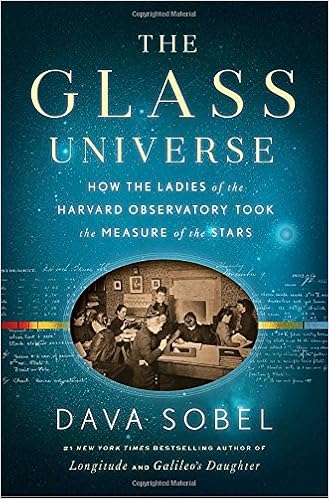
The Glass Universe: How the Ladies of the Harvard Observatory Took the Measure of the Stars- Dava Sobel
Viking 
Release Date: December 6, 2016

Rating (out of 5):
📚📚📚📚

Synopsis: In the mid-nineteenth century, the Harvard College Observatory began employing women as calculators, or “human computers,” to interpret the observations their male counterparts made via telescope each night. At the outset this group included the wives, sisters, and daughters of the resident astronomers, but soon the female corps included graduates of the new women's colleges—Vassar, Wellesley, and Smith. As photography transformed the practice of astronomy, the ladies turned from computation to studying the stars captured nightly on glass photographic plates. 

The “glass universe” of half a million plates that Harvard amassed over the ensuing decades—through the generous support of Mrs. Anna Palmer Draper, the widow of a pioneer in stellar photography—enabled the women to make extraordinary discoveries that attracted worldwide acclaim. They helped discern what stars were made of, divided the stars into meaningful categories for further research, and found a way to measure distances across space by starlight. Their ranks included Williamina Fleming, a Scottish woman originally hired as a maid who went on to identify ten novae and more than three hundred variable stars; Annie Jump Cannon, who designed a stellar classification system that was adopted by astronomers the world over and is still in use; and Dr. Cecilia Helena Payne, who in 1956 became the first ever woman professor of astronomy at Harvard—and Harvard’s first female department chair. 

_________________________

The Glass Universe is a new look behind the scenes of some of the most influential, ground breaking discoveries of the Harvard College Observatory and the women who helped make them.  Beginning in the late nineteenth century, Harvard University began hiring women to assist with astronomical computing.  Thanks to Harvard's Professor Pickering and donors Mrs Anna Palmer Draper and Catherine Wolfe Bruce, women received job opportunities considered unusual at the time.  Astronomy enthusiasts and mathematicians, amateurs and college graduates, they were paid less than their male counterparts but generally treated as equals in the workplace- even publishing work under their own names before women in America had the right to vote.  

I have virtually no knowledge of astronomy, Harvard, or the history associated with either, but I found The Glass Universe to be both easily understandable and very interesting.  It is the story of the development of astronomy in the late nineteenth-early twentieth century as much as it is the women of Harvard.  The story of one cannot be told without the other, and without following the advancements in photography that made so many of the discoveries possible.  I loved learning about Harvard's "glass universe" of glass negatives- photographs taken by telescopes to track stars and their movement.  Before electronic computers there were "human computers"- in Harvard's case largely women- who measured distances and movements, light and speed, of various stars in what I would imagine were mind-boggling calculations.  Eventually they began using the plates for their own research and their work helped to define the universe as we know it today.

This is not a book filled with equations and charts.  It is the human story behind the science. The Glass Universe is a perfect example of how all history can be told through the stories of people and how these stories can make any subject both interesting and relatable.  It is also the story of how Harvard's glass universe helped (perhaps accidentally) break many of the glass ceilings faced by women at the turn of the century.  

I received an ARC of this book from NetGalley in exchange for an honest review.

Monday, May 9, 2016

Valiant Ambition- Nathaniel Philbrick


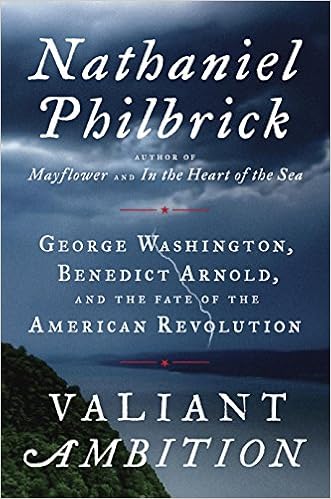
Valiant Ambition: George Washington, Benedict Arnold, and the Fate of the American Revolution- Nathaniel Philbrick
Penguin Group: Viking
Release Date: May 10, 2016

Synopsis: In September 1776, the vulnerable Continental Army under an unsure George Washington (who had never commanded a large force in battle) evacuates New York after a devastating defeat by the British Army. Three weeks later, near the Canadian border, one of his favorite generals, Benedict Arnold, miraculously succeeds in postponing the British naval advance down Lake Champlain that might have ended the war. Four years later, as the book ends, Washington has vanquished his demons and Arnold has fled to the enemy after a foiled attempt to surrender the American fortress at West Point to the British. After four years of war, America is forced to realize that the real threat to its liberties might not come from without but from within.

Valiant Ambition looks at not only the battles and armies that comprised the American Revolution, but individual characters and personalities.  Written for the general audience, Philbrick splits Ambition between following General George Washington- who he believes to be a somewhat ineffectual general, inexperienced, and a slow learner who eventually learns from his mistakes and pushes down his personal feelings for the greater good- and Benedict Arnold. Philbrick portrays Arnold as a brilliant general with the kind of personality who either drew loyal supporters or made deadly enemies.   

The contrast created between the two leaders is often striking, with Washington and his armies suffering defeats, retreats, and harsh conditions while Arnold is a key player in the defeat of British General Burgoyne at Saratoga.  While Washington encourages the Continental Congress to support his troops: to move from militia to a standing army, to provide money, food, and supplies for men literally starving to death over the winter; Arnold is constantly sending letters to Congress to complain that they are not supporting him enough: he is overlooked for a promotion, he is not recompensed the money he claims to have used to support his early militia in Quebec, other generals are taking credit for his glorious actions.

Arnold comes across as something of a sociopath, completely unable to use tact or subtley to get what he wants from others, and completely disregarding all others as nothing more than steps to further his personal ambition.  His obsession over what he perceives as Congress's slights against him explodes when he is made military governor of Philadelphia after the British evacuate the city.  Living beyond his means, making backroom deals to profit from the chaos of rebuilding the city, and socially slighting Americans while supporting British loyalists make him the target of military and civilian backlashes.  The great irony is that Arnold defends himself against all charges, then goes on to do even worse.  With the support of his new, young wife Arnold begins to believe that, since America is going to lose the war anyway, it is his duty to bring about the end of the war and the reconciliation with Britain as quickly as possible. And make money and rise in the ranks while doing it.  His complete disregard for others and his  belief that what he is doing is not treason but is for his own good (and anything for his own good is therefore good for the country) is amazing to read.

Through much of the book the reader finds themselves wondering how America won the war at all given the poor training and military defeats they experienced.  The personality clashes of individual generals and Congressmen as they sought to gain personal glory and profit with America coming in second to their ambition, seems like it should have destroyed the country before the first year of war was out.  In the end Philbrick believes that it was Arnold's treachery that in fact brought America together.  It is not enough to have a great hero like Washington. The country also needed a villain to unite them.

While I wish the epilogue ended with a brief summary of Washington and Arnold's later military careers (I was especially curious to find out how Arnold faired as a general in the British army facing his former soldiers and what happened to him after the war), instead of the "to be continued" feel that the book ends on, Valiant Ambition is an enjoyable read with great attention to detail and fascinating looks into the psyches of some of the Revolutionary War's greatest men, and how the individual is pivotal in shaping both military and national outcomes.  

I received an ARC of this book from NetGalley for an honest review.