Showing posts with label archaeology. Show all posts

Saturday, September 7, 2024

The Northwomen


The Northwomen- Heather Pringle

National Geographic

Release Date: September 10, 2024

Rating: ðŸ“šðŸ“šðŸ“šðŸ“š

Synopsis: Until Scandinavia converted to Christianity and came under the rule of powerful kings, the Vikings were a dominant force in the medieval world. Outfitted with wind-powered sailing ships, they left their mark, spreading terror across Europe, sacking cities, deposing kings, and ransacking entire economies. After the Vikings, the world was never the same.

But as much as we know about this celebrated culture, there is a large missing piece: its women. All but ignored by contemporary European writers, these shadowy figures were thought to have played little part in the famous feats of the Vikings, instead remaining at home as wives, mothers, and homemakers.

In this cutting-edge, revisionist portrait, renowned science journalist Heather Pringle turns those assumptions on their head, using the latest archaeological research and historical findings to reveal this group as they actually were. Members of a complex society rich in culture, courage, and a surprisingly modern gender ideology, the women of the Viking age were in fact forces to be reckoned with, serving as: Sorceresses, Warriors, Traders, Artisans, Explorers, Settlers, Landowners, Power brokers, Queens

Both ambitious and compelling, THE NORTHWOMEN is the true story of some of the most captivating figures of the Viking world—and what they reveal about the modern age.
______________________________________________________________

I'm always interested people who look at history and ask the question: where are the women? Obviously they were there, but women and their stories aren't recorded as often as men, and so are frequently overlooked and forgotten. 

In The Northwomen, journalist Heather Pringle searches for women in Viking world and talks to expert archaeologists who are looking at new (and old) evidence to rewrite what has been "established fact" for so long about the Viking world. 

Pringle does an amazing job here, helping to tell the stories that archaeologists are discovering in ways that laypeople can understand, bringing us into the world of explorers, traders, artisans, raiders, and sorceresses to think about how Viking women could have lived- and when (and if) they might have held power in that world.   

I loved how archaologically focused this book was, making the world very concrete and evidence based. One of my favorite chapters, surprisingly, was on weavers. Pringle interviewed people who have been studying and actually re-creating as much as possible the original Viking weaving methods, and used them to help make a woolen sail for a recreated Viking ship. The amount of work that went into the project and what they learned about the work the women would have done was amazing, and really captured me. There were even descriptions of woolen 'armor' that men would have worn when going into battle- in much of the world, not just among the Vikings! And all of it would have been created by women. 

Pringle doesn't try to completely rehabilitate the Vikings as a people, but recognizes the negative aspects of their society as well as the positive. She talks about them as a slave trading society (as were most societies of their day) and does a really interesting comparison to modern psychological studies in the slave trade to try to understand what it would have been like for women who were subjected to this. 

Overall, The Northwomen was a wonderfully written, well researched book that makes the latest archaeological research on women in the Viking world accessible to anyone who is interested in finding out about it. I definitely recommend this book!

I received an ARC of this book from NetGalley in exchange for an honest review


Tuesday, February 28, 2023

Empress of the Nile


Empress of the Nile: The Daredevil Archaeologist Who Saved Egypt's Ancient Temples From Destruction- Lynne Olson

Random House

Release Date: February 28, 2023

Rating: ðŸ“šðŸ“šðŸ“šðŸ“šðŸ“š

Synopsis: In the 1960s, the world’s attention was focused on a nail-biting race against time: Fifty countries contributed nearly a billion dollars to save a dozen ancient Egyptian temples, built during the height of the pharaohs’ rule, from drowning in the floodwaters of the massive new Aswan High Dam. But the extensive press coverage at the time overlooked the gutsy French archaeologist who made it all happen. Without the intervention of Christiane Desroches-Noblecourt, the temples would now be at the bottom of a vast reservoir. It was an unimaginably large and complex project that required the fragile sandstone temples to be dismantled, stone by stone, and rebuilt on higher ground.

A willful real-life version of Indiana Jones, Desroches-Noblecourt refused to be cowed by anyone or anything. During World War II she joined the French Resistance and was held by the Nazis; in her fight to save the temples she challenged two of the postwar world’s most daunting leaders, Egypt’s President Nasser and France’s President de Gaulle. As she told a reporter, “You don’t get anywhere without a fight, you know.”

Yet Desroches-Noblecourt was not the only woman who played an essential role in the historic endeavor. The other was Jacqueline Kennedy, who persuaded her husband to call on Congress to help fund the rescue effort. After years of Western plunder of Egypt’s ancient monuments, Desroches-Noblecourt did the opposite. She helped preserve a crucial part of Egypt’s cultural heritage, and made sure it remained in its homeland.
_____________________________________________________________

Historian Lynne Olson, best known for her fantastic books on little known aspects of World War II history,  (Last Hope Island) gives us another little known but hugely influential story in Empress of the Nile. Along the lines of Madame Fourcade's Secret War, Empress of the Nile focuses on a Frenchwoman- Christine Desroches-Noblecourt, a resistance fighter during World War II. But what I thought would be the most interesting part of her story ended up being only a small part, and by no means the most fascinating.

Christiane Desroches-Noblecourt was fascinated by Egypt from a young age and was fortunate enough to have parents who supported her in following her dreams. She became the first female archaeologist and Egyptologist in France, facing incredible hostility from the men in her field, who didn't want her on dig sites. They disliked her presence in general, her talent and intelligence, her familiarity and positive working relationship with the local Egyptian workers, and her successes. When not on a dig in Egypt she was working at the Louvre. As the Nazi threat began to loom, the Louvre packed up its treasures and shipped them to different places for protection, with Christiane helping catalog, pack, and transport the Egyptian collections. She remained in Paris during the occupation and was part of the first resistance group against the Nazis, a fascinating collection of men and women who were mostly museum workers but were able to help hide escaping POWs in their museums and get them to safety, among many other things. When Christiane was arrested, questioned, and then released by Nazi officers she knew she would be under surveillance and backed away from the group to keep her friends in the movement safe. While I thought this early part of her life would have been the most fascinating, what really captivated me was what came after the war. Christiane worked with Egyptian officials, UNESCO, and other agencies during the 1960s to save Abu Simbel, the Temple at Philae, and other priceless monuments from being lost to flooding with the building of the new Aswan High Dam. She was the visionary and the driving force behind the effort, even though she received little credit then or now. It was Desroches-Noblecourt who brought experts and professionals from around the world together to work on a project with no political motivation, just pure desire to save archaeological treasures for the good of humankind.

Lynne Olson describes the race to save Abu Simbel, the Temple of Philae, and the other endangered monuments in breathtaking details that leave the reader's heart racing, desperate to find out what will happen next and how they will succeed. What will go wrong? How will they triumph? What political disasters will get in the way? The reader feels some of what Desroches-Noblecourt must have felt as she worked nonstop to save the temples. Along the way I learned a lot about the politics of Egypt, from when France and England took over during the 1800s through the 1960s and how the world's politics affected Egyptology. And how this can be overcome when a few voices prove what really matters.  

Empress of the Nile is a fascinating story of the little known life of Christiane Desroche-Noblecourt and her life long dedication to discovering, interpreting, and preserving Egypt's past. Carefully researched and beautifully written, this is the story of a strong and dedicated woman who inspired generations of archaeologists, and should inspire future generations of people to go for their dreams, no matter how impossible they seem. Because sometimes, you can move mountains.

I received an ARC of this book from NetGalley in exchange for an honest review


Monday, October 31, 2022

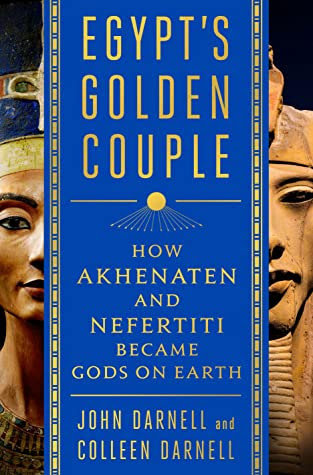
Egypt's Golden Couple


Egypt's Golden Couple: How Akhenaten and Nefertiti Became Gods on Earth- John Darnell & Colleen Darnell

MacMillan

Release Date: November 1, 2022

Rating: ðŸ“šðŸ“šðŸ“š

Synopsis: Akhenaten has been the subject of radically different, even contradictory, biographies. The king has achieved fame as the world's first individual and the first monotheist, but others have seen him as an incestuous tyrant who nearly ruined the kingdom he ruled. The gold funerary mask of his son Tutankhamun and the painted bust of his wife Nefertiti are the most recognizable artifacts from all of ancient Egypt. But who are Akhenaten and Nefertiti? And what can we actually say about rulers who lived more than three thousand years ago?

November 2022 marks the centennial of the discovery of the tomb of Tutankhamun and although "King Tut" is a household name, his nine-year rule pales in comparison to the revolutionary reign of his parents. Akhenaten and Nefertiti became gods on earth by transforming Egyptian solar worship, innovating in art and urban design, and merging religion and politics in ways never attempted before. 

Combining fascinating scholarship, detective suspense, and adventurous thrills, 
Egypt's Golden Couple is a journey through excavations, museums, hieroglyphic texts, and stunning artifacts. From clue to clue, renowned Egyptologists John and Colleen Darnell reconstruct an otherwise untold story of the magnificent reign of Akhenaten and Nefertiti.
___________________________________________________________________

While I love history, I don't consider myself particularly knowledgeable about ancient Egypt. So I was looking forward to learning a little more in Egypt's Golden Couple about Akhenaten and Nefertiti- probably best known (if known at all) as the parents of King Tutankhamun. I knew vaguely that Akhenaten had tried to change Egypt's religion into a more monotheistic focus towards the sun god Aten, but that was all I knew beforehand.

I definitely appreciated that, as Egyptologists themselves, John and Colleen Darnell stuck to physical and written evidence in their interpretation of Akhenaten and Nefertiti. What does the archaeology tell us about their reign? What do writings show about how that might have changed? And, interestingly, what could be put in the context of other pharaohs like Hatshepsut to give us a feel for what would be considered 'normal' versus 'unique'? With rulers as controversial as Akhenaten and Nefertiti, this seemed like a good way to get as much of a feel for them and their world as we are likely to get over 3,000 years later.

The book is written with three styles to it, which took some getting used to. Each chapter starts with a fictionalized imagining of a scene, then moves on to a nonfiction research explanation, archaeological interpretation, or most often a hieroglyph interpretation of another aspect of their rule. I was not a fan of the fictional scenes. I guess the idea was to make things more "real" or "relatable" for the reader, but they really put me off. Much of the rest of the writing was dense, more written for scholars than a layperson like me. The detailed explanations of how the authors interpreted the hieroglyphs as they did was very interesting and certainly made me feel like they knew what they were doing, but went way too much "into the weeds" for my understanding. It was like a lot of the time the book couldn't decide if it was written for scholars and fellow Egyptologists, or for the lay reader to introduce them to Egyptology in general and Akhenaten and Nefertiti in particular, and so tried to do both. The result was often repetitive, frequently interesting, but just as often a dense read.

A book I'd recommend more for people already well versed in Egyptology than the general reader

I received this book from NetGalley in exchange for an honest review     


Friday, August 27, 2021

The Real Valkyrie


The Real Valkyrie: The Hidden History of Viking Warrior Women- Nancy Marie Brown

St. Martin's Press

Release Date: August 31, 2021

Rating: ðŸ“šðŸ“šðŸ“šðŸ“š

Synopsis: In 2017, DNA tests revealed to the collective shock of many scholars that a Viking warrior in a high-status grave in Birka, Sweden was actually a woman. The Real Valkyrie weaves together archaeology, history, and literature to imagine her life and times, showing that Viking women had more power and agency than historians have imagined.

Nancy Marie Brown uses science to link the Birka warrior, whom she names Hervor, to Viking trading towns and to their great trade route east to Byzantium and beyond. She imagines her life intersecting with larger-than-life but real women, including Queen Gunnhild Mother-of-Kings, the Viking leader known as The Red Girl, and Queen Olga of Kyiv. Hervor’s short, dramatic life shows that much of what we have taken as truth about women in the Viking Age is based not on data, but on nineteenth-century Victorian biases. Rather than holding the household keys, Viking women in history, law, saga, poetry, and myth carry weapons. These women brag, “As heroes we were widely known—with keen spears we cut blood from bone.” In this compelling narrative Brown brings the world of those valkyries and shield-maids to vivid life.

______________________________________________________________________

"The Real Valkyrie" studies the history of the Vikings as we know it through a new lens: modern archaeology, free of the Victorian limitations we have allowed to color our thoughts of their world for so long. Others will call it feminist. How about both- as well as extremely interesting and well-written. 

Modern technology has been used to go over bones buried in Birka Bj581, a warrior's grave in Birka, Sweden.  Because of the weapons and others items traditional archaeology has associated with men, this grave was identified as a war leader, a brilliant warrior, and a man.  Today we know the bones are of a woman. Does that make the rest of the story the burial told, that of a well respected warrior, less true? Brown uses modern archaeology to analyze myths, legends, and history to search for the "real valkyrie"- who she argues was not a mythical being but in fact a warrior woman. Brown argues that women in the Viking age had a much larger role than has previously been assigned to them- that they were capable leaders, rulers, merchants, and warriors just like men. I found her arguments very interesting and certainly found myself agreeing that we cannot look at history through the filter of those who wrote about other people. In the case of the Vikings, this would mean men, Christian men, telling about a world that was already hundreds of years in the past when they were writing, and whose world view they could no longer understand. 

The multiethnic society of the Viking world, Brown argues, was a world where power did not come from one person (the pope) and filter down, it was not a world organized by kings as we would come to understand it later. It was a world where talent, need, and opportunity should focus your path and your gender did not limit you.  The idea of the Viking woman as the key-holder and mistress of the house is, according to Brown, the Victorian interpretation of the Vikings because that was how the Victorians viewed the world. And we haven't updated them since.  Here, Brown argues successfully that we should look at what archaeological sites tell us without preconceived notions, and we should not ignore the evidence that goes against what we think we already know.  Because Birka Bj581 is not the only grave of a warrior who has been reexamined and found to be a woman.  

Brown's The Real Valkyrie: The Hidden History of Viking Warrior Women turns traditional images of the Viking world on its head and presents a vivid, well-researched, and fascinating exploration of life in the Viking Age through  a new lens. From the everyday to the afterlife, this is the world as archaeological finds show it might have been.

I received an ARC of this book in exchange for an honest review 


Tuesday, October 20, 2020

World Beneath the Sands


A World Beneath the Sands: The Golden Age of Egyptology- Toby Wilkinson

W.W. Norton & Co.

Release Date: October 20, 2020


Rating: ðŸ“šðŸ“šðŸ“šðŸ“šðŸ“š

Synopsis: From the decipherment of hieroglyphics in 1822 to the discovery of Tutankhamun’s tomb by Howard Carter and Lord Carnarvon a hundred years later, the uncovering of Egypt’s ancient past took place in an atmosphere of grand adventure and international rivalry.


In A World Beneath the Sands, acclaimed Egyptologist Toby Wilkinson chronicles the ruthless race between the British, French, Germans, and Americans to lay claim to its mysteries and treasures. He tells riveting stories of the men and women whose obsession with Egypt’s ancient civilization helped to enrich and transform our understanding of the Nile Valley and its people, and left a lasting impression on Egypt, too. Travelers and treasure-hunters, ethnographers and archaeologists: whatever their motives, whatever their methods, a century of adventure and scholarship revealed a lost world, buried for centuries beneath the sands.

____________________________________________________________________

In A World Beneath the Sands Toby Wilkinson explores the beginnings of Egyptology.  Starting with Napoleon's Egyptian campaign- which produced no successes for the French army, but widespread fascination with Egypt from the cultural point of view, and finding the famous Rosetta Stone- and stretching on for more than 100 years to Howard Carter's discovery of King Tut's tomb in the Valley of the Kings, Wilkinson offers readers a meticulously well-researched account of European fascination with Egypt's cultural past.  From Champollion to Carter, Mariette to Petrie, A World Beneath the Sands explores the methods, discoveries, and motives of the early European archaeologists.  Many came to make great discoveries and become famous, others for the thrill of knowledge, and a disturbing number came as little more than glorified treasure hunters.  A few, like Petrie, worked hard to establish methods that would record each discovery as it was found.  Many more, especially early on, were more than happy to chisel out the pieces they wanted from walls or tombs or literally dynamite out their 'prizes'. The dark history of European museum collections like those found in the Louvre and the British Museum is brought into the light here.  

It is easy to read A World Beneath the Sands as a series of adventures and dramas, ruthless battles between (primarily) the French and English for control of, and preeminence in, the cultural knowledge of ancient Egypt. From amateur adventurers to dedicated philologists seeking to unravel the mysteries of Egypt's hieroglyphics, scientific approaches to archaeology are late to the scene and there are plenty of cringe-worthy stories of removing artifacts, obelisks, and temple pieces. Culture clashes, imperialist agendas and debates on who can best care for a culture's history are all brought up, and I thought Wilkinson did a good job of presenting the facts without pressing his own opinion.  At the same time, the facts presented rather speak for themselves.  

A World Beneath the Sands does an excellent job of telling the story of Europe's discovery of and fascination with Egypt.  It is a readable, comprehensive, and accessible account of over 100 years of discovery that never shies away from the harsher results of Europe's imperialistic approach to Egypt's ancient past. 

I received an ARC of this book from NetGalley in exchange for an honest review
Tuesday, April 28, 2020

Who Ate The First Oyster?


Who Ate the First Oyster?: The Extraordinary People Behind the Greatest Firsts in History by [Cody Cassidy]


Who Ate The First Oyster? The Extraordinary People Behind the Greatest Firsts in History- Cody Cassidy
Penguin Books
Release Date: May 5, 2020

Rating:
📚📚📚📚📚

Synopsis: Who invented the wheel? Who told the first joke? Who drank the first beer? Who was the murderer in the first murder mystery, who was the first surgeon, who sparked the first fire--and most critically, who was the first to brave the slimy, pale oyster?

In this book, writer Cody Cassidy digs deep into the latest research to uncover the untold stories of some of these incredible innovators (or participants in lucky accidents). With a sharp sense of humor and boundless enthusiasm for the wonders of our ancient ancestors, Who Ate the First Oyster? profiles the perpetrators of the greatest firsts and catastrophes of prehistory, using the lives of individuals to provide a glimpse into ancient cultures, show how and why these critical developments occurred, and educate us on a period of time that until recently we've known almost nothing about.
________________________________________________________________

It's a question we've all pondered at some point:  Who first decided to . . . ?  In Cody Cassidy's new book Who Ate the First Oyster? Cassidy's research helps give us a better understanding of some of the most important firsts in human history- and why they are so important.  From eating the first oyster to drinking the first beer, riding the first horse, or first getting smallpox, each chapter covers a different period in human evolution and the "first" that propelled us onward.  Even more important, and interesting (to me anyway), he personalizes the discoveries and inventions by bringing the anonymous people responsible for these "firsts" back into the limelight they so richly deserve.

Cassidy's writing style is casual and full of humor, yet the reader has no doubt that this is an author who has done his research and isn't just making everything up.  While the actual person Cassidy credits the "first" to isn't necessarily a historic figure, they are the general figure.  For example, 'Oyster Girl' may or may not have been what the person who ate the first oyster was actually called, but Cassidy describes what her life would have been like based on archaeological evidence, why the chance is good it was a woman, why eating oysters hadn't been done before, and why we should care.  The science is presented to the reader in an understandable manner, making it accessible to anyone instead of Ph.Ds only.  Each chapter was both entertaining and informative and I found myself wishing I'd be able to remember more of the factoids than I inevitable would- but also thinking this was a book I would enjoy re-reading to remember more with each pass.  


I received an ARC of this book from NetGalley in exchange for an honest review

Wednesday, April 10, 2019

Cities


Cities: The First 6,000 Years by [Smith, Monica L.]


Cities: The First 6,000 Years- Monica L. Smith
Viking/Penguin Group
Release Date: April 16, 2019

Rating:
📚📚📚

Synopsis:Six thousand years ago, there were no cities on the planet. Today, more than half of the world's population lives in urban areas, and that number is growing. Weaving together archeology, history, and contemporary observations, Monica Smith explains the rise of the first urban developments and their connection to our own. She takes readers on a journey through the ancient world of Tell Brak in modern-day Syria; Teotihuacan and Tenochtitlan in Mexico; her own digs in India; as well as the more well-known Pompeii, Rome, and Athens. Along the way, she presents the unique properties that made cities singularly responsible for the flowering of humankind: the development of networked infrastructure, the rise of an entrepreneurial middle class, and the culture of consumption that results in everything from take-out food to the tell-tale secrets of trash.

Cities is an impassioned and learned account full of fascinating details of daily life in ancient urban centers, using archaeological perspectives to show that the aspects of cities we find most irresistible (and the most annoying) have been with us since the very beginnings of urbanism itself. She also proves the rise of cities was hardly inevitable, yet it was crucial to the eventual global dominance of our species--and that cities are here to stay.

_____________________________________________________________________

In her book Cities: The First 6,000 Years, archaeologist Monica L. Smith gives us the story of cities: how people built them and why, how ancient cities compare to modern cities, and how cities impact the people who live in them.  It is a fascinating look at the urban environments that so many of us take for granted, unquestioningly walking streets everyday without considering why or what went before.

Smith's love of archaeology and discovery shine clearly off of each page- she seems as eager to share her discoveries with us as we are to read about them.  What I found most interesting was that Smith's views on the development of cities were such a seamless flow between the physical and the psychological.  She describes what a city needs: infrastructure of roads, water, food, planning, but also what a city does: it provides humans with exposure to people, ideas, and consumer goods that they would never see in a rural setting.  Much of the book examines how consumer habits are both created by the environment but also create the environment and the people's mindsets in turn.

There is also the inevitable discussion of what comes next.  What about the collapse of cities?  Looking at the question from an archaeologist's point of view, Smith argues that perhaps this isn't as inevitable as we often think.  Cities may grow and change with the times, the environment, and the people in them, but historically very few simply end.  And even if a city ends (like Pompeii), its people may survive, move on, integrate and influence other cities.

Although occasionally repetitive, Cities is a book full of fascinating information and new ways for people to look at the urban environments around them.  An excellent read for history lovers, those interested in archaeology, or even human psychology, as Smith makes the argument that all of those aspects go into what makes a city and how we should look at their history. 


I received an ARC of this book from NetGalley in exchange for an honest review