Friday, April 15, 2022

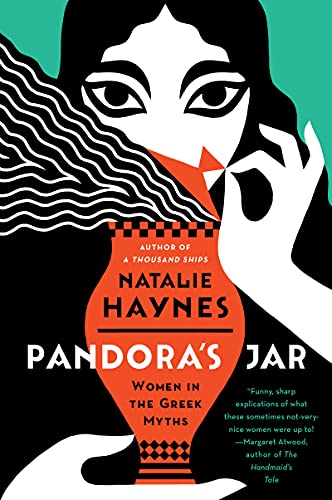
Pandora's Jar


Pandora's Jar: Women in the Greek Myths- Natalie Haynes

Harper Collins

Release Date: March 29, 2022

Rating: ðŸ“šðŸ“šðŸ“šðŸ“š

Synopsis: The tellers of Greek myths—historically men—have routinely sidelined the female characters. When they do take a larger role, women are often portrayed as monstrous, vengeful or just plain evil—like Pandora, the woman of eternal scorn and damnation whose curiosity is tasked with causing all the world’s suffering and wickedness when she opened that forbidden box. But, as Natalie Haynes reveals, in ancient Greek myths there was no box. It was a jar . . . which is far more likely to tip over. 

In Pandora’s Jar, the broadcaster, writer, stand-up comedian, and passionate classicist turns the tables, putting the women of the Greek myths on an equal footing with the men. With wit, humor, and savvy, Haynes revolutionizes our understanding of epic poems, stories, and plays, resurrecting them from a woman’s perspective and tracing the origins of their mythic female characters. She looks at women such as Jocasta, Oedipus’ mother-turned-lover-and-wife (turned Freudian sticking point), at once the cleverest person in the story and yet often unnoticed. She considers Helen of Troy, whose marriage to Paris “caused” the Trojan war—a somewhat uneven response to her decision to leave her husband for another man. She demonstrates how the vilified Medea was like an ancient Beyonce—getting her revenge on the man who hurt and betrayed her, if by extreme measures. And she turns her eye to Medusa, the original monstered woman, whose stare turned men to stone, but who wasn’t always a monster, and had her hair turned to snakes as punishment for being raped.

Pandora’s Jar brings nuance and care to the millennia-old myths and legends and asks the question: Why are we so quick to villainize these women in the first place—and so eager to accept the stories we’ve been told?

_______________________________________________________________


In Pandora's Jar, author Natalie Haynes (A Thousand Ships) explores the different versions of some of the most well known of Greek women in mythology, and how those women have been changed throughout the generations, rarely for the better. Going back to the original Greek, to Homer, Ovid, and scaps of stories before them, Haynes looks at Medusa, Pandora, Helen, Jocasta, Penelope, Clytemnestra, Eurydice, Phaedra, Medea, and the Amazons. Who are these women, both in relation to their original stories, the stories we know best, plays or more modern movies, or perhaps even modern reincarnations or retellings? 


Some of my favorite chapters had to be the ones focused on Medusa, Medea, and the Amazons, although Penelope and Clytemnestra came close behind. With a sharp wit and occasional sarcasm to help keep her reader engaged, Haynes shreds whatever claims to the title hero men like Jason and Theseus have (and you really have to agree with her, especially about Theseus) to bring the story back around to the women. Medusa was hanging out in a cave not bothering anyone, having already suffered being sexually assaulted by Posiedon and cursed by Athene, she's sleeping and along comes this jerk with no personal grudge against her to chops off her head and weaponizes it. Every visual interpretation of this Haynes can find tends to make this moment both violent and sexual. What's that about, really?


Clytemnestra and Medea win Greece's awards for "worst wife" and "worst mother" because, Haynes points out, Greek men were terrified of powerful women. It kind of makes you want to travel back to when the plays were first performed and watch the male audience shake in their sandals- especially over Euripides' Medea. Or would they have been more afraid of Clytemnestra?  A woman with no magical power, no assistance from the gods, just ten years of rage over her husband sacrificing their daughter so he could go off to war and no one saying anything against it. He kills the kid, spends ten years at war making a name for himself and enjoying raping other women, then comes home (with his war "bride" in tow) and expects his wife to be happy about it? I'd have voted justifiable homicide if I was on that jury. 


There's something for everyone in these chapters- from original interpretations of Greek and how they can change meanings that stick with us down through the ages to the dangers of "sanitizing" myths to tell them to children. From descriptions of visual representations of myths in ancient pottery to what Medea's dragon chariot at the end of her play actually meant to the Greeks (which I thought was pretty great even if the male audience might not have); and modern operas of the story of Orpheus and Eurydice to modern Amazons together-we-are-powerful symbolism in Buffy the Vampire Slayer, the exploration into some of Greek mythology's well known (and a few lesser known) women should resonate with women across all levels. 


As Natalie Haynes says, we keep retelling these stories because we find new questions they raise and new voices wanting to be heard, and each generation will undoubtedly continue to do so. But discovering some of the origins makes those stories even more interesting to me.

Tuesday, March 15, 2022

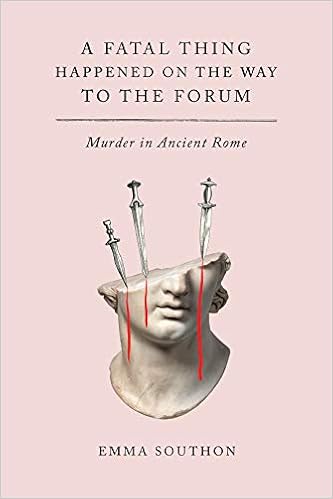
A Fatal Thing Happened on the Way to the Forum


A Fatal Thing Happened on the Way to the Forum: Murder in Ancient Rome- Emma Southon

Abrams Press

Release Date: March 9, 2021

Rating: ðŸ“šðŸ“šðŸ“šðŸ“šðŸ“š

Synopsis: In Ancient Rome, all the best stories have one thing in common—murder. Romulus killed Remus to found the city, Caesar was assassinated to save the Republic. Caligula was butchered in the theater, Claudius was poisoned at dinner, and Galba was beheaded in the Forum. In one 50-year period, 26 emperors were murdered.

But what did killing mean in a city where gladiators fought to the death to sate a crowd? In A Fatal Thing Happened on the Way to the Forum, Emma Southon examines a trove of real-life homicides from Roman history to explore Roman culture, including how perpetrator, victim, and the act itself were regarded by ordinary people. Inside Ancient Rome's darkly fascinating history, we see how the Romans viewed life, death, and what it means to be human.
________________________________________________________________


Anyone who wants to explore Roman history needs to be reading Emma Southon (Agrippina). She tells it like it is (in her view), gleefully abuses sources she finds unreliable but tells you why she finds them unreliable (where they writing 500 years after the events or just trying to make the emperor happy about what his grandfather did?), and analyzes where the truth behind the good stories probably lies. And the good stories in ancient Rome usually revolve around murder. So what does that tell us about the people in Rome?

First, remember that the people writing at the time were men, rich men, Roman men, and Citizens. When you remember that and what it meant at the time (Forum covers the Republic to the High Empire) you know that what these writers would have considered murder and what we in the twenty-first century Western world consider murder are actually very much not the same. Then add in that Romans didn't actually have a law against murder (as we today would consider it), that they expected any killings that were done in the home to be dealt with in the home and absolutely not to be the state's problem and you have a concept of how different things were. Then think about what you do know about ancient Rome (Gladiator anyone?) and how gladiator fights were their version of live streaming TV and in no way considered murder and where are you? 

A Fatal Thing Happened on the Way to the Forum covers everything from murdering your spouse and why this may or may not have been a problem (hint: if you were a woman this was terrible but if you were a man this was considered usually a good way of getting a richer wife- unless you were really stupid about it and your wife's family got Tiberius' attention, in which case you had a problem); murdering your parents/family (Romans really freaked out over that); murdering the enslaved (only worth talking about if it was a spectacle and technically not actually murder); to murdering emperors (how politics got done and kind of a Roman hobby). Southon takes a more Western twenty-first century approach to human beings and explores the lives of the enslaved and women as well as the upper 1% men, searching for the lives behind the stories, sympathizing with them and using this book to show the dark underbelly of the "classical" marble brilliance that is the Roman we all think we know.

Southon's well researched, well written, tongue in cheek, dry British humor should appeal to pretty much everyone. These are the stories we think we know, the ones we don't know, and the ones we can't wait to tell others. From knives to poison, swords to lampreys, this is a book that shows us that as different a world as we think ancient Roman and its people might have been, perhaps the people aren't so different from us after all.  Murder is still a truly universal fact of life.  


Saturday, February 26, 2022

After the Romanovs


After the Romanovs: Russian Exiles in Paris from the Belle Epoque Through Revolution and War- Helen Rappaport

St. Martin's Press

Release Date: March 8, 2022

Rating: ðŸ“šðŸ“šðŸ“šðŸ“š

Synopsis: Paris has always been a city of cultural excellence, fine wine and food, and the latest fashions. But it has also been a place of refuge for those fleeing persecution, never more so than before and after the Russian Revolution and the fall of the Romanov dynasty. For years, Russian aristocrats had enjoyed all that Belle Époque Paris had to offer, spending lavishly when they visited. It was a place of artistic experimentation, such as Diaghilev’s Ballets Russes. But the brutality of the Bolshevik takeover forced Russians of all types to flee their homeland, sometimes leaving with only the clothes on their backs.

Arriving in Paris, former princes could be seen driving taxicabs, while their wives who could sew worked for the fashion houses, their unique Russian style serving as inspiration for designers like Coco Chanel. Talented intellectuals, artists, poets, philosophers, and writers struggled in exile, eking out a living at menial jobs. Some, like Bunin, Chagall and Stravinsky, encountered great success in the same Paris that welcomed Americans like Fitzgerald and Hemingway. Political activists sought to overthrow the Bolshevik regime from afar, while double agents from both sides plotted espionage and assassination. Others became trapped in a cycle of poverty and their all-consuming homesickness for Russia, the homeland they had been forced to abandon. 

This is their story.
________________________________________________________________

Helen Rappaport's latest book takes us to Paris. But not a Paris that most of us are familiar with. Starting in the early 1900s, the Paris of the Belle Ã‰poque was the Paris we may see in movies or books but can barely imagine- a Paris of limitless wealth, royalty, and endless parties. Russian Princes and Grand Dukes threw money around like it was water, bought homes and jewels for their mistresses, and catered to their highest tastes with no thought that the end could be in sight. When World War I arrived and they retreated to Russia, they had no idea of the changes that were to come. The Bolshevik Revolution that killed the tzar and his family, along with countless other hundreds of people, ended their Grand Russia. Hundreds of thousands of people fled for Europe, and tens of thousands ended up in Paris.

Rappaport does an excellent job of not getting sidetracked by all of the stories she could tell us. Instead, she stays focused on the few people or families she chose to follow to give the reader an overarching understanding of the conditions the Russian emigres faced.  She doesn't fall into the possible trap of describing in detail the Revolution or the fighting- that isn't the point of this book and you can look to her bibliography for suggestions if you want to read more (or read one of her other books on the time period). She wants to follow the emigration, and does a brilliant job of immersing the reader in the hellish conditions suffered by everyone escaping Russia, be they peasant or prince. Once back in Paris it is a different world from the first few chapters and the reader can only marvel at the strength of the people who survived such incredible changes. From riches to rags, generals and princes to dishwashers and taxi drivers.

The focus isn't only on the (formerly) ultra rich. There are the writers, the artists, the brilliant circles that Paris was known for, only when they escaped the Bolsheviks so many writers and painters were faced with the shock of never seeing Russia again that they were disconnected from their true muse. Bunin, Chagall, and Stravinsky managed to succeed where so many failed and Rappaport tells the failures as well as the successes with compassion and courage. 

After the Romanovs is in many ways a timely book, asking us to consider questions about success and failure, as well as having compassion for those displaced by political violence they had nothing to do with. It asks if it is possible to be a people, like Russians, if you are not living in Russia but exiled elsewhere- and if the Russia you and your generation remember disappears can you still be inspired by it? The generations of Russia's migration to Paris remained loyal to Russia to the end, a dream they held onto that kept them going, inspired their art and writing, their daily work, and their daily suffering. 

Helen Rappaport's well researched After the Romanovs brings early 20th century Paris and the men and women living there to life in each page. Beautifully written, this is a book that is both inspiring and heart breaking. A must read for history lovers.


I received an ARC of this book from NetGalley in exchange for an honest review

Thursday, February 10, 2022

Duchess Countess


The Duchess Countess: The Woman Who Scandalized Eighteenth Century London- Catherine Ostler

Atria Books

Release Date: February 22, 2022

Rating: ðŸ“šðŸ“šðŸ“šðŸ“šðŸ“š

Synopsis: As maid of honor to the Princess of Wales, Elizabeth Chudleigh enjoyed a luxurious life in the inner circle of the Hanoverian court. With her extraordinary style and engaging wit, she both delighted and scandalized the press and public. She would later even inspire William Thackeray when he was writing his classic Vanity Fair, providing the inspiration for the alluring social climber Becky Sharp. But Elizabeth’s real story is more complex and surprising than anything out of fiction.

A clandestine, candlelit wedding to the young heir to an earldom, a second marriage to a duke, a lust for diamonds, and an electrifying appearance at a masquerade ball in a gossamer dress—it’s no wonder that Elizabeth’s eventual trial was a sensation. Charged with bigamy, an accusation she vehemently fought against, Elizabeth refused to submit to public humiliation and retire quietly.
_________________________________________________________________________

The story of Elizabeth Chudleigh is one that might fall under 'truth is stranger than fiction'- or at least more dramatic- and Catherine Ostler does a good job of captivating the reader from the beginning of her book, The Duchess Countess, investing them in Elizabeth's journey.  Through the highs and lows, the trials (both figurative and literal) and triumphs of her life, Elizabeth travelled among the highest circles of English and European aristocracy. She knew everyone and everyone knew her. While this was often the secret to her success it also became part of her downfall.  

With her father and brother dying while she was still young, Elizabeth learned early on the lessons that women in her time had little security without the men in their family. She never wanted to be dependent on others if she could depend on herself instead.  Pure luck, family connections, beauty and wit combined to get her the position of a maid of honor to the Princess of Wales- a position which meant Elizabeth met nearly everyone worth knowing and had brilliant marriage opportunities despite her lack of fortune. But she threw those away to secretly married Augustus Hervey, a second son to a Count. The two swore to keep it secret and he went on a naval ship a few days later. They almost instantly regretted the marriage and and both were good at acting like it hadn't happened-especially Augustus who apparently took womanizing to a whole new level. When Elizabeth met the Duke of Kingston she knew it was the real thing, unable to marry the two still were in love, he subsidized building projects, parties, and anything else wanted until she was declared free to marry. Reading this book, it is impossible to believe the two weren't genuinely in love and that it was love, not money or title, that attracted Elizabeth. Naturally many at the time were not so kind- especially the Duke's nephews who were looking forward to inheriting. With his tragic death, the vultures descended and Elizabeth found herself fighting once more- this time not only for her husband's will but for her own marriage, as the Kingston family wanted her declared a bigamist. This became the trial of the century and absorbed the country's interest more than the war with the American colonies.

Convicted of bigamy but still fighting for her inheritance, Elizabeth left England for the Continent. Hoping for a more friendly atmosphere she travelled Europe and eventually found her way to Russia and the court of Catherine the Great. Still calling herself the Duchess of Kingston since she refused to accept the House of Lord's verdict against her, Russia was one of the only places that would acknowledge her as a duchess. Elizabeth was lucky enough to hit Russia during their craze for all things English, and being extremely rich and able to gift Catherine and her inner circle with paintings and jewels helped ease her way. Mixed success, lavish spending, and continued trials regarding money plagued her for the rest of her life, as did the Duke of Kingston's nephews. While Elizabeth herself was a generous woman and always tried to forgive others and help them, sadly it seems she was never treated as well as she tried to treat others.  

 Anyone who thinks history is dry and dull has clearly not been paying attention to recent streaming service offerings, and The Duchess Countess would make a brilliant addition to these ranks. It's all here: drama, fashion, jewels, tragedy, love, hatred, glittering balls, venomous barbs, politics, kings, queens, legal dramas, clandestine marriages that may or may not actually be marriages. Ostler does a brilliant job explaining the complexities different kinds of marriage at the time- many people weren't sure if they were or were not married based on some of the laws so when Elizabeth and Augustus faced off years later it wasn't as odd as it would seem to us today for the ecclesiastical courts to declare them not married. And it seems more like Elizabeth got caught up in politics when her marriage came before the House of Lords years later than anything else. 

Elizabeth Chudleigh was a woman who knew men held all the power in her world and refused to accept being pushed into the role of a quiet, subservient, invisible, woman. Whether she accepted the double standard of the day where men could have mistresses and second families and then judge her for marrying when she thought she was free to do so, or whether she was angered by it we don't know. But she believed in herself and believed she could do what pleased her, ignoring jealous and venomous critics along the way. Does that make her an 'adventuress' as Thackery makes the antiheroine Becky Sharpe, always looking out for herself? Someone desperate for advancement at all costs? I don't think so. I think this is the story of a woman ahead of her time, challenging society- and frightening society with that challenge. 

Excellent research and writing will keep those afraid of 'dry' history glued to the pages of this fascinating story. Elizabeth Chudleigh's story is that of a woman ahead of her time, one who made mistakes, but refused to hide away and instead enjoyed life to the fullest. She faced life's challenges and the men who challenged her head on and never apologized when she thought she was right. 


I received an ARC of this book from NetGalley in exchange for an honest review

Monday, January 24, 2022

A Thousand Ships


A Thousand Ships- Natalie Haynes

HarperCollins

Release Date: January 26, 2021

Rating: ðŸ“šðŸ“šðŸ“šðŸ“šðŸ“š

Synopsis: This is the women’s war, just as much as it is the men’s. They have waited long enough for their turn . . .

This was never the story of one woman, or two. It was the story of them all . . .

In the middle of the night, a woman wakes to find her beloved city engulfed in flames. Ten seemingly endless years of conflict between the Greeks and the Trojans are over. Troy has fallen.

From the Trojan women whose fates now lie in the hands of the Greeks, to the Amazon princess who fought Achilles on their behalf, to Penelope awaiting the return of Odysseus, to the three goddesses whose feud started it all, these are the stories of the women whose lives, loves, and rivalries were forever altered by this long and tragic war. 

A woman’s epic, powerfully imbued with new life, A Thousand Ships puts the women, girls and goddesses at the center of the Western world’s great tale ever told.

_____________________________________________________________________________


For those who have been enjoying the resurgence of retold classics and myths from the women's point of view (The Witch's Heart) especially Madeline Miller's Circe, Natalie Haynes' A Thousand Ships should be an absolute must read. Here is a retelling of the end of the Trojan War where the goddess of epic poetry Calliope has decided she is tired of the bards always telling and retelling the bravery of men.  After all, this war affected women as much as men. 


 And so A Thousand Ships is the story of the women: the ones waiting at home for their men to return, the ones waiting on the beaches of Troy to see whose slaves they will be, as well as flickering back in time to hear the stories of women like Briseis- whose removal from Achilles' tent to Agammemnon's caused Achilles to refuse to fight for most of Homer's Iliad. Penelope's story is told as letters to her husband Odysseus throughout the book and we get her absolutely brilliant personality and wit in her thoughts of the bard's tales of Odysseus' adventures. She is by far my favorite person in the entire book.


I loved how Calliope forces her (unnamed) blind bard to see the tragedy of the war instead of the epic manly greatness he thought he wanted to write about. Calliope points out that the casualties of war don't end on the battlefield and that the deaths or tragedies of the women might hurt more exactly because they rarely get to fight back. Her argument that the women are people and should be memorialized just as much as the men is enhanced by including stories of little known women. Creusa, wife of Aeneas and Laodamia, devoted wife of Greek king Protesilaus have their stories told just the same as the Amazon Penthesilea or Hector's wife Andromache. It's an interesting debate that I think would be divided by gender lines (although maybe here I'm being unfair?): are women who don't literally fight in a war heroes as well? Few of the men we meet in this book are honorable, decent or what I would consider 'heroic' while the women suffer by tending the injured, dealing with famine and plague, fear and captivity, etc. Even Odysseus, who I generally consider the most decent among the Greeks, comes in for his share of questioning by Penelope here.


There is one last question that Haynes asks that has never been asked before (as far as I know): where did the golden apple that started all of this come from? Until I read A Thousand Ships it wasn't a question I had asked, but here a larger and wider story unfolds behind the beauty contest and Paris' judgement that might change the way you look at the entire war and make it truly epic in an entirely different way. 


No owls were harmed (or traded) in the course of this book 


Tuesday, January 18, 2022

Lighting in a Mirror


 Lightning in a Mirror (Fogg Lake 3)- Jayne Ann Krentz

Berkley Publishing

Release Date: January 18, 2022

Stars: ðŸ“šðŸ“šðŸ“šðŸ“š

Synopsis: Olivia LeClair's experiment with speed dating is not going well. First there was the nasty encounter with the date from hell who tried to murder her and now the mysterious Harlan Rancourt—long believed dead—sits down at her table and tells her she's the only one who can help him locate the legendary Vortex lab.

This is not what Olivia had in mind when she signed up for the Four Event Success Guaranteed package offered by the dating agency.  She doesn't have much choice, though, because her psychic investigation firm works for the mysterious Foundation and Victor Arganbright, the director, is adamant that she assist Harlan. There's just one problem—no one knows Harlan's real agenda. His father once ran the Foundation like a mob organization, and Harlan was destined to be his heir.  There's a real possibility Harlan has returned to claim his inheritance. 
 
For now, however, it's a case of the enemy of my enemy is my friend because others are after the secrets of the long-lost lab. Unfortunately for Olivia, the one thing friend and foe have in common is that everyone is convinced she is the key. Her unique psychic talent is required to defuse the ticking time bomb that is Vortex.
 
Neither trusts the other but Olivia and Harlan soon realize they must work together to survive and unlock the Bluestone Project's most dangerous secrets before more innocent people die.
_________________________________________________________________

Jayne Ann Krentz wraps up her Fogg Lake Trilogy (The Vanishing, All the Colors of the Night) with a thriller in Lightning in a Mirror. Harlan Rancourt is a powerful talent who passes as nondescript while hunting the monsters of the psychic world. Having disappeared for five years, he's back to help shut down the mysterious Vortex labs- but he's convinced he needs Olivia LeCLair to do that. Private investigator and aura reader, Olivia isn't sure what to make of Harlan, but he's promised to help find her mother's killer so she's willing to help. A series of kidnapping attempts makes it personal. Clearly many people believe Olivia is the key to to secret Vortex labs, even though Olivia herself doesn't. In a race against time Harlan and Olivia must work together to stop a dangerous psychic secret and the people who want to control it before innocent people die.

Olivia is a classic modern woman- tough enough to handle being bait for a serial killer, trying to find the efficient way to weed out the dating losers, and thinking a cat may be the better option when she meets Harlan. He's a bit of a challenge, a bit of a pain in the neck, and a bit clueless in social situations- but exactly the right guy to have at your side when people try to kidnap you or kill you. When he doesn't bother giving her the 'everything will be ok' line after an explosion, she thinks he might have potential. A forthright heroine, a strong-when-working-slightly-unsure-otherwise hero, many spinning plots within plots to get to the center of the conspiracy- this is a plot and character Krentz ties together well and will satisfy all.

Lightning in a Mirror is fast paced and action packed, with plenty of Krentz's dry wit and one liners. Readers new to her books won't need to have read the rest of the series, although it does help. Long time readers will be glad to get a few Easter eggs dropped along the way, particularly at the end as Harlan convinces Victor and Lucas of the Foundation that they should work more with other secretive psychic organizations out there, like a certain Jones & Jones agency . . .


Thursday, January 6, 2022

The Siren of Sussex


The Siren of Sussex- Mimi Matthews

Berkley

Release Date: January 11, 2022

Rating: ðŸ“šðŸ“šðŸ“šðŸ“šðŸ“š

Synopsis: Evelyn Maltravers understands exactly how little she's worth on the marriage mart. As an incurable bluestocking from a family tumbling swiftly toward ruin, she knows she'll never make a match in a ballroom. Her only hope is to distinguish herself by making the biggest splash in the one sphere she excels: on horseback. In haute couture. But to truly capture London's attention she'll need a habit-maker who's not afraid to take risks with his designs—and with his heart.

Half-Indian tailor Ahmad Malik has always had a talent for making women beautiful, inching his way toward recognition by designing riding habits for Rotten Row's infamous Pretty Horsebreakers—but no one compares to Evelyn. Her unbridled spirit enchants him, awakening a depth of feeling he never thought possible.

But pushing boundaries comes at a cost and not everyone is pleased to welcome Evelyn and Ahmad into fashionable society. With obstacles spanning between them, the indomitable pair must decide which hurdles they can jump and what matters most: making their mark or following their hearts?
__________________________________________________________________

The Siren of Sussex begins a new series where a set of friends more at home on horseback than the ballroom will (hopefully) meet their matches. Evelyn Maltravers begins the series, and the plan, by coming to London for a Season in order to find a husband who will in turn support her family. Ever since her older sister ran off with a neighbor the family fortunes have been falling and now Evie has to marry to save the rest of her sisters. It's a tale as old as time in Victorian England, the difference being Evie knows she's nothing special in the ballroom so she plans to make her big splash where she does shine: on horseback. But to really set her apart she needs fabulous riding habits and that sends her to Ahmad Malik, half-Indian, half-English, and all genius when it comes to designing women's clothes. There's a spark between them from the beginning, but plenty of hurdles to overcome before love can win the day.

The Siren of Sussex may be my new favorite of Mimi Matthews' books- books which have always impressed me with excellent writing, detailed descriptions and enjoyable characters. Matthews takes all of this to a new level in Siren with characters willing to look outside of the box to solve their problems, face problems together, change plans as they go, and more. One of the things that always bothers me in books is when characters start the book with a PLAN-whether for their entire life or a set goal- and don't admit that this PLAN can change when they change over the course of the story (until the end of the book at least- I do like a happy ending). Evie starts off with a plan: make her debut on horseback and find someone to marry and support her younger sisters. But when she realizes it's Ahmad she loves, she is completely willing to change plans right away. Then it becomes about how she and Ahmad can be together. Matthews does a good job of not shying away from racism or classism. Evie goes from being a Sussex innocent to discovering how Britain treats India and her people in an excellent scene at Hatchards Books. She also glimpses the lives of seamstresses in sweatshops, the poor living at the docks, and many other worlds that a country gentlewoman would often not be exposed to.  Her instinct is always to help, to stand by her man, to work with him towards the greater good. 

Ahmad's only goal is to have his own dressmaking shop and that goal is nearly in reach. He has to deal with sexual harassment (and more) from some of his wealthy clients who think he can't say 'no' because of his position. He always feels like he's living on the outside- not truly English, not truly Indian. Evie becomes his muse because he can't admit he loves her, then he wants to do the honorable thing and stay away to not ruin her plans. He's a wonderfully complicated, caring, thoughtful man and easy to see why Evie falls for him.  Since Matthews believes in happy endings for her main characters, the challenge is how will they overcome the obstacles in front of them and make things work? It's as complicated as real life, but I found it to have quite the perfect ending.

I can't finish this review without singing the praise to one of the great characters in The Siren of Sussex: fashion. For those of you who don't know, Mimi Matthews has written a nonfiction book, A Victorian Lady's Guide to Fashion and Beauty. Her research into 1861-2 women's fashions comes through each page here- beautiful and detailed without being overdone, much like Ahmad's designs themselves.


I received an ARC of this book from NetGalley in exchange for an honest review